What Is a Good GPA in College? It Depends What It’s For
· 6 min read
A good college GPA is generally 3.0 or above, and 3.5 or higher is strong. The average is about 3.15, going by federal data from 2020. What counts as good really depends on what the number has to do, though: a 3.1 clears most employers’ filters and falls well short for medical school. This guide covers what each range means in practice, who checks your GPA, and how much yours can still move.
GPA ranges at a glance
On the usual 4.0 scale, here’s how the numbers tend to read.
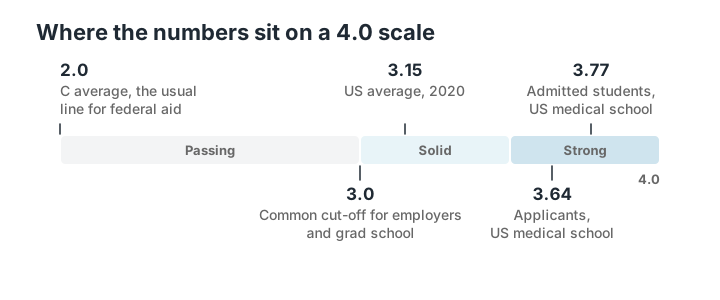
- Below 2.0: a problem. You may be on academic probation, and your financial aid could be at risk.
- 2.0 to 2.9: you’re passing and can graduate, but some employers and grad programs will filter you out.
- 3.0 to 3.4: solid. You’re clearing most filters, and around the national average.
- 3.5 to 3.7: strong, and often in Latin honours territory, though each college sets its own line.
- 3.8 and up: excellent. Competitive for almost anything.
Is a 3.0 good? Is a 3.5?
These are the numbers people ask about most.
| GPA | Roughly | Good for most jobs? | Good for grad school? |
|---|---|---|---|
| 2.5 | B- / C+ | Fine for many, but some filters will catch it | Hard, unless you can explain it |
| 3.0 | B | Yes, it clears the common cut-off | Meets many minimums |
| 3.3 | B+ | Yes | Reasonable for many master’s programs |
| 3.5 | Mostly As and Bs | Yes, and worth listing on your résumé | Good, short of the most selective |
| 3.7 | A- | Yes | Strong, and close to the average for medicine |
| 4.0 | Straight As | More than you need | As good as it gets |
How much do employers care?
Less than they used to, going by the most recent figures we could find. The National Association of Colleges and Employers asks employers what sways them when choosing between two otherwise equally qualified candidates. On its five-point scale, a GPA of 3.0 or above fell from 3.5 in 2020 to 3.1 in 2022. In the 2022 survey, internship experience in the industry scored 4.3, major 3.8 and general work experience 3.7.
So a 3.0 still matters at firms that screen by it, which tends to mean big graduate programs. Beyond that line, an internship will usually do more for you than another tenth of a point. Consulting, finance and engineering firms can be stricter, so look at the actual listings for jobs you want.
The usual résumé advice is to include your GPA if it’s 3.0 or above and leave it off if it isn’t. Your major GPA can be listed instead if it’s higher, as long as you label it clearly. Never round up in a way a transcript would contradict.
What graduate programs expect
Many master’s programs list 3.0 as a minimum, and most publish their numbers, so look up the programs you want instead of relying on general advice. Medicine is the clearest case at the top end. In 2023-24, applicants to US MD programs averaged a 3.64, and the students who enrolled averaged a 3.77, according to the Association of American Medical Colleges.
Admissions readers also look past the single number. A rough first year followed by three strong ones reads very differently from the same GPA with a downward slide.
The lines you need to stay above
The one that catches people out is financial aid. To keep federal student aid in a program longer than two years, US rules require a C average or equivalent by the end of your second academic year, or standing consistent with your college’s graduation requirements. Your college sets its own standards on top of that.
Many colleges also put students on academic probation below a 2.0, and many scholarships ask for a 3.0 or higher. Check the terms for yours, because some are stricter.
Why the same GPA can mean different things
A 3.3 isn’t the same everywhere. Some departments grade far harder than others, and colleges vary as well. That’s why employers often ask about your major, and why graduate programs read the transcript itself. A B in organic chemistry may impress someone more than an A in an easy elective.
Averages hide variation too. The 3.15 national figure comes from 2020 federal data: women averaged 3.20 and men 3.09.
How to work out your GPA
Multiply each class’s grade points by its credits, add those up, and divide by your total credits. A 3-credit A (12 points), a 4-credit B+ (13.2) and a 3-credit C (6) come to 31.2 points over 10 credits, which is a 3.12. Our free GPA calculator does this for you, adds in your previous terms, and tells you what next term has to look like to reach a target.
How much can you still raise it?
That depends on how many credits you’ve already got. This is what one perfect 15-credit term does to a 2.5.
| Credits so far | GPA now | After a 4.0 term |
|---|---|---|
| 30 (end of first year) | 2.50 | 3.00 |
| 60 (end of second year) | 2.50 | 2.80 |
| 90 (end of third year) | 2.50 | 2.71 |
Try this: Had a terrible term early on? Find out whether your college lets a retake replace the old grade. Some do, and it can move your GPA more than anything else.
What raises a GPA
A few habits explain a lot of the gap. Our guide to getting better grades covers them properly, but these are the ones with the quickest payoff.
- Go to class. A 2010 meta-analysis by Marcus Credé and colleagues found attendance was more strongly linked to college grades than SAT scores or study skills.
- Know your deadlines. Note when you can drop a class without a mark on your transcript, because that’s easy to miss.
- Test yourself instead of rereading.
- Balance your load. Stacking your four hardest classes in one term helps nobody.
- Go to office hours early, while there’s time for it to help.
Keep going
Common questions
Is a 3.5 GPA good?
Yes. It’s well above the national average of about 3.15, clears the 3.0 cut-off most employers use, and is competitive for many graduate programs. It’s below average for medical school.
Is a 3.0 GPA good?
It’s solid. It sits a little under the average, but it clears the most common cut-off for employers and many master’s programs. Very selective programs will want more.
Is a 2.5 GPA bad?
It’s below average and will get you filtered out of some jobs and grad programs, but it’s far from the end of anything. Experience counts for more with many employers, and if you still have credits to go, it can be raised.
What does GPA stand for?
Grade point average. It’s your average grade, weighted by each class’s credits, usually on a scale from 0 to 4.0.
Do employers actually check your GPA?
Some do, mainly large graduate programs, and they may ask for a transcript. Many never ask. Lying about it can cost you an offer if you’re caught, so report it accurately or leave it off.
Can I get from a 2.5 to a 3.0?
Yes, if you have enough credits left. With 30 credits behind you, one perfect 15-credit term gets you there. With 90 credits, it would take several very strong terms. Use the GPA calculator to see your own numbers.
Calm Study
If you’re trying to pull a GPA up, Calm Study takes the planning off your plate. It turns your class notes into flashcards, quizzes and mock exams, and spreads them across the weeks before each exam, so you’re testing yourself early and often.
References
- BestColleges (2025). Average college GPA: full statistics, citing 2020 data from the National Center for Education Statistics. https://www.bestcolleges.com/research/average-college-gpa-statistics/
- National Association of Colleges and Employers (2022). Internship experience the most influential factor in tough hiring decisions. Job Outlook 2022. https://www.naceweb.org/talent-acquisition/candidate-selection/internship-experience-the-most-influential-factor-in-tough-hiring-decisions
- Association of American Medical Colleges (2023). Table A-16: MCAT scores and GPAs for applicants and matriculants to U.S. MD-granting medical schools. https://www.aamc.org/media/6056/download
- US Code of Federal Regulations. 34 CFR 668.34: Satisfactory academic progress. https://www.ecfr.gov/current/title-34/subtitle-B/chapter-VI/part-668/subpart-C/section-668.34
- Credé, M., Roch, S. G., & Kieszczynka, U. M. (2010). Class attendance in college: A meta-analytic review of the relationship of class attendance with grades and student characteristics. Review of Educational Research, 80(2), 272–295. https://doi.org/10.3102/0034654310362998