How to Read Faster for Study (and Does Speed Reading Work?)
· 7 min read
If you want to know how to read faster, start with an honest answer: most speed-reading claims you see online do not hold up. The average adult reads non-fiction silently at about 240 words a minute, and pushing far beyond that costs understanding. But there are real ways to get through study reading faster: read with a purpose, preview before you read, skim the parts that matter less, build background knowledge, and spend the time you save recalling what you read.
How fast do people read?
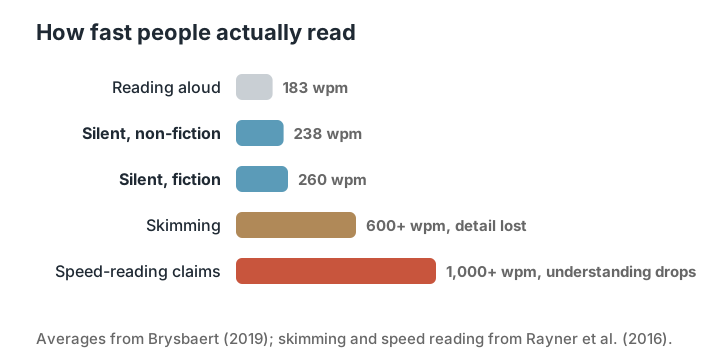
In 2019, Marc Brysbaert pooled 190 studies of reading speed covering almost 18,000 people. Adults reading silently in English averaged about 238 words per minute for non-fiction and 260 for fiction. Reading aloud averaged about 183. Textbooks, technical material, and anything with new terms are slower again, often well under 200 words per minute.
At 238 words per minute, a dense 20-page chapter of around 10,000 words takes about 40 minutes just to read once, before any notes. That is why students look for ways to read faster. But it also shows where the real savings are: not in reading every word faster, but in choosing what to read closely.
Does speed reading work?
In 2016, a team led by the eye-movement researcher Keith Rayner published a detailed review of speed reading. Their conclusion was that there is a trade-off between speed and accuracy. Readers can go much faster, but only by understanding and remembering less. What most speed-reading courses actually teach, the authors found, is skimming.
Some claims run into hard limits of the eye. You only see a small area in sharp detail around the point you are looking at, so you cannot take in a whole line or page at a glance. Skilled readers already move their eyes efficiently, and the time spent reading is mostly time spent understanding words, not moving eyes. The authors’ advice for reading faster was unglamorous: read a lot, and build your vocabulary.
What speed-reading apps get wrong
Apps that flash words one at a time in the same spot, a method called rapid serial visual presentation, promise to remove the time your eyes spend moving. In a 2015 study of one such app, Simone Benedetto and colleagues found that it lowered comprehension and increased visual fatigue compared with normal reading.
One reason is that these apps stop you looking back. Skilled readers regularly glance back at earlier words, and those glances help. In a 2014 study, Elizabeth Schotter, Randy Tran, and Keith Rayner made earlier words disappear so readers could not look back, and comprehension fell, especially for tricky sentences.
Another common tip is to stop “subvocalising”, the quiet inner voice you hear as you read. That inner speech is part of how skilled readers process language, and trying to eliminate it tends to reduce understanding of anything complex.
What actually makes reading faster
The biggest driver of reading speed is how familiar the words and ideas already are. Familiar words are recognised almost instantly; unfamiliar ones slow you down and need re-reading. That is why the first chapter of a new subject feels slow and the tenth feels faster. You did not learn to move your eyes better. You learned the vocabulary.
So the honest long-term answer is to read more in your subject and learn its key terms early. A short glossary of the course’s core terms, learned with flashcards in the first weeks, can speed up every reading that follows.
Read with a purpose
You read faster and remember more when you know what you are reading for. Before you open a chapter, check what you need from it: the learning objectives on the syllabus, the questions from last week’s lecture, or a past exam question on the topic.
Turn those into two or three questions and write them down. Now you are searching for answers, not trying to absorb everything equally. Sections that do not help answer them can be skimmed.
Preview before you read
Spend two to five minutes surveying the chapter before reading it. This is the first step of the SQ3R method, and it pays for itself.
- Read the title, the introduction, and the summary or conclusion.
- Look at every heading and subheading to see the structure.
- Glance at figures, tables, and their captions.
- Note words in bold or italics, which are usually key terms.
- Read the end-of-chapter questions. They tell you what the author thinks matters.
Skim on purpose, not by accident
Skimming has a bad reputation because people do it accidentally, sliding over everything. Done deliberately, it is a real skill. In a 2009 study, Geoffrey Duggan and Stephen Payne found that when people did not have time to read a whole text, skimming it helped them pick up the most important points better than reading the first part carefully, though they lost detail.
Decide in advance which parts deserve close reading and which can be skimmed.
| Part of the text | How to read it |
|---|---|
| Introduction and summary | Read closely. They state the main points. |
| Definitions and key claims | Read closely, and note them in your own words. |
| Examples of ideas you already understand | Skim to confirm, then move on. |
| Long case details not on your syllabus | Skim or skip for now. |
| Figures and tables | Study the ones that summarise a process or comparison. |
| End-of-chapter questions | Use them as a test after reading. |
Paper or screen?
If you can choose, paper may help with hard reading. A 2018 meta-analysis by Pablo Delgado and colleagues, covering 54 studies, found that people understood informational texts slightly better on paper than on screens, and the gap was larger when they were under time pressure.
If you read on a screen, reduce the extra distractions: full-screen mode, notifications off, and no other tabs. Scrolling through a PDF while messages pop up is the worst of both worlds.
How to remember what you read
For students, reading speed is rarely the real bottleneck. Remembering is. Rereading feels productive but is one of the least effective study methods. The fastest route to remembering a chapter is to spend some of your reading time recalling.
- After each section, look away and say or write the main points from memory.
- At the end, write three to five questions the chapter answers.
- The next day, answer those questions before you look at the chapter again.
- Check your answers, and reread only the parts you got wrong.
Try this: If you finish a page and cannot say what it said, do not reread it straight away. Try to recall one point first. The effort is what makes it stick.
A faster reading routine for study
Put together, this routine gets you through more reading in less time, and you remember more of it.
- Set your purpose: write two or three questions you need the chapter to answer (1 minute).
- Preview the chapter: headings, summary, figures, bold terms, questions (3 to 5 minutes).
- Read the key parts closely and skim the rest.
- After each section, look away and recall the main point (30 seconds).
- At the end, write questions for tomorrow.
- Next day, answer them before rereading anything.
Keep going
Common questions
What is the average reading speed?
About 238 words per minute for adults reading non-fiction silently in English, and about 260 for fiction, according to a 2019 meta-analysis. Reading aloud averages about 183 words per minute. Dense textbooks are slower.
Does speed reading really work?
Not as advertised. You can read much faster by skimming, but comprehension drops. Research has found no way to read at several times normal speed while understanding as much.
How can I read faster and still understand?
Read with specific questions in mind, preview the chapter first, read the key parts closely and skim the rest, and build your vocabulary in the subject. Familiar words and ideas are what make reading fast.
Is it bad to subvocalise when reading?
No. The inner voice is part of how skilled readers understand text. Trying to suppress it usually reduces comprehension, especially for complex material.
How long should it take to read a textbook chapter?
At typical speeds, a 20-page chapter of dense text takes roughly 40 to 60 minutes to read once. Previewing first and skimming less important sections can cut that, and recall afterwards is time well spent.
Do speed-reading apps work?
Studies of apps that flash one word at a time found lower comprehension and more eye strain than normal reading, partly because they stop you glancing back at earlier words.
Calm Study
Calm Study helps with the part after reading. Upload the chapter or your notes on it, and it writes questions on the key points so you can test yourself instead of rereading, then brings those points back on later days before your exam.
References
- Brysbaert, M. (2019). How many words do we read per minute? A review and meta-analysis of reading rate. Journal of Memory and Language, 109, 104047. https://doi.org/10.1016/j.jml.2019.104047
- Rayner, K., Schotter, E. R., Masson, M. E. J., Potter, M. C., & Treiman, R. (2016). So much to read, so little time: How do we read, and can speed reading help? Psychological Science in the Public Interest, 17(1), 4–34. https://doi.org/10.1177/1529100615623267
- Benedetto, S., Carbone, A., Pedrotti, M., Le Fevre, K., Bey, L. A. Y., & Baccino, T. (2015). Rapid serial visual presentation in reading: The case of Spritz. Computers in Human Behavior, 45, 352–358. https://doi.org/10.1016/j.chb.2014.12.043
- Schotter, E. R., Tran, R., & Rayner, K. (2014). Don’t believe what you read (only once): Comprehension is supported by regressions during reading. Psychological Science, 25(6), 1218–1226. https://doi.org/10.1177/0956797614531148
- Duggan, G. B., & Payne, S. J. (2009). Text skimming: The process and effectiveness of foraging through text under time pressure. Journal of Experimental Psychology: Applied, 15(3), 228–242. https://doi.org/10.1037/a0016995
- Delgado, P., Vargas, C., Ackerman, R., & Salmerón, L. (2018). Don’t throw away your printed books: A meta-analysis on the effects of reading media on reading comprehension. Educational Research Review, 25, 23–38. https://doi.org/10.1016/j.edurev.2018.09.003
- Dunlosky, J., Rawson, K. A., Marsh, E. J., Nathan, M. J., & Willingham, D. T. (2013). Improving students’ learning with effective learning techniques. Psychological Science in the Public Interest, 14(1), 4–58. https://doi.org/10.1177/1529100612453266