Elaborative Rehearsal: How Asking Why Makes Things Stick
· 8 min read
Elaborative rehearsal is a way of memorising by connecting new information to things you already know: asking why it is true, how it relates to other ideas, and what it reminds you of. It is the opposite of maintenance rehearsal, where you repeat something over and over, like a code you need for the next ten seconds. Elaboration takes more thought per fact, but what you learn this way lasts much longer. The study technique built on it, elaborative interrogation, is one of the few methods rated moderately useful in the big reviews of study techniques.
What is elaborative rehearsal?
Elaborative rehearsal means processing information for its meaning. Instead of repeating “the mitochondria produce ATP”, you ask what ATP is used for, why muscle cells have so many mitochondria, and how this links to why you get out of breath when you sprint. Each link is another route back to the fact later.
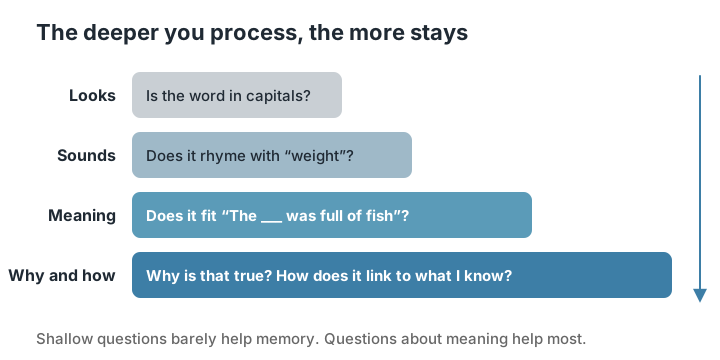
The idea comes from the levels of processing framework, proposed by Fergus Craik and Robert Lockhart in 1972. They argued that how well you remember something depends less on how long you spend rehearsing it and more on how deeply you process it. Noticing what a word looks like is shallow. Thinking about what it means, and connecting it to other things you know, is deep.
Elaborative vs maintenance rehearsal
Both are forms of rehearsal, and both have their place. Maintenance rehearsal is what you do with a phone number between reading it and dialling it. It keeps information active, but it does little to store it.
| Maintenance rehearsal | Elaborative rehearsal | |
|---|---|---|
| What you do | Repeat the information as it is | Connect it, explain it, compare it |
| Depth | Shallow | Deep |
| How long it lasts | Seconds to minutes, unless repeated a lot | Much longer |
| Good for | Holding something briefly | Anything you need in an exam |
The research behind it
In a well-known set of experiments published in 1975, Fergus Craik and Endel Tulving showed people a series of words and asked a question about each one. Some questions were about appearance (“Is the word in capital letters?”), some about sound (“Does it rhyme with weight?”), and some about meaning (“Does it fit the sentence: The ___ was full of fish?”). Later, in a surprise memory test, people remembered the words they had judged for meaning far better than those they had judged for appearance or sound.
Later research refined the picture. Depth is hard to measure on its own, and the best kind of processing also depends on how you will be tested. But the core finding has held up well: thinking about meaning, and linking new material to what you know, produces more durable memory than repetition.
Elaborative interrogation: the study technique
Elaborative interrogation turns elaboration into a routine. For each fact you study, you ask why it is true, and you answer.
In a 1987 study by Michael Pressley and colleagues, people read simple sentences such as “The hungry man got into the car.” Some just read them. Others were asked “Why would that man do that?” and came up with their own reason. The people who answered the why questions remembered roughly twice as much about who did what.
The method has since been tested with real study material. A 1994 study by Vera Woloshyn and colleagues found it helped students learn new facts, including ones that contradicted what they already believed. A 2010 study by Bradley Smith and colleagues found that college students reading a biology textbook understood more when they answered why questions as they read.
In their 2013 review of ten popular study techniques, John Dunlosky and colleagues rated elaborative interrogation as moderately useful. It works well for factual material and for students with some background knowledge, though there is less evidence for long delays and complex material.
How to use elaborative interrogation, step by step
It needs no materials beyond your notes and a willingness to think.
- Pick a fact or statement from your notes, such as “arteries have thicker walls than veins”.
- Ask why it is true, or why it makes sense: “Why would arteries need thicker walls?”
- Answer from what you already know, before you look anything up: “Because blood leaves the heart at high pressure.”
- Check your answer against your notes or textbook, and correct it if needed.
- Push one step further: “How is this different from capillaries, and why?”
- Write the why question down. It becomes a flashcard for later.
Try this: If your answer to “why?” is “because my notes say so”, you have found a gap. Look up the reason, then try the question again tomorrow.
Elaborative rehearsal examples by subject
The same move works in almost every subject: take a fact and ask why it holds, or what it connects to.
| Subject | The fact | The why question and answer |
|---|---|---|
| Biology | Arteries have thicker walls than veins | Why? They carry blood at higher pressure straight from the heart. |
| Chemistry | Noble gases are unreactive | Why? Their outer electron shells are already full. |
| Economics | Higher interest rates tend to reduce inflation | Why? Borrowing costs more, so spending and demand fall. |
| History | France pushed for heavy German reparations in 1919 | Why? Much of the Western Front fighting had wrecked northern France. |
| Psychology | Eyewitness memory is unreliable | Why? Memory is rebuilt each time, and questions can reshape it. |
| Spanish | “Biblioteca” means library | What does it link to? “Bibliography”, a list of books. |
Self-explanation: the close cousin
Self-explanation is a related technique. Instead of asking why a single fact is true, you explain to yourself how each step of a text, diagram, or worked example follows from the last. In a 1994 study by Michelene Chi and colleagues, students who were prompted to explain each line of a text about the circulatory system understood it far better than students who read it twice.
A 2018 meta-analysis by Kiran Bisra and colleagues combined dozens of studies and found a solid overall benefit from prompting self-explanation. It suits maths, physics, and any subject with worked examples, while elaborative interrogation suits lists of facts. The Feynman technique, explaining a topic in plain words as if to someone else, is a third version of the same idea.
Why elaboration works
Elaboration helps memory in a few ways at once. Each connection you make is another cue that can bring the fact back. Linking new material to what you know fits it into an existing structure, which is easier to search than a pile of loose facts. And generating an answer yourself is more memorable than reading one, because producing information takes more effort than recognising it.
There is also a benefit for understanding. Asking why forces you to notice when a fact does not make sense to you. That is far better found in a study session than in the exam.
When elaboration does not help
Elaborative rehearsal is powerful, but it is not the right tool for every job.
- Brand-new topics: with no background knowledge, your “why” answers are guesses. Read or listen first, then elaborate.
- Arbitrary lists: there is no reason why the planets are in that order, so a mnemonic is a better fit.
- Unchecked answers: a confident wrong explanation sticks just as well as a right one.
- As a replacement for testing: elaboration helps you learn, but you still need to practise recalling the material later.
Combine it with retrieval practice
The best routine uses elaboration while you learn and retrieval practice afterwards. When you first study a topic, ask why questions and answer them. Write the best questions down. A day or two later, use them as flashcards: “Why do arteries have thicker walls than veins?” Answer from memory, then check.
This way you get the deep processing of elaboration and the memory boost of testing yourself, spaced over time. It also means your flashcards ask for explanations, which is what most exam questions want, rather than one-word definitions.
Common questions
What is elaborative rehearsal in psychology?
A way of encoding information by thinking about its meaning and connecting it to what you already know. It comes from the levels of processing framework, which holds that deeper processing leads to longer-lasting memory.
What is an example of elaborative rehearsal?
Learning that arteries have thicker walls than veins by asking why, and working out that arteries carry blood at higher pressure straight from the heart, instead of repeating the sentence until it sticks.
What is the difference between elaborative and maintenance rehearsal?
Maintenance rehearsal repeats information to keep it in mind briefly. Elaborative rehearsal connects it to meaning and other knowledge, which stores it for much longer.
Is elaborative interrogation effective?
Yes, moderately. A major review of study techniques rated it moderately useful, especially for factual material when students have some background knowledge. It works even better followed by retrieval practice on later days.
How is elaborative interrogation different from the Feynman technique?
Elaborative interrogation asks why individual facts are true. The Feynman technique asks you to explain a whole topic in plain words, as if teaching it. Both make you produce explanations, and both expose gaps.
Can I use elaborative rehearsal for vocabulary?
Partly. Linking a new word to related words you know, such as “biblioteca” to “bibliography”, is elaboration and helps. For words with no obvious link, a keyword image or plain retrieval practice may work better.
Calm Study
Calm Study makes elaboration easy to check. Ask its tutor why something in your notes is true and it answers from your own materials, so a wrong explanation gets caught. The questions it writes from your notes then bring those facts back on later days, so the why sticks.
References
- Craik, F. I. M., & Lockhart, R. S. (1972). Levels of processing: A framework for memory research. Journal of Verbal Learning and Verbal Behavior, 11(6), 671–684. https://doi.org/10.1016/S0022-5371(72)80001-X
- Craik, F. I. M., & Tulving, E. (1975). Depth of processing and the retention of words in episodic memory. Journal of Experimental Psychology: General, 104(3), 268–294. https://doi.org/10.1037/0096-3445.104.3.268
- Pressley, M., McDaniel, M. A., Turnure, J. E., Wood, E., & Ahmad, M. (1987). Generation and precision of elaboration: Effects on intentional and incidental learning. Journal of Experimental Psychology: Learning, Memory, and Cognition, 13(2), 291–300. https://doi.org/10.1037/0278-7393.13.2.291
- Woloshyn, V. E., Paivio, A., & Pressley, M. (1994). Use of elaborative interrogation to help students acquire information consistent with prior knowledge and information inconsistent with prior knowledge. Journal of Educational Psychology, 86(1), 79–89. https://doi.org/10.1037/0022-0663.86.1.79
- Smith, B. L., Holliday, W. G., & Austin, H. W. (2010). Students’ comprehension of science textbooks using a question-based reading strategy. Journal of Research in Science Teaching, 47(4), 363–379. https://doi.org/10.1002/tea.20378
- Dunlosky, J., Rawson, K. A., Marsh, E. J., Nathan, M. J., & Willingham, D. T. (2013). Improving students’ learning with effective learning techniques. Psychological Science in the Public Interest, 14(1), 4–58. https://doi.org/10.1177/1529100612453266
- Chi, M. T. H., de Leeuw, N., Chiu, M.-H., & LaVancher, C. (1994). Eliciting self-explanations improves understanding. Cognitive Science, 18(3), 439–477. https://doi.org/10.1207/s15516709cog1803_3
- Bisra, K., Liu, Q., Nesbit, J. C., Salimi, F., & Winne, P. H. (2018). Inducing self-explanation: A meta-analysis. Educational Psychology Review, 30(3), 703–725. https://doi.org/10.1007/s10648-018-9434-x