The Best Study Methods, Ranked by the Research
· 6 min read
The best study methods are practice testing and spaced practice. That is the conclusion of one of the most influential reviews of study techniques, which rated ten popular methods on how well they work across students, subjects, and settings. Below is the full ranking, what each method looks like in practice, and how to put the top ones together in a normal week.
Where the ranking comes from
In 2013, a team of cognitive and educational psychologists led by John Dunlosky published a review in Psychological Science in the Public Interest. They picked ten techniques that students commonly use or that are easy to adopt, and went through the research on each one.
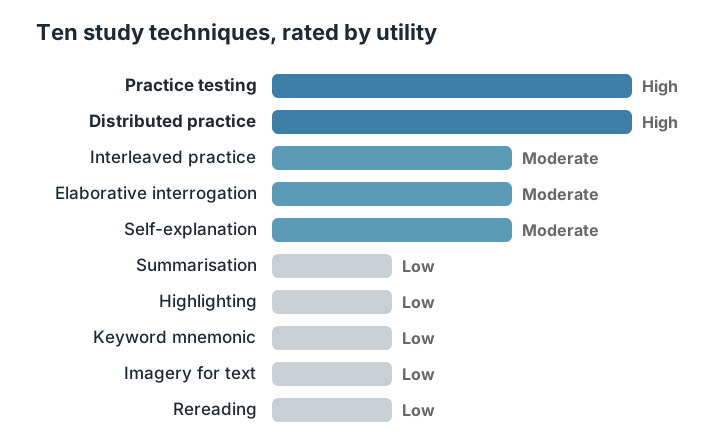
Each technique was judged on whether its benefits hold across different learners, different kinds of material, different ways of testing, and real classrooms rather than just the lab. A technique that worked well but only for one narrow task got a lower rating than one that worked broadly. The result is a ranking of high, moderate, and low utility.
The full ranking
Here are all ten techniques, with their rating and what each one means in practice.
| Technique | Rating | What it means |
|---|---|---|
| Practice testing | High | Answering questions or flashcards from memory |
| Distributed practice | High | Spreading study over several sessions |
| Interleaved practice | Moderate | Mixing different topics or problem types |
| Elaborative interrogation | Moderate | Asking and answering “why is this true?” |
| Self-explanation | Moderate | Explaining each step to yourself as you learn |
| Summarisation | Low | Writing summaries of what you read |
| Highlighting | Low | Marking key parts of the text |
| Keyword mnemonic | Low | Linking a word to a vivid image |
| Imagery for text | Low | Picturing what you read |
| Rereading | Low | Reading the material again |
Top method: practice testing
Practice testing means retrieving information from memory: flashcards, short-answer questions, past papers, or writing everything you know on a blank page. It does not have to be graded or formal. What matters is that you produce the answer before you see it.
The effect is large and consistent. In one classic experiment, students who read a passage and then took recall tests remembered 56% of it a week later, against 42% for students who spent the same time rereading. Testing also shows you what you do not know, which is information rereading never gives you.
Top method: distributed practice
Distributed practice means spreading the same study time across several sessions instead of packing it into one. The gaps let you forget a little, and coming back to it after a gap makes the memory more durable. The effect has been found in hundreds of studies, with everything from vocabulary to surgical skills.
Distributed practice and practice testing work best together. Testing yourself on spaced days is often called spaced retrieval or successive relearning, and it is close to the best general-purpose study strategy available.
The moderate methods are worth adding
Interleaved practice means mixing problem types in a session rather than doing all of one type, then all of the next. It helps you learn which method fits which problem, and its evidence is strongest in maths and science. It was rated moderate mainly because fewer subjects had been tested.
Elaborative interrogation and self-explanation both ask you to explain: why a fact is true, or how one step leads to the next. They help you connect new material to what you know. Both take more time than simply testing, so they are best used on the ideas you need to understand rather than just recall.
Why the most popular methods rank low
Highlighting and rereading are the methods students use most, and both were rated low. They are not harmful, but they produce little benefit for the time spent. Rereading makes text feel familiar, and that familiarity is easily mistaken for knowing it.
Low utility does not mean useless. Summarising helps students who have been taught to summarise well. The keyword mnemonic works for some vocabulary learning, but the benefit fades faster than with testing. A single first read of a chapter is necessary. The point is that these methods should not be the main way you study.
Try this: If you highlight, turn each highlight into a question afterwards. The highlight finds the fact; the question makes you learn it.
What the review left out
The review covered ten techniques, not every good idea. Two others are widely recommended by learning scientists: dual coding, which combines words with visuals such as diagrams and timelines, and concrete examples, which tie abstract ideas to specific cases. Sleep is not a technique, but memory research is clear that it matters for keeping what you learn.
You may also hear about learning styles, the idea that you learn best through your preferred sense. A 2008 review by Pashler and colleagues found no good evidence that matching teaching to a learning style improves results. Everyone benefits from the same top methods.
Matching study strategies to the material
The most effective study methods are the same for almost every subject, but how you apply them changes with the material. Facts and definitions suit flashcards. Processes and sequences suit blank-page recall and diagrams drawn from memory. Problem-solving subjects need worked problems, mixed together once you know each method. Essay subjects need practice planning and writing answers under time pressure.
A useful test for any study session is to ask: at the end of this, will I have produced answers from memory? If the honest answer is no, because the session was all reading, highlighting, or making notes look nice, swap part of it for questions.
| Material | Best way to test it | Add |
|---|---|---|
| Facts, terms, definitions | Flashcards answered before flipping | Spacing over days |
| Processes and cycles | Draw or write the steps from memory | A “why” for each step |
| Maths and science problems | Problems from mixed topics | Say the method before solving |
| Essays and arguments | Timed plans and paragraphs from memory | Mark against the criteria |
How to combine the best study methods in a week
You do not need to choose one method. The best study techniques fit together into one routine.
- After each class: five minutes writing what you remember, then check your notes.
- Next day: answer questions on that lecture from memory. Read only the pages you missed.
- Later in the week: a short mixed quiz across this week’s and last week’s topics.
- On hard ideas: after answering, add one sentence explaining why the answer is right.
- Every few weeks: a timed practice paper, then focus on what it shows.
Common questions
Which study method is most effective?
Practice testing, especially when it is spread over several days. Answering questions from memory and checking your misses beats rereading and highlighting in study after study.
What are the most effective study methods for ADHD?
The same top methods work. A 2016 study of college students with ADHD found they benefited from practice testing about as much as their peers. Short sessions, clear starting points, and external structure help make the methods easier to stick to.
Is highlighting a waste of time?
Mostly, if it is all you do. Highlighting picks out information but does not make you remember it. Use highlights as a source for questions you then answer from memory.
Do learning styles matter for choosing a study method?
There is no good evidence that they do. Choose methods based on the research and the material, not on whether you think of yourself as a visual or auditory learner.
Are flashcards or practice questions better?
Both are practice testing. Flashcards suit facts, terms, and definitions. Practice questions suit applying what you know, which is what most exams ask. Use flashcards to build recall and questions to test whether you can use it.
How long should a study session be?
Long enough to work through a set of questions and check your misses, usually 25 to 50 minutes. Several shorter sessions on different days beat one marathon, even with the same total time.
Calm Study
Calm Study is built on the two top-rated methods. It turns your notes into flashcards and quizzes you answer from memory, schedules them on spaced days, mixes topics in its quizzes, and writes mock exams in your course’s format, so you are always using the best study methods instead of rereading.