The SQ3R Method: How to Study a Textbook, Step by Step
· 6 min read
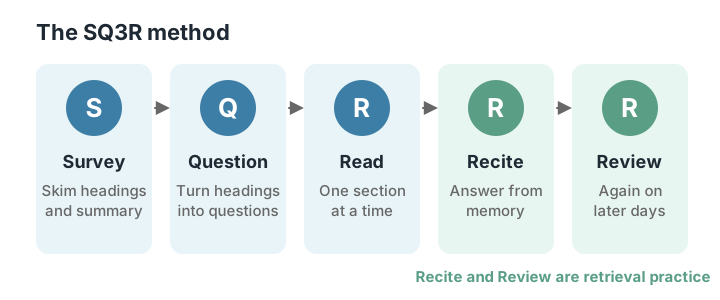
The SQ3R method is a five-step way to study from a textbook: Survey, Question, Read, Recite, and Review. Instead of reading a chapter from start to finish and hoping it sticks, you preview its structure, turn headings into questions, read to answer them, recite the answers from memory, and review them later. It was designed in the 1940s and is still one of the most widely taught reading strategies.
What is SQ3R?
SQ3R was introduced by the American educational psychologist Francis P. Robinson in his 1946 book Effective Study. He developed it to help university students learn from textbooks more efficiently. The name comes from the five steps: one S, one Q, and three Rs.
The idea is that reading is more effective when it has a purpose. If you know what questions you are trying to answer before you read a section, you read more actively, notice what matters, and remember it better. The recite step then makes you retrieve those answers, which strengthens memory more than reading alone.
Step 1: Survey
Spend a few minutes looking over the whole chapter before reading any of it properly. Read the title, introduction, headings, subheadings, bold terms, figure captions, and the summary or end-of-chapter questions.
The aim is a mental map: what the chapter covers, how it is organised, and where the main ideas are. This takes three to five minutes for a typical chapter. It is not reading; resist the urge to start.
Step 2: Question
Turn each heading into a question. “The causes of inflation” becomes “What causes inflation?” “Mitosis” becomes “What happens during mitosis, and why?” Write the questions down, either in your notes or on sticky notes in the book.
If the chapter has end-of-chapter questions or learning objectives, use those too. They are a direct statement of what you are supposed to learn.
Try this: Add one “why” or “how” question for each section, not just “what”. Those are the questions exams use to separate grades.
Step 3: Read
Now read the first section only, actively looking for the answer to its question. Slow down for dense paragraphs, diagrams, and examples. Do not take extensive notes yet; focus on understanding.
Reading one section at a time keeps each chunk small enough to recall in the next step. Trying to read the whole chapter and then recall it all at once is much harder.
Step 4: Recite
At the end of each section, close the book or look away and answer the section’s question from memory, out loud or in writing, in your own words. If you cannot answer it, reread the relevant part and try again.
This is the most important step. It is retrieval practice, one of the best-supported study methods in cognitive psychology. As early as 1917, the psychologist Arthur Gates found that students who spent much of their study time reciting remembered more than those who mostly read, and a century of retrieval research since has backed that up. Write brief notes based on your recited answer, not copied from the book.
Step 5: Review
After finishing the chapter, go back through all your questions and answer each one from memory again. Then review again on later days: the next day, a few days later, and a week later. Each review should take less time than the one before.
This step adds spacing, the other study method with the strongest evidence behind it. Without it, much of what you learned on the first pass will fade within days.
An SQ3R example
Imagine an economics chapter on supply and demand. Survey: the headings are demand, supply, market equilibrium, and shifts in curves, and there is a summary with five review questions. That takes three minutes.
Question: “What determines demand?”, “Why does the supply curve slope upwards?”, “What is equilibrium and how is it reached?”, and “What shifts a curve rather than moving along it?” Read the demand section. Recite: without looking, explain that demand falls as price rises, list the factors that shift demand, and sketch the curve. You forget one factor, so you check and try again.
Repeat for each section. At the end, answer all four questions from memory, then the five review questions. Two days later, Review: answer the same questions again, without the book. Most of it is still there, and the parts that are not show you exactly what to reread.
Does the SQ3R method work?
Studies of SQ3R as a complete package have had mixed results, partly because it takes training and time to do properly, and many studies tested it briefly. Some students also skip the steps that matter most, recite and review, and keep the easy ones, survey and read.
The method’s strongest parts line up with techniques that have excellent support. Recite is retrieval practice. Review is spaced practice. Question encourages the kind of “why” thinking that research on elaborative interrogation supports. If you keep those three, SQ3R is a solid way to study from a textbook.
A faster SQ3R for busy weeks
The full method can feel slow. This lighter version keeps the parts that matter.
- Survey in two minutes: headings and the summary only.
- Write one question per major heading.
- Read each section once, then recite the answer in one or two sentences.
- At the end, answer all your questions from memory and mark the ones you missed.
- The next day, answer the missed questions again before moving on.
When SQ3R is not the right tool
SQ3R was built for textbooks with clear headings. It works less well for material without that structure, such as a novel, a research paper with dense methods sections, or a lecture recording. For a research paper, a common alternative is to read the abstract, figures, and conclusion first, then the rest. For a novel, reading straight through and then recalling the plot, characters, and themes is more natural.
It is also more than you need for a quick reread of familiar material. If you already know a topic well, skip straight to answering questions on it, and only read the sections where you get stuck.
Variations: SQ4R and PQ4R
Later versions add steps. SQ4R usually adds a fourth R for Reflect, Relate, or wRite, asking you to connect the material to what you know or to write a summary. PQ4R, developed by Thomas and Robinson in 1972, uses Preview, Question, Read, Reflect, Recite, Review.
All share the same core: question before reading, recall after it, and review later. Choose whichever version of the SQ3R study method you will actually use.
Keep going
Common questions
What are the 5 steps in the SQ3R study system?
Survey the chapter, turn headings into Questions, Read one section at a time, Recite the answer from memory, and Review all the questions later.
Is the SQ3R method effective?
Its key steps are. Recite and Review are retrieval and spaced practice, both strongly supported by research. Students who skip those steps get much less from it.
How long does SQ3R take?
Longer than a single read-through: often one and a half to two times as long for the first pass. But the material sticks much better, so you save time later.
What is the difference between SQ3R and SQ4R?
SQ4R adds a fourth R, usually Reflect, Relate, or wRite, to connect the material to what you already know or summarise it in your words. The core cycle of questioning, reading, reciting, and reviewing is the same.
Can I use SQ3R with lecture slides or PDFs?
Yes. Survey the slide titles, turn each into a question, read the slides for each section, recite the answer, and review the questions later in the week.
Calm Study
Calm Study does the Question step for you. Upload a chapter, slides, or a PDF, and it writes the questions from your material, quizzes you on them so you recite from memory, and schedules the reviews on later days.