How to Study Effectively: A Simple Routine That Works
· 7 min read
How to study effectively comes down to three habits: spend most of your time pulling answers out of memory instead of reading them again, spread that work over several days, and mix topics once you know the basics. Those habits have more evidence behind them than anything else in learning research. This guide turns them into a routine you can run before class, after class, and on the days in between.
Why so much study time is wasted
Most students study by rereading notes, highlighting, and copying things out neatly. These feel like work, and the material starts to look familiar. The problem is that familiarity is not memory. Recognising a page when you see it is very different from producing the answer on a blank exam paper.
In 2013, John Dunlosky and colleagues reviewed hundreds of studies on ten popular techniques. Practice testing and distributed practice (spacing) were the only two rated high utility. Rereading, highlighting, and summarising were rated low. The effective study techniques feel slower and more effortful in the moment, which is exactly why students avoid them, and exactly why they work.
Psychologists call this a desirable difficulty: the struggle to recall is what builds the memory. If a session feels smooth and easy the whole way through, you are probably reviewing what you already know rather than strengthening what you do not.
Before class: skim and guess
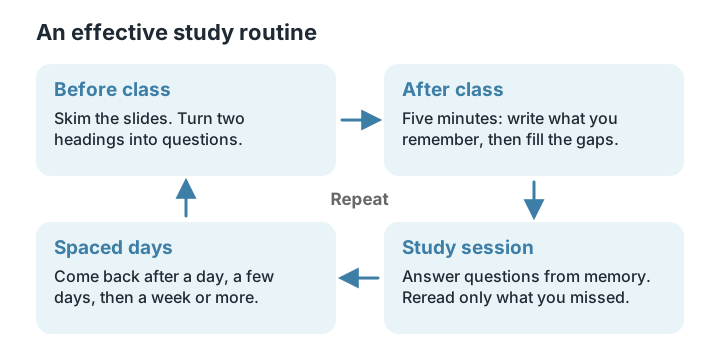
Spend five minutes looking at the slides or chapter headings before the lecture. Do not try to learn it. Turn two or three headings into questions and guess the answers.
Research on pretesting suggests that attempting an answer before you are taught it improves later memory for the correct answer, even when your guess is wrong. The guess gives the lecture something to attach to. You walk in with questions, so you listen for answers instead of transcribing.
After class: five minutes of recall
Within a day of the lecture, close everything and write down what you remember: the main ideas, the examples, any definitions. Then open your notes and fill the gaps in a different colour.
This is the cheapest study session you will ever do, and it does two jobs. It strengthens what you caught, and it shows you what you missed while the lecture is still fresh enough to fix. Leave it a fortnight and the gaps are much harder to fill.
Try this: Set a five-minute timer straight after each lecture and write on a blank page before you look at the slides.
Each study session: questions, not pages
A study session should be built around questions. For each topic, have a set of questions whose answers are in your notes: definitions, steps in a process, causes and effects, comparisons, and at least one “explain why”. Answer each one before you look. Mark yourself honestly, and count a hesitation as a miss.
Then go back to your notes for the misses only. Read that page, close it, and try the question again. This loop of question, answer, check, and retry is retrieval practice, and it is the core of effective study. Everything else in this guide is about when and how often to run it.
Space your sessions across the week
Studying a topic for an hour on one day is less effective than twenty minutes on each of three days. This is the spacing effect, one of the most reliable findings in psychology. Each time you come back after a gap, you have forgotten a little, and the effort of retrieving it makes the memory stronger.
The best gap depends on how long you need to remember. A large 2008 study by Cepeda and colleagues found the ideal gap was roughly a fifth to two fifths of the time until a test a week away, shrinking to a twentieth to a tenth of the time for a test a year away. In practice, a simple expanding schedule works well.
| When | What to do | How long |
|---|---|---|
| Day of the lecture | Five-minute recall, then fill the gaps | 10 minutes |
| Next day | Answer the questions for that lecture | 15 minutes |
| A few days later | Questions again, misses only after | 10 minutes |
| A week later | Mixed questions with other topics | 10 minutes |
| Two to three weeks later | Mixed questions or a short mock | 10 minutes |
Mix topics once you know the basics
When you first learn a topic, practise it on its own. Once you have the basics, mix questions from different lectures in one session. This is called interleaving. It feels harder because you have to work out which idea each question needs before you can answer it, and that is the skill the exam tests.
Interleaving matters most for subjects with problems that look alike but need different methods, such as maths, physics, statistics, and grammar. For essay subjects, mixing still helps: switch between topics so you practise choosing the right argument and evidence.
Make it make sense
Two techniques rated moderate utility in the Dunlosky review are worth adding once your recall habit is in place. Elaborative interrogation means asking “why is this true?” and answering from what you know. Self-explanation means explaining each step of a worked example or argument to yourself as you go.
Both push you to connect new material to what you already know, which makes it easier to recall and to use in an unfamiliar question. A simple version: after answering a flashcard correctly, add one sentence on why the answer is right.
How to study effectively for exams
The routine above is how you learn during term. As an exam gets closer, the balance shifts from learning new material to testing what you have. Around three weeks out, sit a full timed practice paper under exam conditions, then list what fell apart. Spend most of the following week on that list rather than on the topics you already know.
In the final week, keep sessions short and mixed: questions from every topic, with extra rounds on your weak list. Do not start rereading everything from the beginning. If you have been testing yourself all term, the last week is for polishing, not for a first pass.
Protect your focus and your sleep
Short, focused sessions beat long, distracted ones. Put your phone in another room, decide what the session is for before you start, and stop when the questions are done rather than when a timer says so. Twenty-five to fifty minutes is a sensible block for most people.
Sleep is not a break from studying. Memory is consolidated during sleep, and studies of students who trade sleep for extra study hours find they tend to do worse the next day, not better. If the choice is one more chapter or a full night’s sleep, sleep usually wins.
Common questions
What is the most effective way to study?
Practice testing spread over several days. Answer questions from memory, check your misses against your notes, and come back to the same material after a gap. Research reviews consistently rank this above rereading, highlighting, and summarising.
How much should I study outside class?
There is no magic number. Two to four focused hours a day is plenty for most students outside exam season, split into shorter sessions. Count questions answered and gaps fixed, not hours at a desk.
What is the 1-3-5-7 rule in studying?
It is a simple spacing schedule: review new material on day 1, day 3, day 5, and day 7 after you learn it. The exact days are a convention rather than a research-tested formula, but the principle behind it, reviewing at growing intervals, is well supported.
What is the 3-2-1 study method?
Versions vary, but a common one is: read a concept three times, say it from memory twice, and write it from memory once. The parts that help are the two recall steps. Reading three times adds little, so you can cut that to one careful read.
How do I study effectively when I have no motivation?
Make the first step tiny: open your notes and answer three questions. Starting is usually the hardest part, and once you are answering questions, momentum tends to carry you into a full session.
Is it better to study in the morning or at night?
Study when you can focus and protect your sleep. A short review before bed can help, but not if it replaces sleep. Consistency matters more than the time of day.
Calm Study
Calm Study runs this routine for you. Upload your notes and it writes the questions, quizzes you before showing answers, points to the page for every miss, and schedules the next review on spaced days, so effective study is the default instead of something you have to set up each night.