How to Get Better Grades: 10 Changes That Actually Move Them
· 8 min read
If you want to know how to get better grades, start with the habits that research links most strongly to results: go to every class, find out exactly how you will be marked, test yourself instead of rereading, spread your studying over weeks, and protect your sleep. None of these needs more hours. Most students who raise their grades do it by changing how they use the time they already spend, and by treating each exam and assignment as something to plan for rather than something that happens to them.
Why grades are more changeable than they feel
It is easy to believe grades reflect fixed ability: some people are “A students” and some are not. The research paints a different picture. In a 2012 meta-analysis of what predicts university grades, Michelle Richardson, Charles Abraham, and Rod Bond found that some of the strongest links were with things students can work on: confidence in their ability to perform well, the grades they aimed for, and how well they kept up effort when work got hard or boring.
Grades are won in four places: in class, on assignments, in how you study, and in the exam room itself. The ten changes below cover all four.
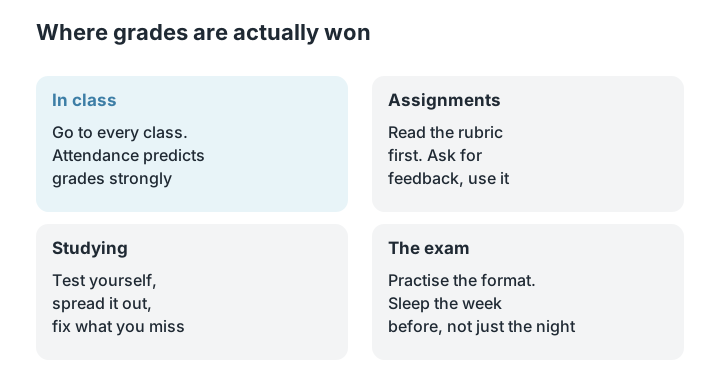
Change 1: Go to every class
It sounds too simple, but it is one of the strongest findings in education research. In a 2010 meta-analysis of studies on college students, Marcus Credé, Sylvia Roch, and Urszula Kieszczynka found that class attendance was more strongly linked to grades than SAT scores, high school grades, or study skills.
Class is where you find out what the teacher thinks matters, which topics they emphasise, and what kinds of questions they ask. Recordings and slides miss most of that. If you must miss a class, get notes from a classmate and ask what was emphasised.
Change 2: Find out exactly how you will be marked
Many lost marks are not about knowledge. They come from answering a different question from the one being asked, or not knowing what an A answer looks like. Before you start any assignment or revision, find the marking criteria.
- Read the rubric or mark scheme before you start, not after.
- Look at past papers and examiner reports, if your course has them.
- Learn what the command words mean: “describe”, “explain”, and “evaluate” ask for different things.
- Ask your teacher what separates a top answer from an average one.
- Check how marks are split, so you spend time where the marks are.
Change 3: Use feedback, every time
In a 2007 review, John Hattie and Helen Timperley found that feedback is one of the most powerful influences on learning, but only when it tells you how to improve and you act on it. A grade on its own teaches very little.
Keep a simple feedback log: for each returned piece of work, write down the one or two comments that would have gained you the most marks. Before your next assignment, read the log and make those changes on purpose. If feedback is vague, ask: “What would have made this an A?”
Change 4: Test yourself instead of rereading
Retrieval practice, pulling information out of memory, is one of the best-supported study methods there is. A 2017 meta-analysis by Olusola Adesope and colleagues, pooling more than a hundred studies, found practice testing produced clearly better learning than rereading or other study methods. In a 2012 survey of college students, Marissa Hartwig and John Dunlosky found that students who tested themselves had higher GPAs.
In practice, that means flashcards you answer before flipping, practice questions, past papers, and writing out what you remember on a blank page. Rereading notes and highlighting feel productive but do much less.
Try this: Start each study session by answering five questions on last week’s material before looking at anything new.
Change 5: Spread your studying out
The same total study time, spread over several days, produces much better long-term memory than the same time crammed into one. This spacing effect is one of the most reliable findings in psychology; a 2006 review by Nicholas Cepeda and colleagues analysed hundreds of experiments that showed it.
For grades, that means studying each subject a little most weeks, from the start of term, and going back to older topics regularly. It also takes the panic out of exam season, because most of the learning has already happened.
Change 6: Plan for each exam
In a 2017 study by Patricia Chen and colleagues, college students were sent a short online survey a week or so before each exam. It asked them to think about what the exam would cover, which resources would help, and how they would use them. Students who did it scored about a third of a letter grade higher than those who did not.
You can do this yourself in ten minutes. For each exam, write down what it covers, the question types, which resources will help most (practice questions, past papers, office hours, your notes), and when you will use each one.
Changes 7 and 8: Start early, and ask early
Start each assignment on the day it is set, even if it is only reading the brief and writing a rough outline. Starting early gives your mind time to work on it in the background, exposes problems while there is time to ask about them, and removes the all-nighter at the end.
Ask for help as soon as you are stuck, not the week before the exam. Office hours, teaching assistants, tutors, study groups, and classmates are all underused. A question that takes five minutes to answer in week three can save hours of confusion in week ten.
Change 9: Sleep enough, all term
Sleep is not a reward for finishing your work; it is part of how learning gets stored. In a 2019 study of MIT chemistry students who wore activity trackers, Kana Okano and colleagues found that better and more consistent sleep over the weeks before exams was linked to higher grades, while sleep on the single night before a test was not.
Aim for a regular bedtime and wake time, even at weekends, and treat all-nighters as an emergency measure, not a strategy.
Change 10: Fix old gaps
In cumulative subjects such as maths, science, and languages, a weak foundation shows up later as confusion that seems to be about a new topic. If you keep struggling with the same kind of problem, go back a step. The gap is often in last year’s material, not this week’s.
Spend a few sessions on fundamentals, such as algebra for physics or core grammar for a language. It feels like going backwards, but it often unlocks progress across the whole subject.
How to get straight A’s
Straight A students are rarely studying all the time. They tend to be consistent: they attend, they start early, they test themselves regularly, and they know exactly what each exam wants. A weekly rhythm like this one covers most of it.
- After each class, spend five minutes recalling the main points without notes.
- Once a week per subject, do practice questions on that week’s topic and one older topic.
- Start every assignment the day it is set, and check it against the rubric before handing it in.
- For each exam, write a plan two to three weeks ahead and sit at least one timed practice paper.
- Keep a regular sleep schedule, especially in the weeks before exams.
How to improve your grades fast
If a test is close and you need a quick improvement, focus where marks are easiest to gain.
- Get the past papers or practice questions and do them under timed conditions.
- Mark them and find the topics that cost you the most marks.
- Fix those first, starting with the ones that come up most often.
- Learn the command words and the answer structure the marking expects.
- Sleep properly in the days before, rather than cramming through the night.
Keep going
Common questions
How can I raise my grades quickly?
Do timed practice papers, find the topics costing you the most marks, and fix those first. Learn what the marking criteria reward, and sleep properly before the test rather than cramming overnight.
How do I get straight A’s?
Consistency more than hours: attend every class, start assignments early, test yourself every week, plan for each exam weeks ahead, use feedback, and keep a regular sleep schedule.
How many hours should I study to get good grades?
There is no magic number. How you study matters more than how long. An hour of self-testing spread across the week usually beats several hours of rereading the night before.
Why are my grades bad even though I study a lot?
Often because the studying is passive, like rereading and highlighting, or crammed into a few days. It can also be that you are answering a different question from the one being marked. Check the marking criteria, test yourself, and spread study out.
Does going to class really affect grades?
Yes. A large meta-analysis found class attendance was more strongly linked to college grades than SAT scores, high school grades, or study habits.
How can I improve my GPA in college?
Attend every class, use office hours early, plan for each exam, test yourself instead of rereading, spread study across the term, and act on feedback. Talk to your adviser about retaking or balancing difficult courses if your school allows it.
Calm Study
Calm Study covers several of these changes at once. It writes flashcards, quizzes, and mock exams from your own notes, so self-testing replaces rereading, and its plan spaces every topic out before each exam date, so the work happens weeks early instead of the night before.
References
- Richardson, M., Abraham, C., & Bond, R. (2012). Psychological correlates of university students’ academic performance: A systematic review and meta-analysis. Psychological Bulletin, 138(2), 353–387. https://doi.org/10.1037/a0026838
- Credé, M., Roch, S. G., & Kieszczynka, U. M. (2010). Class attendance in college: A meta-analytic review of the relationship of class attendance with grades and student characteristics. Review of Educational Research, 80(2), 272–295. https://doi.org/10.3102/0034654310362998
- Hattie, J., & Timperley, H. (2007). The power of feedback. Review of Educational Research, 77(1), 81–112. https://doi.org/10.3102/003465430298487
- Adesope, O. O., Trevisan, D. A., & Sundararajan, N. (2017). Rethinking the use of tests: A meta-analysis of practice testing. Review of Educational Research, 87(3), 659–701. https://doi.org/10.3102/0034654316689306
- Hartwig, M. K., & Dunlosky, J. (2012). Study strategies of college students: Are self-testing and scheduling related to achievement? Psychonomic Bulletin & Review, 19(1), 126–134. https://doi.org/10.3758/s13423-011-0181-y
- Cepeda, N. J., Pashler, H., Vul, E., Wixted, J. T., & Rohrer, D. (2006). Distributed practice in verbal recall tasks: A review and quantitative synthesis. Psychological Bulletin, 132(3), 354–380. https://doi.org/10.1037/0033-2909.132.3.354
- Chen, P., Chavez, O., Ong, D. C., & Gunderson, B. (2017). Strategic resource use for learning: A self-administered intervention that guides self-reflection on effective resource use enhances academic performance. Psychological Science, 28(6), 774–785. https://doi.org/10.1177/0956797617696456
- Okano, K., Kaczmarzyk, J. R., Dave, N., Gabrieli, J. D. E., & Grossman, J. C. (2019). Sleep quality, duration, and consistency are associated with better academic performance in college students. npj Science of Learning, 4, 16. https://doi.org/10.1038/s41539-019-0055-z