How to Focus While Studying: 12 Fixes That Actually Work
· 8 min read
If you cannot focus on studying, you are not unusual or broken. Attention naturally dips and wanders, and studying gives it plenty of reasons to. The good news is that focus is mostly about setup, not willpower. How to focus while studying comes down to a few things: removing the easiest distractions before you start, giving yourself one clear task, working in timed blocks with real breaks, and making the work active enough to hold your attention.
Why it is so hard to focus on studying
Minds wander. In a 2010 study, Matthew Killingsworth and Daniel Gilbert used a phone app to ask thousands of adults what they were doing and thinking at random moments. Almost half the time, 47%, their minds were somewhere other than the task in front of them.
Studying makes it worse. It is effortful, the reward is weeks away, and the alternatives are instant. In a 2012 study, Evan Risko and colleagues found that students’ minds wandered more as an hour-long lecture went on, and the more their minds wandered, the less they remembered afterwards. Losing focus is the default. The fixes below work by making focus the easier option.
Fix 1: Put your phone in another room
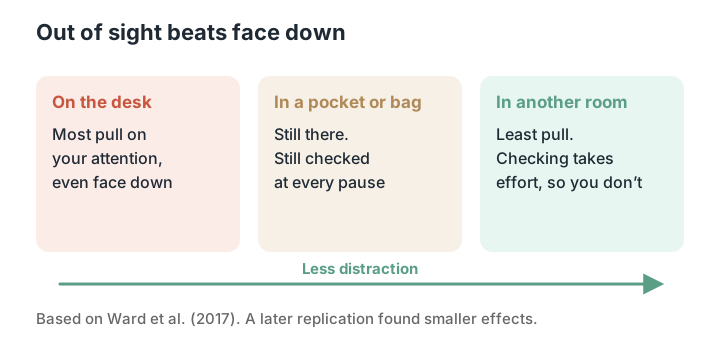
In a widely cited 2017 study, Adrian Ward and colleagues gave people tests of working memory and attention with their phone either on the desk (face down), in a pocket or bag, or in another room. People whose phones were in another room did best, even though no one actually used their phone during the test.
The evidence is not settled. A 2020 replication by Matthias Hartmann and colleagues did not find the same cost on their tasks. But the practical point holds either way: a phone within reach is a phone you will check at every pause. Putting it in another room turns checking from a reflex into a decision.
Try this: If you need your phone for a timer or two-factor login, put it across the room with notifications off. Any distance that makes checking take effort helps.
Fix 2: Decide on one task before you start
“Study chemistry” is not a task. It is a cloud, and your attention will drift out of it. “Answer the ten practice questions on equilibrium, then check them” is a task. You know where to start, what done looks like, and whether you are on track.
Writing it down helps. A 2006 meta-analysis by Peter Gollwitzer and Paschal Sheeran, covering 94 studies, found that people who made specific if-then plans (“When I sit down after dinner, I will open the equilibrium questions”) followed through on their goals far more often than people who only set the goal.
Fix 3: Stop switching
Checking a message “for a second” costs more than a second. Experiments on task switching, such as a 2001 study by Joshua Rubinstein, David Meyer, and Jeffrey Evans, show that every switch between tasks costs time and accuracy. Sophie Leroy described a related problem in 2009 called attention residue: part of your mind stays on the last thing you looked at, so you work worse on the next one.
The classroom studies are sobering. In a 2013 experiment by Faria Sana and colleagues, students who multitasked on a laptop during a lecture scored 11% lower on a comprehension test, and students sitting where they could see a multitasking peer’s screen scored 17% lower. In a 2019 study by Arnold Glass and Mengxue Kang, allowing phones and laptops in lectures for non-class use lowered students’ final exam scores by about half a letter grade.
- Turn off notifications, or use focus mode, for the whole block.
- Close every tab and app that is not part of the task.
- Use full-screen mode for the document or questions you are working on.
- If you keep drifting to the same sites, block them for set hours with a site blocker.
Fix 4: Work in timed blocks
A timer takes away a question your brain keeps asking: should I stop now? When you have committed to 25 or 50 minutes, you only need to keep going until the alarm. That is far easier than deciding, minute by minute, to keep working.
Start with blocks you can actually finish. If 25 minutes is a struggle, try 15 and build up. Take a real break after each block, away from your phone, and stop for longer every couple of hours. The Pomodoro Technique is the best-known version of this, but any regular rhythm works.
Fix 5: Park stray thoughts on paper
Some distractions come from inside: the email you have not answered, the essay due Friday, the thing you forgot to buy. Trying to ignore them rarely works. They keep coming back because your mind is trying to make sure you do not forget them.
A 2011 study by E. J. Masicampo and Roy Baumeister found that making a specific plan for an unfinished goal stopped it intruding on an unrelated task. So keep a notepad next to you. When a stray thought arrives, write it down, with when you will deal with it if you can, and go back to work. It is out of your head and safe on paper.
Fix 6: Make the work active
Rereading is the easiest kind of studying to drift through. Your eyes keep moving down the page while your mind leaves the room, and you might not notice for minutes. Active study does not allow that. If you are answering a question, solving a problem, or writing what you remember on a blank page, you notice immediately when you stop thinking, because nothing comes out.
Active methods are also the ones that work best for memory. Testing yourself, explaining ideas aloud, and doing practice problems top the research rankings, while rereading and highlighting sit near the bottom. Making study active is the rare fix that improves focus and learning at the same time.
Try this: If you catch yourself rereading the same paragraph, close the book and write down the one thing it said. Then open it and check.
Fixes 7 to 9: Set up the room
Your surroundings decide what is easy. Make focus the easy option.
- Fix 7, sound: quiet is best for reading and memorising. If your space is noisy, steady background noise such as brown noise or rain masks conversations better than music with lyrics.
- Fix 8, one screen: study on one device with one window. If you need a computer, consider a separate browser profile with no social accounts logged in.
- Fix 9, a clear desk: keep only today’s materials in sight, in good light, at a table rather than on your bed.
Fixes 10 to 12: Look after the basics
Some focus problems are really energy problems.
- Fix 10, sleep: tiredness hits attention first. A short night makes every other fix harder.
- Fix 11, food and water: study after eating something, and keep water nearby. Hunger and thirst are distractions in their own right.
- Fix 12, real breaks: step away from the screen, move, and look at something far away. A 2019 study by Sanghoon Kang and Terri Kurtzberg found that people who took their break on a phone solved fewer problems afterwards than people who took a break without one.
What to do when you lose focus mid-session
You will lose focus sometimes, even with a perfect setup. What matters is how quickly you come back.
- Notice it without beating yourself up. Drifting is normal; returning is the skill.
- Write down what pulled you away. Patterns tell you what to fix next time.
- Stand up, drink some water, and stretch for two minutes.
- Restart with a smaller task, such as one question instead of the whole set.
- Switch to a more active method if you were reading.
- If nothing works after a couple of tries, end the session and come back later. A tired hour is worth less than a fresh twenty minutes.
When focus problems might be something more
Everyone struggles to focus sometimes. But if you find it hard to concentrate in most parts of your life, not just studying, and it has been that way for a long time, it may be worth talking to a doctor or your school or university’s support service. ADHD, anxiety, depression, and sleep problems can all show up as trouble focusing, and all of them can be helped.
If you have ADHD, the fixes above still apply, often with extra structure: shorter blocks, more external accountability, and very small first steps.
Common questions
Why can I not focus on studying?
Usually a mix of easy distractions, a vague task, and passive study like rereading. Minds wander about half the time even in normal life. Move your phone away, set one specific task, and switch to an active method like answering questions.
How long can you focus while studying?
It varies by person, task, and how rested you are. Blocks of 25 to 50 minutes followed by a short break work well for most students. If you cannot manage 25, start with 15 and build up.
Does music help you focus when studying?
Music with lyrics tends to hurt reading and memorising. Instrumental music or steady background noise is safer if you need sound, and silence is best for the hardest material.
How do I stop checking my phone while studying?
Put it in another room for each study block. If that is not possible, turn on focus mode, turn off notifications, and put it out of reach and out of sight.
Is it better to study in short bursts or long sessions?
Several shorter sessions with breaks usually beat one long session, both for focus and for memory, because spreading study out helps you remember.
What should I do if I keep zoning out while reading?
Stop rereading. After each section, close the book and write or say the main points from memory, or turn the headings into questions and answer them. It forces your attention back to the material.
Calm Study
Calm Study removes the decision that breaks most study sessions: what to do next. Its plan names today’s topics from your own notes, and its flashcards and quizzes keep every block active, so there is always a next question instead of a next tab.
References
- Killingsworth, M. A., & Gilbert, D. T. (2010). A wandering mind is an unhappy mind. Science, 330(6006), 932. https://doi.org/10.1126/science.1192439
- Risko, E. F., Anderson, N., Sarwal, A., Engelhardt, M., & Kingstone, A. (2012). Everyday attention: Variation in mind wandering and memory in a lecture. Applied Cognitive Psychology, 26(2), 234–242. https://doi.org/10.1002/acp.1814
- Ward, A. F., Duke, K., Gneezy, A., & Bos, M. W. (2017). Brain drain: The mere presence of one’s own smartphone reduces available cognitive capacity. Journal of the Association for Consumer Research, 2(2), 140–154. https://doi.org/10.1086/691462
- Hartmann, M., Martarelli, C. S., Reber, T. P., & Rothen, N. (2020). Does a smartphone on the desk drain our brain? No evidence of cognitive costs due to smartphone presence in a short-term and prospective memory task. Consciousness and Cognition, 86, 103033. https://doi.org/10.1016/j.concog.2020.103033
- Gollwitzer, P. M., & Sheeran, P. (2006). Implementation intentions and goal achievement: A meta-analysis of effects and processes. Advances in Experimental Social Psychology, 38, 69–119. https://doi.org/10.1016/S0065-2601(06)38002-1
- Rubinstein, J. S., Meyer, D. E., & Evans, J. E. (2001). Executive control of cognitive processes in task switching. Journal of Experimental Psychology: Human Perception and Performance, 27(4), 763–797. https://doi.org/10.1037/0096-1523.27.4.763
- Leroy, S. (2009). Why is it so hard to do my work? The challenge of attention residue when switching between work tasks. Organizational Behavior and Human Decision Processes, 109(2), 168–181. https://doi.org/10.1016/j.obhdp.2009.04.002
- Sana, F., Weston, T., & Cepeda, N. J. (2013). Laptop multitasking hinders classroom learning for both users and nearby peers. Computers & Education, 62, 24–31. https://doi.org/10.1016/j.compedu.2012.10.003
- Glass, A. L., & Kang, M. (2019). Dividing attention in the classroom reduces exam performance. Educational Psychology, 39(3), 395–408. https://doi.org/10.1080/01443410.2018.1489046
- Masicampo, E. J., & Baumeister, R. F. (2011). Consider it done! Plan making can eliminate the cognitive effects of unfulfilled goals. Journal of Personality and Social Psychology, 101(4), 667–683. https://doi.org/10.1037/a0024192
- Kang, S., & Kurtzberg, T. R. (2019). Reach for your cell phone at your own risk: The cognitive costs of media choice for breaks. Journal of Behavioral Addictions, 8(3), 395–403. https://doi.org/10.1556/2006.8.2019.21