Study Guide Maker or DIY? How to Make a Study Guide
· 6 min read
Whether you write it yourself or use a study guide maker, a good study guide does one thing: it turns a course’s worth of notes into a short set of questions, answers, and summaries you can test yourself from. This guide shows how to make a study guide in six steps, gives you a study guide template to copy, and explains what to check before trusting an AI study guide maker with your exam.
What a study guide is, and is not
A study guide is a condensed, organised version of a course, built for revision. It pulls the essential content out of lectures, readings, and notes, and arranges it so you can review and test yourself efficiently.
It is not a neater copy of your notes. If your study guide is twenty pages of paragraphs, you have made more material to reread. The most useful guides are short, structured around the topics that will be examined, and full of questions you can answer from memory.
Why making your own helps
The act of making a study guide is itself a form of study. Deciding what matters, putting it in your own words, and organising topics forces you to think about the material, which helps you remember it. Writing questions is especially useful, because you have to understand a topic to ask a good question about it.
The catch is time. A full study guide for a course can take many hours, and those hours are only worth it if you then use the guide to test yourself. A beautiful guide that you only reread gives you most of the cost and little of the benefit.
How to make a study guide in six steps
This process works for most courses. Allow a few hours per course, spread over several sessions.
- Get the skeleton: the syllabus, learning objectives, exam specification, or the professor’s review sheet. Each objective becomes a section.
- Under each section, write the key questions it covers: definitions, processes, causes, comparisons, and at least one “why” or “how”.
- Answer each question briefly, in your own words, from your notes. Bullet points are fine.
- Add tables for anything you need to compare, and simple diagrams or timelines for processes and sequences.
- Add two or three exam-style practice questions per section, from past papers or written yourself.
- Mark each section by confidence, so you know where to focus first.
A study guide template
Use this layout for each topic. One topic usually fits on one or two pages.
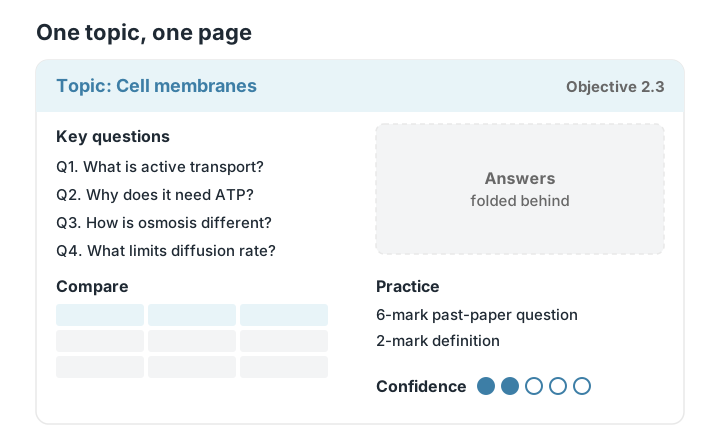
| Part | What goes in it | Example |
|---|---|---|
| Topic and objective | The syllabus point it covers | Cell membranes: explain transport across them |
| Key questions | Five to ten questions, answers hidden | What is active transport? Why does it need ATP? |
| Brief answers | Short answers in your words | Movement against a gradient using energy |
| Compare or draw | A table or diagram | Diffusion vs osmosis vs active transport |
| Practice questions | Two or three exam-style questions | A 6-mark past-paper question |
| Confidence | Your rating, updated each review | 2 out of 5, review on Thursday |
Study guide formats
Different courses suit different formats. You can mix them within one guide.
- Question and answer: the most flexible, and the easiest to test yourself from.
- Comparison charts: for theories, case studies, or anything you need to tell apart.
- Concept maps: for topics where ideas connect in many directions.
- Timelines: for history, processes, and anything ordered in time.
- One-page summaries: a final condensed sheet for the last review before the exam.
How to study from your study guide
A study guide earns its keep in the weeks after you make it. Cover the answers and work through the questions from memory, marking each one right or wrong. Read the answers only for the ones you missed, then try those again at the end of the session.
Come back to each section on spaced days, starting with the low-confidence sections. Near the exam, do the practice questions under timed conditions. The guide should get more marked up over time, not stay pristine.
Try this: Fold each page down the middle so the questions are on one side and the answers on the other. Instant self-test.
A study guide for a cumulative exam
For a final that covers a whole course, build the guide in stages through the term rather than all at the end. After each week or unit, add that section while the material is fresh. By exam season, most of the guide exists and you can spend your time studying from it.
Add a final section at the front: a one-page overview of how the course fits together. List the big themes or methods and which topics belong to each. Cumulative exams often include questions that connect topics from different parts of the course, and that overview is where you practise seeing those links.
What an AI study guide maker does well
AI study guide makers can turn a set of slides, a PDF, or a lecture transcript into an organised guide in minutes. For a student with five courses and limited time, that can save many hours of formatting and summarising.
The best ones do more than summarise. They write questions as well as answers, organise them by topic, and let you test yourself directly. Used well, an AI study guide maker shifts your time from producing the guide to studying from it, which is where most of the learning happens.
What to check before you trust one
AI tools can be wrong, and a confident mistake in a study guide can cost you marks. Before relying on any study guide maker, check these things.
- Is it built from your materials, or from general knowledge? Your course has its own terms, emphasis, and examples.
- Can you see where each point came from? A link or reference back to the page lets you check it in seconds.
- Does it cover the whole syllabus? Compare its sections with your learning objectives.
- Does it make you answer, or just give you summaries to read?
- Spot-check a few answers against your notes, especially numbers, names, and definitions.
Keep going
Common questions
What should a study guide include?
The key topics from your syllabus, questions for each one with brief answers, tables or diagrams for comparisons and processes, a few practice questions, and a way to mark your confidence. Keep it short enough to work through.
How long should a study guide be?
Roughly one to two pages per major topic. A whole course often fits into ten to twenty pages. If it is much longer, it is probably turning into a copy of your notes.
Is it better to make your own study guide or use one?
Making your own helps you learn, but takes time. A ready-made or AI-generated guide saves that time. Either way, the real benefit comes from testing yourself with it, so choose whichever leaves you more time for that.
Is there a free study guide template?
The template in this guide is free to copy: topic and objective, key questions, brief answers, a comparison table or diagram, practice questions, and a confidence rating. A folded sheet of paper or a simple two-column document works fine.
Can ChatGPT make a study guide?
Yes, if you give it your notes. Without them, it writes from general knowledge, which may not match your course. Check its answers against your materials, and ask for questions as well as summaries.
Calm Study
Calm Study is a study guide maker that works from your own notes. Upload slides, PDFs, or lecture recordings, and it writes flashcards, quizzes, and mock exams organised by your course. A quiz miss names the page it came from and you can edit any card, so checking takes seconds and your time goes on testing yourself.