UK University Grading System Explained, With US GPA Equivalents
· 5 min read
The UK university grading system uses percentages, but not the way American or Canadian students expect. A 70 is a top mark, a 60 is good, and 40 is usually a pass. Those marks then add up to a degree classification, from a First down to a Third, rather than a GPA. Here’s how it works, what Masters grades and credits look like, and how UK results roughly compare with a US GPA.
How UK university marks work
Each essay, exam and project gets a mark out of 100, and the marking criteria describe what work in each band looks like. The scale is used differently from American percentages. At the University of Edinburgh, for example, the common marking scheme puts 70 to 79 and 90 to 100 in the First-class bands and 60 to 69 at “very good”, and the university tells visiting students that the pass mark is 40% and that it’s relatively unusual for students to get 70 or above regularly.
So a mark of 65 isn’t a weak result. It’s solidly upper second, the grade most UK graduates leave with. The 80s and 90s exist, but in essay subjects they’re kept for exceptional work. In maths and the sciences, where an answer is right or wrong, high marks are more common.
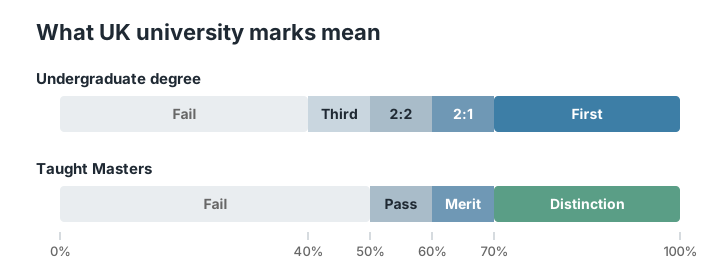
Undergraduate degree classifications
Your module marks are averaged into one of these classes. Most universities use the same boundaries.
| Class | Usual average | Often called |
|---|---|---|
| First-class honours | 70% and above | A First |
| Upper second-class honours | 60% to 69% | A 2:1 |
| Lower second-class honours | 50% to 59% | A 2:2 |
| Third-class honours | 40% to 49% | A Third |
Try this: How the average is worked out varies a lot. First year often doesn’t count, and later years usually count more, so look up your own university’s weighting before you work out where you stand.
Scotland, integrated Masters and ordinary degrees
Most Scottish honours degrees take four years rather than three, and the classification usually rests on the last two. A shorter ordinary degree, without honours, is also an option at many Scottish universities.
Integrated Masters degrees, like an MEng, MSci or MPharm, run for four or five years and are usually classified on the same First, 2:1, 2:2 and Third scale as a bachelor’s degree.
Masters and PhD grades
Taught Masters degrees such as an MA, MSc or MRes usually use Distinction, Merit and Pass, with the pass mark at 50% rather than 40%. The bands differ by university. St Andrews, for instance, marks on its own 20-point scale and awards a Merit for an average of 13.5 to 16.4 and a Distinction for 16.5 to 20.
A PhD isn’t graded. After the thesis and an oral exam called the viva, the outcome is a pass, often with minor or major corrections to make first.
Credits and modules
UK degrees are built from modules worth a number of credits. In England, Wales and Northern Ireland, a full-time year is usually 120 credits and an honours degree 360. One credit stands for about 10 hours of learning in total, counting lectures, reading, coursework and revision, so a 20-credit module is about 200 hours of work.
For study abroad, two UK credits usually count as one European ECTS credit, so a year of 120 UK credits is about 60 ECTS.
UK grades to a US GPA
There’s no official conversion. Even St Andrews, which calculates its own GPA, says it doesn’t offer a formal conversion to the US system and points students to credential evaluation agencies instead. Conversion websites agree only roughly, and these are the ranges you’ll see quoted most.
| UK result | Rough US GPA often quoted |
|---|---|
| First (70% and above) | 3.7 to 4.0 |
| 2:1 (60% to 69%) | 3.3 to 3.7 |
| 2:2 (50% to 59%) | 2.7 to 3.0 |
| Third (40% to 49%) | Around 2.0 |
Try this: Before converting anything, read the application’s instructions. Some US programmes ask for your classification or average mark and convert it themselves, and some want an evaluation from a service such as WES.
If you’re studying in the UK from abroad
A few things catch visiting and international students out in their first term.
- A 60 feels low and isn’t. Compare yourself with the marking criteria, not with what 60% meant at home.
- Feedback matters more than the number. Read what a marker says separates your work from the band above.
- Many courses have fewer, bigger assessments, so one exam can be 50% or more of a module.
- Resits are usually capped at the pass mark, so it pays to pass first time.
Keep going
Common questions
What is a good grade at a UK university?
Anything over 60% is good, because that’s 2:1 territory, and 70% and above is excellent. Marks above 80 are rare in most essay subjects.
Is 70% a good mark in the UK?
Yes. It’s First-class standard at almost every UK university.
What is the pass mark at UK universities?
Usually 40% for undergraduate modules and 50% for postgraduate ones. Your course regulations will confirm it.
What is a 2:1 in GPA?
There’s no official conversion, but a 2:1 is often quoted as roughly 3.3 to 3.7. Check how the university you’re applying to treats UK degrees.
Do UK universities use GPA?
Most don’t, and use degree classifications instead. A few report a GPA alongside the classification, such as St Andrews on its own 20-point scale.
Calm Study
Whatever your current average, the classification depends on the years still to come. Calm Study turns your lectures and readings into a day-by-day plan, flashcards and mock exams, so the marks you need for a 2:1 or a First are something you can work towards week by week.
References
- University of Edinburgh. Common marking scheme. https://registryservices.ed.ac.uk/timetabling-examinations/exams/regulations/common-marking-scheme
- University of Edinburgh. Completing your studies: marks, grades and transcripts. https://edinburgh-global.ed.ac.uk/study-abroad/successful-applicants/completing-your-studies
- University of St Andrews. Degree classifications at the University. https://www.st-andrews.ac.uk/guides/degree-classification/
- QAA (2021). Higher Education Credit Framework for England. https://www.qaa.ac.uk/docs/qaa/quality-code/higher-education-credit-framework-for-england.pdf
- Prospects. Understanding university grades in the UK. https://www.prospects.ac.uk/applying-for-university/university-life/understanding-university-grades-in-the-uk/