Brain Food for Studying: Best Snacks and What to Eat Before an Exam
· 6 min read
The best brain food for studying is less exciting than the lists online suggest. No snack will make you smarter, but eating regularly, drinking enough water, and avoiding sugar crashes can stop hunger, thirst, and tiredness from dragging your focus down. For snacks, pair something with protein or fibre with slower-release carbohydrates: nuts, yoghurt, fruit with peanut butter, wholegrain crackers and cheese, or hummus and vegetables. Before an exam, eat a familiar, balanced meal two to three hours ahead and bring water.
Can food really help you study?
Food affects studying mostly by affecting how you feel. Being hungry, thirsty, sluggish after a heavy meal, or jittery from too much caffeine all make it harder to concentrate. The realistic goal is to remove those problems, not to find a food that upgrades your brain.
There is some evidence that glucose can briefly help memory. A 2011 review by Michael Smith and colleagues found that a glucose drink sometimes improved memory, mainly on demanding tasks, in older adults, or after fasting. That is not a reason to snack on sweets. If you have eaten a normal meal, your brain is not short of fuel.
What the research says about breakfast
Most of the research on breakfast is with schoolchildren. A 2013 systematic review by Katie Adolphus, Clare Lawton, and Louise Dye found that eating breakfast had positive effects on behaviour in class, such as staying on task, and that regular breakfast eating was linked to better school performance. The evidence on test scores was more limited.
For older students, the practical point is simple: if you normally eat breakfast, do not skip it on an exam morning. If you never eat breakfast, a big unfamiliar one on exam day is not the moment to start. A smaller version of your usual routine is the safest choice.
Sugar: rush or crash?
Many students reach for sweets or sugary drinks for energy. The research does not back this up. In a 2019 meta-analysis, Konstantinos Mantantzis and colleagues pooled studies on carbohydrates and mood. Sugar did not improve mood at any point. Within an hour of eating it, people tended to feel more tired and less alert than people who had not.
A sugary snack is fine as a treat. As a study fuel, it is more likely to leave you flat in the middle of a session.
Water: the easiest win
Dehydration is a quiet focus-killer. In a 2012 review, Ana Adan reported that losing about 2% of body weight through dehydration can impair attention, memory, and mood. You do not need to force down litres of water, though. In a 2013 study by Caroline Edmonds and colleagues, drinking water sped up people’s reactions only if they were thirsty to begin with.
Keep a bottle on your desk, drink when you are thirsty, and take one into the exam if it is allowed.
Caffeine: helpful, in the right dose
Caffeine is the one thing that reliably boosts alertness and attention in the short term, as a 2016 review by Tom McLellan and colleagues confirmed. Tea is a gentler option: it contains less caffeine and also L-theanine, and in a 2008 study by Gail Owen and colleagues, the two together improved accuracy on an attention-switching task and reduced tiredness.
The rules are about dose and timing. The US Food and Drug Administration says up to 400 milligrams a day, roughly four cups of brewed coffee, is generally safe for healthy adults; teenagers should have much less. Keep caffeine well away from bedtime, and do not drink more than usual on exam day, when nerves are already doing the job of a strong coffee.
Foods with a “brain food” reputation
Some foods have a reputation for boosting the brain. Here is what the evidence actually says.
| Food | The claim | What the evidence says |
|---|---|---|
| Blueberries | Boost memory | Some short studies in children found small memory gains a couple of hours after a blueberry drink. A good snack, not a fix. |
| Dark chocolate | Sharpens focus | Cocoa flavanols show modest short-term effects in some studies, but chocolate bars have far less flavanol and plenty of sugar. |
| Oily fish, omega-3 | Brain health | One trial in young adults found modest memory gains after six months of DHA supplements. No quick pre-exam boost. |
| Nuts | Brain food | A filling, slow-release snack with protein, fat, and fibre. Useful, if not magical. |
| Energy drinks | Focus and energy | Caffeine plus sugar, sometimes a lot of both. Check the label and avoid them late. |
The best snacks for studying
A good study snack keeps you going until the next meal without a crash, and is not messy enough to distract you. Look for protein, fibre, or healthy fats, ideally with some slower-release carbohydrate.
- A small handful of nuts or trail mix.
- Greek yoghurt with fruit or a sprinkle of oats.
- An apple or banana with peanut butter.
- Hummus with carrots, peppers, or wholegrain crackers.
- Wholegrain crackers or oatcakes with cheese.
- A boiled egg or two.
- Popcorn, plain or lightly salted.
- Edamame beans.
- A couple of squares of dark chocolate with some nuts, as a treat.
Try this: Portion your snack before you sit down. A whole bag on the desk turns into an hour of grazing.
What to eat before an exam
Exam day is not the day for experiments. Eat food you know agrees with you, at times you are used to.
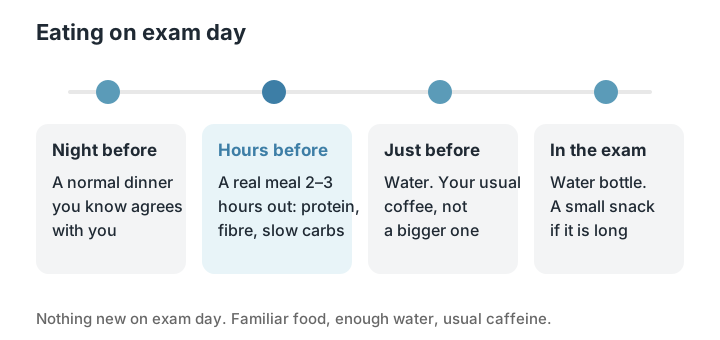
- The night before: a normal dinner. Avoid anything very heavy, spicy, or new.
- Two to three hours before: a proper meal with protein, fibre, and slower carbs, such as porridge with yoghurt and fruit, or eggs on wholegrain toast.
- Just before: water, and your usual coffee or tea if you drink it, but not more.
- In a long exam: a water bottle, and a small quiet snack if the rules allow it.
Eating well during long study days
Exam season tends to wreck eating habits: skipped meals, grazing on whatever is nearby, and too much caffeine. A little planning helps.
- Eat proper meals at regular times, and take them away from your desk.
- Keep a few healthy snacks in stock so you are not relying on vending machines.
- Cook simple meals in batches at the weekend, so dinner takes five minutes.
- Go easy on heavy meals right before a hard study block.
- Count energy drinks and coffee together, and keep an eye on the total.
Common questions
What is the best brain food for studying?
There is no single brain food. What helps is regular meals, enough water, and snacks that combine protein or fibre with slower carbs, such as nuts, yoghurt, fruit with peanut butter, or hummus with vegetables.
What should I eat before an exam?
A familiar, balanced meal two to three hours before, such as porridge with fruit and yoghurt or eggs on toast. Drink water, keep caffeine at your normal level, and avoid heavy, greasy, or unfamiliar food.
What are good snacks for studying late at night?
Something light and caffeine-free, like yoghurt, a banana, a small bowl of cereal, or toast. Avoid coffee, energy drinks, and heavy meals late, since they can disturb your sleep.
Does sugar help you study?
Not really. A meta-analysis found sugar did not improve mood and was linked to more tiredness and lower alertness within an hour. A balanced snack is a better choice for a long session.
Is chocolate good for studying?
A little dark chocolate is a fine treat. Cocoa flavanols have shown modest short-term effects in some studies, but ordinary chocolate contains much less of them, plus sugar.
Should I drink coffee before an exam?
If you normally drink coffee, have your usual amount so you do not get a withdrawal headache. If you do not, exam day is not the time to start, since it can make nerves and jitters worse.
Calm Study
Calm Study cannot cook for you, but it can make the study day shorter. Its plan breaks each day into short sessions of flashcards and quizzes from your own notes, which leaves room for proper meals and breaks instead of snacking through one long cram.
References
- Smith, M. A., Riby, L. M., van Eekelen, J. A. M., & Foster, J. K. (2011). Glucose enhancement of human memory: A comprehensive research review of the glucose memory facilitation effect. Neuroscience & Biobehavioral Reviews, 35(3), 770–783. https://doi.org/10.1016/j.neubiorev.2010.09.008
- Adolphus, K., Lawton, C. L., & Dye, L. (2013). The effects of breakfast on behavior and academic performance in children and adolescents. Frontiers in Human Neuroscience, 7, 425. https://doi.org/10.3389/fnhum.2013.00425
- Mantantzis, K., Schlaghecken, F., Sünram-Lea, S. I., & Maylor, E. A. (2019). Sugar rush or sugar crash? A meta-analysis of carbohydrate effects on mood. Neuroscience & Biobehavioral Reviews, 101, 45–67. https://doi.org/10.1016/j.neubiorev.2019.03.016
- Adan, A. (2012). Cognitive performance and dehydration. Journal of the American College of Nutrition, 31(2), 71–78. https://doi.org/10.1080/07315724.2012.10720011
- Edmonds, C. J., Crombie, R., & Gardner, M. R. (2013). Subjective thirst moderates changes in speed of responding associated with water consumption. Frontiers in Human Neuroscience, 7, 363. https://doi.org/10.3389/fnhum.2013.00363
- McLellan, T. M., Caldwell, J. A., & Lieberman, H. R. (2016). A review of caffeine’s effects on cognitive, physical and occupational performance. Neuroscience & Biobehavioral Reviews, 71, 294–312. https://doi.org/10.1016/j.neubiorev.2016.09.001
- Owen, G. N., Parnell, H., De Bruin, E. A., & Rycroft, J. A. (2008). The combined effects of L-theanine and caffeine on cognitive performance and mood. Nutritional Neuroscience, 11(4), 193–198. https://doi.org/10.1179/147683008X301513
- US Food and Drug Administration. Spilling the beans: How much caffeine is too much? https://www.fda.gov/consumers/consumer-updates/spilling-beans-how-much-caffeine-too-much
- Whyte, A. R., Schafer, G., & Williams, C. M. (2016). Cognitive effects following acute wild blueberry supplementation in 7- to 10-year-old children. European Journal of Nutrition, 55(6), 2151–2162. https://doi.org/10.1007/s00394-015-1029-4
- Socci, V., Tempesta, D., Desideri, G., De Gennaro, L., & Ferrara, M. (2017). Enhancing human cognition with cocoa flavonoids. Frontiers in Nutrition, 4, 19. https://doi.org/10.3389/fnut.2017.00019
- Stonehouse, W., Conlon, C. A., Podd, J., et al. (2013). DHA supplementation improved both memory and reaction time in healthy young adults: A randomized controlled trial. The American Journal of Clinical Nutrition, 97(5), 1134–1143. https://doi.org/10.3945/ajcn.112.053371