How to Study Anatomy and Physiology: A Method That Sticks
· 7 min read
To study anatomy well, learn each structure in layers: its name and what the name means, where it sits and what is next to it, what it does, and what happens when it goes wrong. Test yourself from blank diagrams instead of rereading labelled ones, use spaced flashcards for the sheer volume of terms, and link every structure to its function, which is where anatomy and physiology meet. This guide covers how to study anatomy and physiology for lectures, practical exams, and written tests.
Why anatomy is hard to study
Anatomy asks you to learn thousands of names, many of them similar, and to hold them in three dimensions: what is in front of, behind, and beside what. Physiology then adds how it all works. Faced with that volume, many students fall back on reading and rereading the atlas, which makes everything look familiar and very little stick.
It is also a subject where learning-style labels get a lot of airtime, so it is worth knowing that one of the clearest tests of them was in anatomy. In a 2019 study of 426 undergraduate anatomy students, Polly Husmann and Valerie O’Loughlin found that studying in line with their VARK learning style made no difference to grades. How students studied mattered; their label did not.
Learn the language first
Anatomical terms look intimidating until you see that they are built from a small set of parts. Learn the directional terms, the body planes, and the common roots early, and new names start explaining themselves.
- Directions: anterior and posterior (front and back), superior and inferior (above and below), medial and lateral (towards and away from the midline), proximal and distal (nearer to and further from the trunk), superficial and deep.
- Planes: sagittal (left and right), coronal or frontal (front and back), and transverse (top and bottom).
| Root | Meaning | Examples |
|---|---|---|
| brachi- | arm | brachial artery, brachialis |
| cardi- | heart | cardiac muscle, pericardium |
| hepat- | liver | hepatic portal vein, hepatocyte |
| nephr- / ren- | kidney | nephron, renal artery |
| oste- | bone | osteocyte, osteoporosis |
| my- / myo- | muscle | myocardium, myosin |
| cost- | rib | intercostal muscles, costal cartilage |
| -itis | inflammation | tendinitis, appendicitis |
Learn each structure in layers
Trying to learn everything about a structure at once is overwhelming. Learning it in layers gives you a checklist, and each layer helps the next one stick.
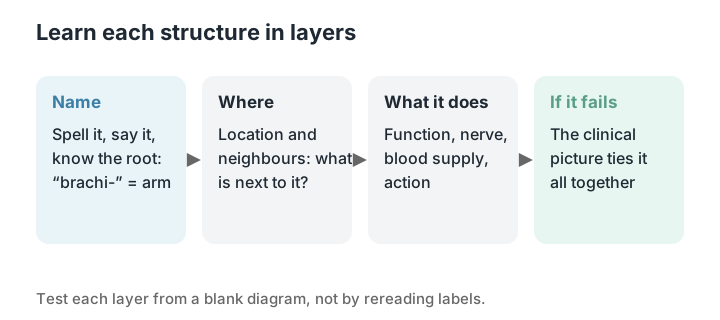
- Name: spell it, say it, and work out what the name means from its roots.
- Where: its location and its neighbours. What is anterior, posterior, medial, and lateral to it?
- What it does: its function, and for muscles, the action, nerve supply, and blood supply.
- If it fails: the clinical picture. What happens if this nerve is damaged or this valve leaks? This layer ties the others together.
Test from blank diagrams
Looking at a labelled diagram is recognition. The exam asks for recall: an unlabelled structure, a pin in a specimen, or a blank to fill. Practise that from the start.
There is direct evidence for this in anatomy courses. In a 2011 study, Jason Logan, Andrew Thompson, and David Marshak found that students remembered anatomy better when they were tested on it than when they restudied it. Print unlabelled diagrams, cover the labels in your atlas, or use image occlusion flashcards that hide one label at a time. Label from memory, check, and redo the ones you missed until you get them right on separate days.
Try this: Test structures from more than one view. Many students can name a muscle from the front and draw a blank from the side, which is exactly what practical exams exploit.
Draw it yourself
Drawing anatomy, even badly, is one of the most effective ways to learn it. In a 2017 study, Mark Backhouse and colleagues found that a cycle of observing, reflecting, drawing, editing, and repeating improved students’ anatomy knowledge. Drawing forces you to decide how structures relate in space, which a label never does.
Keep drawings schematic. The brachial plexus can be drawn as a simple pattern of lines; blood flow through the heart can be a flow chart of chambers and valves. Draw from memory first, then check against the atlas and correct in another colour.
Use spaced flashcards for the volume
There are simply too many names to learn by occasional rereading. Spaced repetition flashcards, which bring each card back just as you are about to forget it, handle the volume a few minutes at a time. Medical students rely on them heavily. A 2015 study by Felix Deng and colleagues found that medical students who did more flashcard retrieval practice scored higher on a major licensing exam, though as an observational study it cannot prove the flashcards caused the difference.
Start in the first week of term and keep up daily. A backlog of thousands of unreviewed cards is how flashcards stop working.
Connect structure to function
Physiology questions usually ask why a structure is built the way it is. Why is the wall of the left ventricle thicker than the right? Because it pumps blood around the whole body at higher pressure. Why are alveoli walls one cell thick? To make the diffusion distance short. Asking “why is it built like this?” for every structure turns separate facts into explanations.
For physiological processes, draw the loop. Blood glucose control, thermoregulation, and blood pressure control are all feedback loops: a stimulus, a receptor, a control centre, an effector, and a response that reverses the change. If you can draw the loop from memory and explain each arrow, you understand it.
Use 3D models, apps, and your own body
Anatomy is three-dimensional, and flat diagrams only go so far. In a 2015 meta-analysis, Kaissar Yammine and Claudio Violato found that 3D visualisation tools, such as anatomy apps and virtual models, improved students’ anatomical knowledge compared with traditional methods, especially their spatial understanding.
Use whatever your course offers: models, prosected specimens, dissection, and 3D apps. Your own body is free: feel for bony landmarks, move a joint and name the muscles doing the work, and trace where a nerve runs.
How to study for an anatomy practical
Practical exams, where you identify tagged structures on specimens, models, or images, need their own preparation.
- Find out the format: how many stations, how long at each, and whether they ask only names or also functions and relations.
- Practise with images of real specimens, not just clean diagrams. Real tissue looks different.
- Test yourself on structures from different angles and on both sides of the body.
- Learn the distinguishing features of structures that look alike.
- Check whether spelling counts, and practise writing names out.
- Do timed rounds with a classmate, pointing at structures for each other.
Studying for written anatomy and physiology exams
Written papers ask you to explain processes and apply them to cases. Turn each process into a flow chart and practise explaining it aloud. Use past questions and clinical scenarios: “a patient cannot lift their arm above their head; which nerve might be damaged?”
For fixed lists, a mnemonic helps. The cranial nerves in order (olfactory, optic, oculomotor, trochlear, trigeminal, abducens, facial, vestibulocochlear, glossopharyngeal, vagus, accessory, hypoglossal) are a classic case, with “Oh Oh Oh To Touch And Feel Very Good Velvet, Such Heaven” as one well-known version. Make sure you also know what each nerve does; the mnemonic only gives you the order.
Common questions
What is the best way to study anatomy?
Learn terms by their roots, learn each structure in layers (name, location, function, clinical link), test yourself from unlabelled diagrams, draw from memory, and use spaced flashcards every day for the volume of names.
How do I memorise anatomy fast?
Use spaced flashcards with image occlusion, test from blank diagrams rather than rereading labels, use mnemonics for fixed lists, and learn word roots so names make sense. Short daily sessions beat long weekly ones.
How many hours a day should I study anatomy?
Consistency matters more than hours. Twenty to thirty minutes of flashcards every day, plus a few longer sessions a week for drawing, labelling, and practice questions, works for most courses.
What is the hardest part of anatomy and physiology?
For most students, it is the volume of terms combined with 3D relationships in anatomy, and multi-step processes such as feedback loops in physiology. Spaced flashcards and drawing tackle the first; flow charts tackle the second.
Are anatomy apps worth it?
Research suggests 3D visualisation tools improve anatomy learning, especially spatial understanding. Use them actively: hide labels and test yourself, rather than just rotating the model.
How do I study for an anatomy practical exam?
Practise identifying structures on images of real specimens from different angles, learn the features that distinguish similar structures, do timed rounds, and check whether you also need functions, relations, and correct spelling.
Calm Study
Calm Study turns your anatomy lectures and lab handouts into spaced flashcards and quizzes, so the volume of names gets handled a few minutes a day. Its tutor can explain how a structure’s position links to its function using your own course materials.
References
- Husmann, P. R., & O’Loughlin, V. D. (2019). Another nail in the coffin for learning styles? Disparities among undergraduate anatomy students’ study strategies, class performance, and reported VARK learning styles. Anatomical Sciences Education, 12(1), 6–19. https://doi.org/10.1002/ase.1777
- Logan, J. M., Thompson, A. J., & Marshak, D. W. (2011). Testing to enhance retention in human anatomy. Anatomical Sciences Education, 4(5), 243–248. https://doi.org/10.1002/ase.250
- Backhouse, M., Fitzpatrick, M., Hutchinson, J., Thandi, C. S., & Keenan, I. D. (2017). Improvements in anatomy knowledge when utilizing a novel cyclical “Observe-Reflect-Draw-Edit-Repeat” learning process. Anatomical Sciences Education, 10(1), 7–22. https://doi.org/10.1002/ase.1616
- Deng, F., Gluckstein, J. A., & Larsen, D. P. (2015). Student-directed retrieval practice is a predictor of medical licensing examination performance. Perspectives on Medical Education, 4(6), 308–313. https://doi.org/10.1007/s40037-015-0220-x
- Yammine, K., & Violato, C. (2015). A meta-analysis of the educational effectiveness of three-dimensional visualization technologies in teaching anatomy. Anatomical Sciences Education, 8(6), 525–538. https://doi.org/10.1002/ase.1510
- Rawson, K. A., & Dunlosky, J. (2011). Optimizing schedules of retrieval practice for durable and efficient learning: How much is enough? Journal of Experimental Psychology: General, 140(3), 283–302. https://doi.org/10.1037/a0023956