The Leitner System: How to Use Flashcard Boxes
· 6 min read
The Leitner system is a way of studying flashcards in boxes. Cards you answer correctly move to the next box, which you review less often. Cards you get wrong go back to the first box, which you review every day. The result is that you spend your time on the cards you do not know yet, and the ones you do know come back just often enough to stay put.
What is the Leitner system?
The method is named after Sebastian Leitner, a German science journalist who described it in his 1972 book So lernt man lernen (How to Learn to Learn). He wanted a way to study flashcards that did not waste time on cards already known, without needing a teacher or a computer.
His answer was a set of boxes, each reviewed on a different schedule. It is one of the earliest practical spaced repetition systems, and most flashcard apps today use a more refined version of the same idea.
How the Leitner method works
You need a set of flashcards and several boxes, usually five, labelled 1 to 5. The rules are simple.
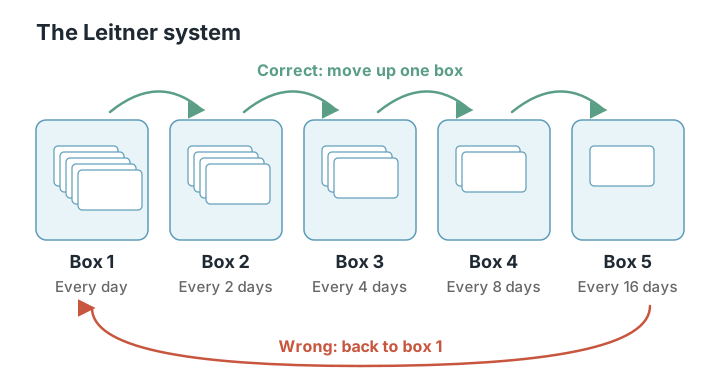
- All new cards go into box 1.
- When you study a box, answer each card before you turn it over.
- If you get it right, move the card up to the next box.
- If you get it wrong, move it back to box 1, wherever it was.
- Cards that reach box 5 and are answered correctly there count as learned. Keep them for a final review before the exam.
A Leitner box schedule you can copy
Leitner’s own schedule was based on how full each box was. Most people now use a fixed timetable, with each box reviewed half as often as the one before. Here is a common version.
| Box | Review every | What is in it |
|---|---|---|
| Box 1 | Day | New cards and cards you just missed |
| Box 2 | 2 days | Cards you got right once |
| Box 3 | 4 days | Cards you got right twice in a row |
| Box 4 | 8 days | Cards that are starting to stick |
| Box 5 | 16 days | Cards you know well |
Try this: Number your study days, and on each day review every box whose interval divides into that number. Day 4, for example, is boxes 1, 2, and 3.
Setting up a Leitner box on paper
You do not need anything special. Index cards and five envelopes, sections of a shoebox, or elastic-banded piles all work. Write one question per card, with the answer on the back. Keep the cards small: one fact, definition, or step per card.
Start with twenty to thirty cards in box 1. Add a similar batch every few days, not all at once. If you put two hundred new cards in box 1 on the first day, every session becomes a slog and the system stops being used.
A sample first week
Here is how the first week looks if you start with 30 cards and add 15 new ones every other day. On day 1, all 30 are in box 1. You study them all; say 12 are right and move to box 2. On day 2, you study box 1 again (the 18 misses) plus box 2. On day 3, you add 15 new cards to box 1 and study it.
By day 4, the first cards are reaching box 3, and box 1 is a mix of new cards and cards you keep missing. That is the system working. The sessions stay short, usually 10 to 20 minutes, because only some boxes are due each day, and most of your time goes on the cards in box 1 and box 2 that you have not learned yet.
If box 1 keeps growing faster than you can clear it, stop adding new cards for a few days. The cards in box 1 are the ones that need the work.
Using the Leitner method for languages and exams
The Leitner system became especially popular with language learners, because vocabulary suits flashcards so well. For languages, make cards in both directions, from your language to the new one and back, and keep them as separate cards in the boxes, since you can know one direction without the other.
For exams, work back from the date. If your exam is in four weeks, a box reviewed every 16 days will only come round once or twice, so in the final week, review every box regardless of the schedule. The system gets the cards learned; a final pass makes sure each one is fresh on the day.
Writing good Leitner system flashcards
The system only works if each card can be answered clearly right or wrong. A card that says “Explain the causes of the First World War” cannot be marked honestly in a few seconds. Split it into several cards, each with one cause.
Phrase cards as questions rather than prompts. “What enzyme breaks down starch?” is better than “Amylase”. And use the wording from your course, since the exam will too.
Is the Leitner system effective?
The Leitner system combines two methods with very strong research support. Answering a card before you flip it is practice testing, which reliably beats rereading. Reviewing cards at growing intervals is spaced practice, which reliably beats cramming. Moving missed cards back to the start means your effort goes where it is needed.
The specific intervals are not magic. They are a reasonable rule of thumb. Modern spaced repetition software uses algorithms that adjust intervals for each card based on how you answered it, which is more efficient, but the paper version captures most of the benefit.
Common mistakes
The system is simple, but a few habits undermine it.
- Flipping too early: if you peek before committing to an answer, it is not a test.
- Grading kindly: if you hesitated or were only half right, it goes back to box 1.
- Skipping box 1 days: that is where the cards you do not know live.
- Adding too many cards at once: steady small batches beat one big start.
- Cards that are too big: one idea per card, or you cannot mark it honestly.
Common questions
How do you do the Leitner system?
Put all your flashcards in box 1. Study box 1 every day and less frequent boxes on a schedule. Move each card you get right up one box, and send each card you get wrong back to box 1.
How many boxes does the Leitner system use?
Five is the most common number, but three to seven all work. Fewer boxes means more frequent reviews; more boxes stretches the longest interval.
Should a wrong card go back to box 1 or down one box?
The original rule is back to box 1. Some people prefer moving it down one box, which is gentler and wastes less time on cards that slipped once. Either works; stick with one rule.
How many new cards should I add each day?
Start with 10 to 20 new cards a day, or a batch of 20 to 30 every few days. If your box 1 session takes more than 20 minutes, add fewer until it shrinks.
What is the difference between the Leitner system and Anki?
Both are spaced repetition. The Leitner system uses fixed boxes and intervals and can be done on paper. Apps like Anki use an algorithm that sets a separate interval for each card based on how you rated it.
Calm Study
Calm Study does the Leitner sorting for you. It writes flashcards from your notes, asks you to answer before you flip, and uses Again, Hard, and Good to bring each card back at the right interval, so the cards you miss return tomorrow and the ones you know wait.