The Blurting Method: Revise by Writing What You Know
· 6 min read
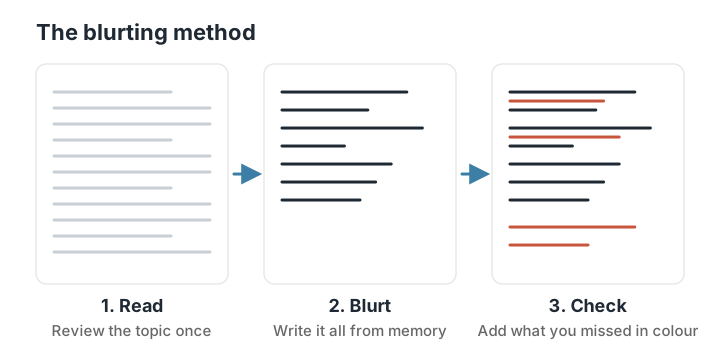
The blurting method is a revision technique where you study a topic, put your notes away, and write down everything you can remember on a blank page. Then you compare it with your notes and fill in what you missed in a different colour. It takes no preparation, works for almost any subject, and gives you an honest map of what you know.
What is the blurting method?
Blurting is a brain dump with a purpose. You pick a small topic, such as one specification point, a lecture, or a section of a chapter. You read or review it. Then you close everything and, on a blank sheet, write all you can remember: key terms, definitions, processes, examples, diagrams, dates, and quotes.
When you run out, you open your notes and check. Anything you missed or got wrong goes onto the same page in a different colour, usually red or green. The coloured parts are the bits you need to work on. The black parts are what you already know.
Why blurting works
Blurting is a form of retrieval practice, specifically free recall, where you produce information without any cue. Retrieval practice is one of the best-supported study methods in cognitive psychology. In a 2011 study published in Science, Karpicke and Blunt found that students who practised free recall of a text remembered more a week later than students who built detailed concept maps while looking at it.
Blurting also fixes a common problem: students are poor judges of what they know. Reading notes makes them feel familiar, which feels like knowing. A blank page is brutally honest. You cannot fool yourself that you know something you could not write down.
How to do blurting, step by step
A full blurting session on one topic takes about 20 to 30 minutes.
- Pick one small topic. A single spec point or lecture section is plenty.
- Review it for 5 to 10 minutes: read your notes, slides, or textbook section once, carefully.
- Close everything. Set a timer for 5 to 10 minutes and write everything you can remember.
- Do not stop at the first blank. Sit with it for a moment; more often comes back.
- Open your notes and check line by line. Add missing or wrong points in a different colour.
- Without looking, try to recall the coloured points once more before you finish.
What to include when you blurt
Write whatever the exam would want from you on that topic. For a science process, that is the stages, the key terms, and a labelled diagram. For a history topic, it is causes, events, dates, consequences, and evidence. For a text in English literature, it is themes, key quotes, and the effect of language choices.
Diagrams and mind-map layouts are fine. You do not need full sentences. What matters is that every item comes from your memory, not from a glance at your notes.
Try this: Before you start, write the topic heading and the exam command words, such as “explain” or “evaluate”, at the top of the page. It keeps the blurt focused on what will be asked.
An example blurt
Say the topic is photosynthesis. After ten minutes with your notes, you close them and write: light-dependent and light-independent stages, chloroplasts, chlorophyll absorbs light, water is split, oxygen released, carbon dioxide used, glucose made, the word equation, and a rough sketch of a chloroplast.
Then you check. In a different colour, you add: the light-dependent stage happens in the thylakoid membranes, it produces ATP and reduced NADP, the light-independent stage is the Calvin cycle in the stroma, and the three limiting factors. You also correct the equation, which had a missing term.
Now you have a clear list for next time: the locations, the products of each stage, and the limiting factors. Next session, you blurt those first. The rest of the page you already know, so you do not need to reread it.
Blurting revision for different subjects
The blurting technique suits subjects with a lot of content to recall: biology, chemistry, psychology, geography, history, and religious studies. It is a favourite for GCSE and A-level content-heavy topics, and it works just as well at university for lecture-by-lecture review.
For maths and physics, blurt the formulas, the steps of each method, and the conditions for using them, then do practice problems. Blurting helps you remember the tools; only problems teach you to use them. For languages, blurt vocabulary sets or grammar rules, then use them in sentences.
Make blurting stick
One blurt is useful. Repeated blurts are where the gains are. Two or three days later, come back to the same topic and blurt again on a fresh page. Start with the points you missed last time, since those are the ones most likely to be missing again.
Compare the two pages. The coloured section should be smaller. When a topic’s blurt is almost entirely in black, move it to a longer gap, such as a week, and spend the time on topics with more colour.
Blurting also works as a quick diagnostic before a mock or a past paper. Spend two minutes blurting each topic on the paper’s syllabus. The topics where your page stays nearly blank are the ones to revise first, and you will know that before the mock shows you the hard way.
Try this: Keep your blurt pages in a folder by topic. Before an exam, the coloured ink across them is a ready-made list of what to revise.
Common blurting mistakes
The technique is simple, which makes it easy to do in ways that waste the effort.
- Topics that are too big: blurting a whole module produces a vague page and no clear gaps.
- Peeking halfway through: that turns recall into copying.
- Copying the gaps without retrying: recall the coloured points before you stop.
- Only blurting easy topics: the hard ones are where blurting pays off.
- Never coming back: one blurt shows the gaps, but repeats fill them.
Blurting, flashcards, or past papers?
Each technique tests a different thing, so they work well together.
| Technique | Best for | Tests |
|---|---|---|
| Blurting | Seeing everything you know on a topic | Free recall and connections |
| Flashcards | Definitions, facts, and terms | Recall of specific items |
| Past papers | Applying knowledge to exam questions | Recall plus exam technique |
Common questions
Does blurting actually work?
Blurting has not been studied under that name, but it is free recall, a form of retrieval practice with strong research support. Students who practise recall consistently remember more than those who reread.
How long should a blurting session be?
About 20 to 30 minutes per topic: 5 to 10 minutes reviewing, 5 to 10 minutes writing, and 10 minutes checking and filling gaps.
Is blurting good for GCSE and A-level revision?
Yes. It suits content-heavy subjects and maps neatly onto specification points. Blurt one spec point at a time, then use past paper questions to practise applying it.
How often should I blurt a topic?
Blurt a new topic once on the day you study it, again two or three days later, and then about a week after that. Once a blurt comes out almost complete, space it further and move on to weaker topics.
What is the difference between blurting and a brain dump?
They are close. A brain dump is any writing-out of what is in your head. Blurting adds the parts that make it a study method: a focused topic, checking against your notes, marking the gaps, and repeating it later.
Can you blurt out loud instead of writing?
Yes. Saying everything you remember out loud, then checking, is the same principle and is faster. Writing gives you a record of the gaps to come back to, so use it when you plan to repeat the topic.
Calm Study
Calm Study helps you check a blurt in seconds. Ask its tutor about any gap and it answers from your own notes, and the questions it writes from your materials bring back the points you missed on later days, so the coloured section keeps shrinking.