How to Study Chemistry: From the Basics to Organic Mechanisms
· 6 min read
To study chemistry well, practise problems instead of rereading, and keep linking three ways of seeing the same reaction: what you can observe, what the particles are doing, and how it is written in symbols. Learn the core ideas, like bonding, the mole, and how electrons move, until they are automatic, because almost everything else builds on them. For calculations, learn from worked examples and then solve problems on your own. For organic chemistry, learn mechanisms by drawing the electron arrows rather than memorising reactions one by one.
Why chemistry feels hard
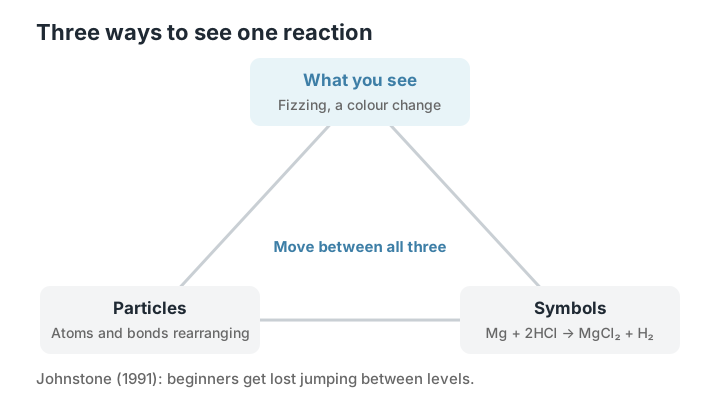
In a much-cited 1991 paper, the chemistry educator Alex Johnstone explained why so many students find the subject hard. Chemists constantly switch between three levels: the macroscopic (what you can see, like fizzing or a colour change), the sub-microscopic (atoms, ions, and electrons), and the symbolic (formulas and equations). Experts move between them without thinking. Beginners are asked to juggle all three at once, which overloads working memory.
Chemistry is also cumulative and mathematical. A shaky grasp of moles makes every calculation that follows feel impossible, and that confusion is easy to mistake for a problem with the new topic.
Master the foundations first
A handful of core ideas carry most of the subject. If any of these feels shaky, go back and fix it before pushing on. It will save you time on every later topic.
- Atomic structure and electron arrangement.
- Bonding and structure: ionic, covalent, and metallic, and how they explain properties.
- The mole, balancing equations, and reacting masses.
- Trends in the periodic table and why they happen.
- Energy changes in reactions.
- Acids, bases, and what pH measures.
Link the three levels for every reaction
For each reaction you learn, practise describing it at all three levels. Take magnesium in hydrochloric acid. What you see: fizzing, and the magnesium ribbon disappears. What the particles do: magnesium atoms lose two electrons to become ions, and hydrogen ions gain electrons to form hydrogen gas. The symbols: Mg + 2HCl → MgCl₂ + H₂.
Exam questions often give you one level and ask for another: “explain this observation in terms of particles”, or “what would you see?” If you have practised moving between levels, those questions stop being surprising.
Try this: Make a three-column flashcard or table for key reactions: observation, particle explanation, and equation. Cover one column and recall it from the other two.
Learn calculations from worked examples
When a type of calculation is new, studying worked examples is more efficient than diving straight into problems. In a classic 1985 study, John Sweller and Graham Cooper found that beginners learned more from studying worked examples than from solving the same problems unaided. A 2000 review by Robert Atkinson and colleagues found the benefit is largest when students explain each step to themselves.
Then fade the help: study a full example, try a partly worked one, then solve problems alone. Write units at every step. Many chemistry mistakes are unit mistakes, and units also show you when a method has gone wrong.
Mix problem types
Textbooks group problems by type, so you always know which method to use. Exams do not. Once you know several types of calculation, such as moles, concentrations, gas volumes, and titrations, practise them mixed together.
In maths, a 2007 study by Doug Rohrer and Kelli Taylor found that students who practised problem types mixed together scored 63% on a later test, compared with 20% for students who practised them in blocks. Chemistry shows similar benefits: in a 2017 study, Luke Eglington and Sean Kang found that mixing examples of different organic compound families helped students classify new molecules.
How to study organic chemistry
Organic chemistry has a reputation as a memory marathon, because there seem to be endless reactions. The trick is that a small number of mechanisms explain most of them. Mechanisms show, with curved arrows, how electrons move as bonds break and form.
Students who use mechanisms do better. In a 2012 study, Nathaniel Grove, Melanie Cooper, and Kelli Rush found that organic chemistry students who drew mechanisms were more likely to arrive at the correct product than those who tried to recall the answer directly.
- Learn the functional groups until you recognise them instantly.
- Understand nucleophiles and electrophiles: what has spare electrons, and what wants them.
- Draw every mechanism with curved arrows starting from electrons, never from atoms.
- Build a one-page reaction map showing how functional groups convert into each other, with reagents and conditions on the arrows.
- Practise three question types: predict the product, suggest the reagents, and plan a short synthesis.
Use flashcards for the right things
Flashcards are not the main way to learn chemistry, but they are ideal for things that need instant recall: definitions, functional groups, reagents and conditions, tests for ions and gases, trends, and key equations. Knowing these automatically frees up working memory for the actual problem.
Do not put whole calculations on flashcards. Recognising a worked answer is not the same as being able to produce one. Keep problems for practice sessions.
Lab work and practical questions
Practical skills are tested in written exams as well as in the lab. After each practical, write a short paragraph: what was the aim, what were the independent and dependent variables, what was controlled, what were the main sources of error, and how were the results processed? Those are the questions exams ask.
How to study for a chemistry test
In the one to two weeks before a test, shift from learning to practising.
- List every topic and rate your confidence, then start with the weakest.
- Blurt definitions, trends, and reactions on a blank page to find gaps.
- Work through calculation problems for each type, then mixed sets.
- Do past papers, at least one timed, and mark them with the mark scheme.
- Keep a mistakes log, sorted into concept, method, and careless errors, and redo those questions two days later.
- For organic chemistry, redraw your reaction map from memory.
- The night before: review your mistakes log and reaction map, then sleep.
Common mistakes when studying chemistry
Most wasted chemistry study comes from a few habits.
- Reading worked solutions instead of attempting problems first.
- Memorising organic reactions one by one without the mechanisms.
- Dropping units and significant figures in calculations.
- Pushing on to new topics with shaky foundations.
- Only practising one problem type at a time.
- Highlighting the textbook as the main way of studying.
Common questions
What is the best way to study chemistry?
Practise problems rather than rereading, secure the foundations like bonding and moles, link observations to particles and equations, learn calculations from worked examples, and use flashcards for definitions, reagents, and tests.
How do I get better at chemistry calculations?
Study a worked example while explaining each step, solve similar problems without it, then mix calculation types. Write units at every step and keep a log of the mistakes you make most often.
How should I study organic chemistry?
Learn functional groups and mechanisms rather than individual reactions. Draw curved arrows for every mechanism, build a reaction map of how groups convert into each other, and practise predicting products and suggesting reagents.
Is chemistry harder than biology?
They are hard in different ways. Chemistry involves more maths and abstract ideas about particles; biology involves more vocabulary and content. Both reward active practice over rereading.
Do I need to memorise the periodic table?
Usually not the whole thing. Learn the common elements and their symbols, the groups and periods, and the trends across and down the table, which explain far more than memorising positions.
How do I study for a chemistry final?
Start two to three weeks ahead. Rate each topic, fix weak foundations first, practise mixed calculation sets and past papers, redraw organic reaction maps from memory, and review your mistakes log regularly.
Calm Study
Calm Study helps with the parts of chemistry that are recall. It turns your notes into flashcards for reagents, conditions, functional groups, and definitions, writes mixed quizzes across your topics, and spaces each one out before your test, so problem practice gets the time it needs.
References
- Johnstone, A. H. (1991). Why is science difficult to learn? Things are seldom what they seem. Journal of Computer Assisted Learning, 7(2), 75–83. https://doi.org/10.1111/j.1365-2729.1991.tb00230.x
- Sweller, J., & Cooper, G. A. (1985). The use of worked examples as a substitute for problem solving in learning algebra. Cognition and Instruction, 2(1), 59–89. https://doi.org/10.1207/s1532690xci0201_3
- Atkinson, R. K., Derry, S. J., Renkl, A., & Wortham, D. (2000). Learning from examples: Instructional principles from the worked examples research. Review of Educational Research, 70(2), 181–214. https://doi.org/10.3102/00346543070002181
- Rohrer, D., & Taylor, K. (2007). The shuffling of mathematics problems improves learning. Instructional Science, 35(6), 481–498. https://doi.org/10.1007/s11251-007-9015-8
- Eglington, L. G., & Kang, S. H. K. (2017). Interleaved presentation benefits science category learning. Journal of Applied Research in Memory and Cognition, 6(4), 475–485. https://doi.org/10.1016/j.jarmac.2017.07.005
- Grove, N. P., Cooper, M. M., & Rush, K. M. (2012). Decorating with arrows: Toward the development of representational competence in organic chemistry. Journal of Chemical Education, 89(7), 844–849. https://doi.org/10.1021/ed2003934