The Best Place to Study, and Why Changing It Can Help
· 7 min read
The best place to study is somewhere quiet, well lit, and free of easy distractions, where you only do work. For most students that is a library, a study room, or a desk at home that is not your bed. Research on context-dependent memory adds a twist: memory is tied a little to the place you learn, so studying the same material in more than one place can make it easier to recall in an unfamiliar exam hall. Here is how to choose where to study, and how to set the space up.
What makes a good place to study
The best study spot is less about the place and more about what it makes easy. A good one makes focus easy and distraction effortful.
- Few interruptions: people are less likely to start a conversation.
- Distractions out of reach: no TV, games console, or bed in arm’s reach, and room to put your phone away.
- Good light: daylight if possible, and a lamp so you are not straining.
- A table and an upright chair, with space for your materials.
- The right noise level: quiet for reading, or steady background noise if you need it.
- A place you only use for work, so sitting down there signals that it is time to study.
Library, home, café, or bed?
Every option has trade-offs. Clutter matters more than people expect: a 2014 study by Anna Fisher and colleagues found that young children in a heavily decorated classroom were more distracted and learned less than in a plain one. A busy setting competes for attention.
| Place | Good for | Watch out for |
|---|---|---|
| Library | Deep focus, quiet, everyone else working | Travel time, opening hours, finding a seat |
| Desk at home | Convenience, all your materials | Housemates, family, the fridge, your phone |
| Café | A change of scene, background buzz | Music with lyrics, conversations, cost |
| Study room with friends | Accountability, quick questions | Chatting instead of working |
| Outside | Fresh air, a reset between sessions | Glare, wind, noise, no table |
| Bed | Comfort | Drowsiness, poor posture, worse sleep |
What is context-dependent memory?
Context-dependent memory is the finding that people recall information better in the same setting where they learned it. The setting acts as a cue: sights, sounds, and smells that were around when you learned something can help bring it back.
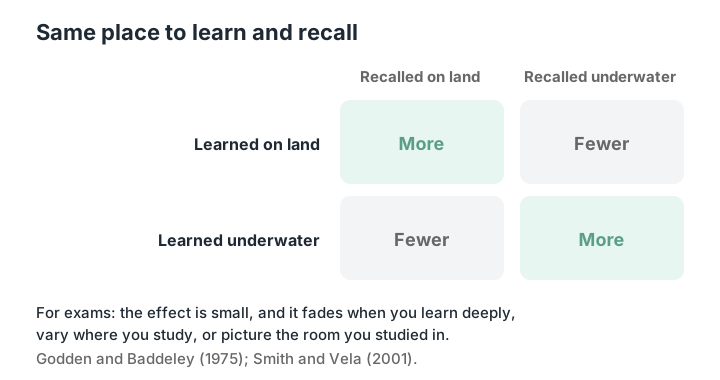
The most famous demonstration comes from 1975, when Duncan Godden and Alan Baddeley had scuba divers learn lists of words either on a beach or about 6 metres underwater. When they were tested, divers recalled more words in the same environment they had learned them in. Words learned underwater were recalled best underwater, and words learned on land were recalled best on land.
How much does it matter for exams?
Less than the diver study suggests. Land and water are extremely different settings. Most study spots and exam halls are just rooms. In a 2001 meta-analysis of 75 experiments, Steven Smith and Edward Vela found the context effect was real but modest. It shrank when people could imagine the original setting, and when the material had been learned well enough that the setting was not needed as a cue.
The context that may matter most is noise. In a 1998 study by Harry Grant and colleagues, students read an article in either silence or recorded background noise, then took a test in silence or noise. Students did better when the test conditions matched the study conditions. Since exams are silent, doing at least some of your final revision in quiet is a sensible match.
Why changing where you study can help
If memory leans on context, the answer is not to study in the exam hall. It is to make your memory less dependent on any one place. In a classic 1978 study by Steven Smith, Arthur Glenberg, and Robert Bjork, students who studied a list of words in two different rooms recalled more when tested in a new, third room than students who studied it twice in the same room.
In practice, that means rotating between two or three good places: the library, your desk, and the kitchen table, for example. Varying the setting also keeps sessions feeling fresher, and it fits naturally with spreading study over several days.
Try this: For your final practice papers, copy exam conditions: a quiet room, a clock, a table, no notes, and your phone out of the room.
Picture the room
There is a simple trick for when you cannot recall something in the exam. In a 1979 study, Steven Smith found that people tested in an unfamiliar room recalled much more when they were first asked to picture the room where they had learned the material.
If you go blank on a question, close your eyes for a moment and picture where you studied that topic: the desk, the page, the view out of the window. It costs a few seconds and often brings back a thread to pull.
Why not to study in bed
Studying in bed is comfortable, which is exactly the problem. Lying down makes you drowsy, your posture makes writing hard, and it is the easiest place to slide from studying to scrolling to sleeping.
There is also a sleep cost. Sleep specialists recommend keeping the bed for sleep, so that getting into it becomes a strong signal to wind down. It is part of a treatment called stimulus control, which the American Academy of Sleep Medicine includes in its guidelines for insomnia. Working in bed weakens that signal.
If your room is the only place you have, set up at a table or desk, even a small one. At the very least, sit up on top of the covers with your back supported, and get off the bed before you get sleepy.
How to set up a study space at home
A good home study space does not need much.
- A table and an upright chair, ideally facing a wall or window rather than the TV.
- Light from in front of you or to the side, plus a lamp for evenings.
- Only today’s materials on the desk; everything else out of sight.
- Your phone in another room, or at least out of reach with notifications off.
- Water and anything else you need, so you have no reason to wander off.
- Headphones for background noise, and a signal for housemates that you are working.
- The same short routine to start each session, such as writing the task and starting a timer.
Noise: silence, background noise, or music?
Quiet is best for reading, memorising, and writing, which also happen to be the tasks most like your exam. In busy places, steady background noise such as brown noise, white noise, or rain can mask conversations, which are more distracting because your brain cannot help processing speech.
Music with lyrics is the riskiest choice for word-heavy tasks. If you like music, keep it instrumental and quiet, and save it for routine work.
Common questions
Where is the best place to study?
A quiet, well-lit place with a table and chair, few interruptions, and no easy distractions, such as a library or a desk at home away from your bed. Having two or three good places to rotate between is even better.
Is it bad to study in bed?
Generally, yes. It makes you drowsy, encourages poor posture, and can weaken the link between bed and sleep. Use a desk or table if you can.
Should you study in the same place every time?
Not necessarily. Research on context-dependent memory suggests studying in a few different places can make recall less tied to one setting, which helps when you sit the exam somewhere new.
Is studying at a library better than at home?
For many students, yes, because there are fewer distractions and everyone around you is working. But a well-set-up home desk can work just as well. What matters is quiet, few interruptions, and your phone out of reach.
Does it help to study where you will take the exam?
A little, in theory, but it is rarely possible and the effect is modest. Studying in several places, practising in exam-like quiet conditions, and learning material well all reduce the need for a matching room.
How do I study at home with distractions?
Pick one spot used only for work, put your phone in another room, use headphones with background noise, tell people when you are studying, and work in timed blocks with breaks.
Calm Study
Calm Study goes wherever you study. Your plan, flashcards, and quizzes from your own notes live in your account, so you can switch between the library, your desk, and the kitchen table without losing your place, and practise the same material in more than one setting.
References
- Godden, D. R., & Baddeley, A. D. (1975). Context-dependent memory in two natural environments: On land and underwater. British Journal of Psychology, 66(3), 325–331. https://doi.org/10.1111/j.2044-8295.1975.tb01468.x
- Smith, S. M., & Vela, E. (2001). Environmental context-dependent memory: A review and meta-analysis. Psychonomic Bulletin & Review, 8(2), 203–220. https://doi.org/10.3758/BF03196157
- Grant, H. M., Bredahl, L. C., Clay, J., Ferrie, J., Groves, J. E., McDorman, T. A., & Dark, V. J. (1998). Context-dependent memory for meaningful material: Information for students. Applied Cognitive Psychology, 12(6), 617–623. https://doi.org/10.1002/(SICI)1099-0720(1998120)12:6<617::AID-ACP542>3.0.CO;2-5
- Smith, S. M., Glenberg, A., & Bjork, R. A. (1978). Environmental context and human memory. Memory & Cognition, 6(4), 342–353. https://doi.org/10.3758/BF03197465
- Smith, S. M. (1979). Remembering in and out of context. Journal of Experimental Psychology: Human Learning and Memory, 5(5), 460–471. https://doi.org/10.1037/0278-7393.5.5.460
- Fisher, A. V., Godwin, K. E., & Seltman, H. (2014). Visual environment, attention allocation, and learning in young children: When too much of a good thing may be bad. Psychological Science, 25(7), 1362–1370. https://doi.org/10.1177/0956797614533801
- Edinger, J. D., Arnedt, J. T., Bertisch, S. M., et al. (2021). Behavioral and psychological treatments for chronic insomnia disorder in adults: An American Academy of Sleep Medicine clinical practice guideline. Journal of Clinical Sleep Medicine, 17(2), 255–262. https://doi.org/10.5664/jcsm.8986