The Ebbinghaus Forgetting Curve, and How to Beat It
· 6 min read
The forgetting curve describes how quickly we lose what we have learned: steeply in the first hours and days, then more slowly. It was first measured by the German psychologist Hermann Ebbinghaus in the 1880s, and the basic shape has held up for well over a century. The useful part is not the forgetting. It is what reviews do to the curve, and how you can time them.
What is the forgetting curve?
Between 1879 and 1885, Hermann Ebbinghaus ran a long series of memory experiments on himself. He memorised lists of nonsense syllables, such as “DAX” and “BOK”, so that no prior knowledge could help him. Then he waited a set time, from twenty minutes to a month, and measured how much effort it took to relearn each list.
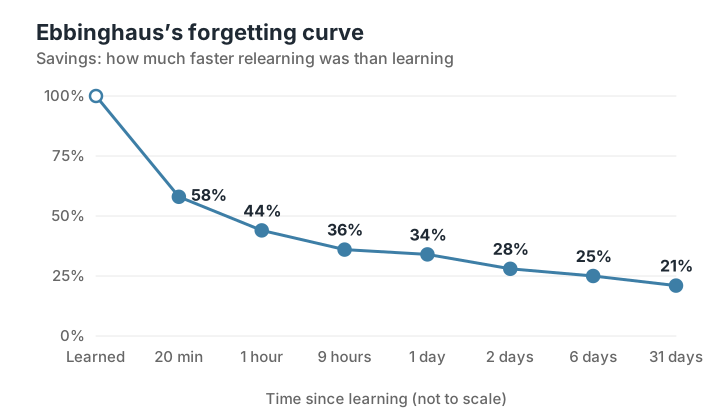
He published the results in 1885 in a book called Memory: A Contribution to Experimental Psychology. Plotted on a graph, they show a steep early drop that levels off into a long, slow tail. That shape is what we now call the Ebbinghaus forgetting curve.
What the numbers actually mean
Ebbinghaus did not measure how much he could recall. He measured savings: how much less time it took to relearn a list compared with learning it the first time. If a list took ten minutes to learn and six minutes to relearn, the savings were 40%.
His savings were roughly 58% after twenty minutes, 44% after an hour, about a third after a day, and about a fifth after a month. These numbers are often repeated as “we forget 70% of what we learn within a day”. That is not what they show. They show that relearning nonsense syllables a day later took about two thirds as long as learning them fresh. Meaningful material, like a lecture you understood, is forgotten more slowly.
Has the forgetting curve been replicated?
Yes. In 2015, Jaap Murre and Joeri Dros repeated Ebbinghaus’s experiment as closely as possible, with one participant spending about 70 hours learning and relearning lists of nonsense syllables. The curve they found was very similar to the original.
They also found a small upward bump at the 24-hour point, also visible when they reanalysed Ebbinghaus’s own data, which may reflect the effect of a night’s sleep on memory. The general rule, fast early forgetting followed by slow later forgetting, has been found many times with many kinds of material.
Why we forget
Psychologists describe a few causes. Some memories fade if they are never used. More often, other learning gets in the way: new material can interfere with old memories, and old memories can interfere with new ones. Sometimes the memory is still there but you cannot find the route to it without the right cue.
Interference is easy to recognise in real study. If you learn two similar enzymes in the same week, you may mix up which does what. If you learned French at school and now study Spanish, French words may pop up when you reach for Spanish ones. Spacing and mixed practice both help, because they make you practise telling similar things apart.
All three point to the same fix. Memories you retrieve regularly stay accessible. Memories you never retrieve become harder to reach, whether or not they are technically still stored.
How reviews flatten the curve
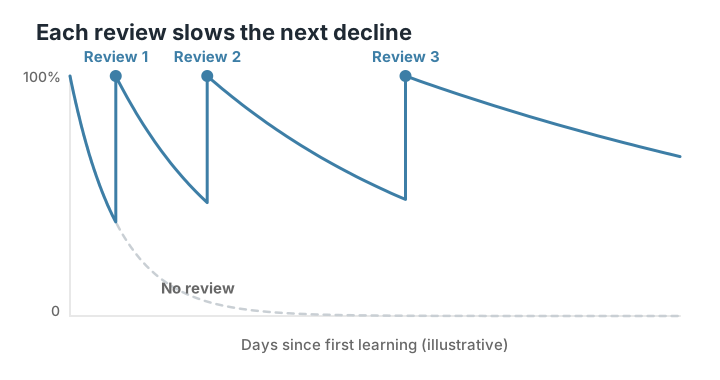
Each time you successfully recall something, two things happen. You top the memory back up, and the curve after that review is shallower than the one before. You forget more slowly than you did the first time.
That is why reviews can get further apart. The first review should come soon, within a day. The next can wait a few days, then a week, then several weeks. This expanding pattern is called spaced repetition, and it is the most direct way to use the forgetting curve in your favour.
Three forgetting curve myths
The forgetting curve is one of the most quoted findings in psychology, and one of the most distorted. Three claims come up again and again.
- Myth: you forget 70% of what you learn within 24 hours. That misreads Ebbinghaus’s savings scores as recall, and applies results from nonsense syllables to all learning.
- Myth: everyone forgets at the same rate. The rate depends heavily on the material, how well it was learned, and how it is tested. Meaningful material fades much more slowly.
- Myth: forgotten means gone. Ebbinghaus’s own method showed the opposite. Even after a month, relearning was faster than learning from scratch, so something was still there.
How to use the forgetting curve before an exam
The curve tells you two practical things. First, the most valuable review is the earliest one. A five-minute recall on the day of a lecture catches material at the point where it is fading fastest, and it changes the shape of everything that follows. Skipping it means your first proper review comes when much more has gone.
Second, the right gap depends on when you need the memory. If the exam is in a week, review every day or two. If it is in two months, start with short gaps and let them stretch to a week or more. In the final days, bring every topic back once more, so the last review before the exam is recent for all of them.
What makes material last longer
Ebbinghaus deliberately chose meaningless material. Real study material is easier to keep, especially if you do the following.
- Understand it: material that connects to what you know is forgotten more slowly.
- Recall it, do not reread it: retrieval strengthens memory far more than review.
- Space it: the same number of reviews spread over days beats them packed into one.
- Sleep on it: memory is consolidated during sleep.
- Overlearn a little: one or two extra correct recalls beyond “I know it” help it last.
A review schedule that works with the curve
There is no single perfect schedule, but an expanding one like this fits the shape of the curve. Adjust it to your exam date: the closer the exam, the shorter the gaps.
| Review | When | What to do |
|---|---|---|
| First | Same day or next day | Recall the main points from memory, then check |
| Second | 2 to 3 days later | Answer questions; read only what you missed |
| Third | About a week later | Mixed questions with other topics |
| Fourth | 2 to 4 weeks later | A short quiz or practice paper section |
| Before the exam | The final week | Mixed questions, focusing on misses |
Common questions
How much do we forget in 24 hours?
It depends on the material. For Ebbinghaus’s nonsense syllables, relearning a day later took about two thirds as long as the original learning. Meaningful material you understood is forgotten more slowly, and material you recalled once soon after learning is held much better.
Why do I forget what I study so quickly?
Usually because the study was rereading rather than recall, and there was no review in the first day or two. Material you read once and never retrieve follows the steep part of the curve. One quick recall the same day changes that.
What is the 2-7-30 rule for memory?
It is a simple spaced review schedule: review new material 2 days, 7 days, and 30 days after you learn it. The exact numbers are a rule of thumb, not a tested formula, but the expanding gaps fit the shape of the forgetting curve.
What is the difference between the learning curve and the forgetting curve?
A learning curve shows how performance improves with practice. The forgetting curve shows how memory declines over time without practice. Spaced reviews are how you keep the learning curve rising while the forgetting curve flattens.
Is the forgetting curve still accurate?
Its general shape is. Modern replications find the same steep early drop and long slow tail. The exact numbers vary widely with the material, how well it was learned, and how memory is tested.
Calm Study
Calm Study schedules your reviews around the forgetting curve. It writes flashcards and questions from your notes, brings each one back just as it starts to fade, sends the ones you miss back sooner, and shortens the gaps as your exam date gets closer.