Test Anxiety: What Helps Before and During the Exam
· 6 min read
Test anxiety is intense worry and physical stress before or during an exam, strong enough to get in the way of showing what you know. It is common, and it is not a sign that you are bad at a subject. Several techniques with good research behind them can reduce it, from practising under exam conditions to a ten-minute writing exercise just before you start. This guide explains what causes test anxiety and what helps.
What is test anxiety?
Test anxiety has two sides. The mental side is worry: thoughts like “I am going to fail”, “everyone else is ready”, or “I cannot remember anything”. The physical side is the body’s stress response: a racing heart, sweating, a tight chest, nausea, or shaky hands. Some students also experience their mind going blank when they look at the paper.
Some nervousness before an exam is normal and can even help, by raising alertness and focus. Test anxiety is when the nerves become strong enough to disrupt your performance, or so unpleasant that you avoid studying or exams altogether.
Why anxiety hurts exam performance
Worry takes up mental space. Your working memory, the system you use to hold and manipulate information while solving a problem, has limited capacity. When part of it is busy with anxious thoughts, less is left for the exam itself. This is why anxious students often know more than they manage to show.
The effect tends to be largest on questions that demand the most working memory, such as multi-step calculations or complex reasoning. It also explains blanking: under stress, retrieving information becomes harder, even when the memory is there.
What triggers test anxiety
Common triggers include feeling underprepared, high stakes such as a final exam or entrance test, a previous bad exam experience, perfectionism or fear of disappointing others, and unfamiliarity with the exam format or conditions.
Some of these are about preparation and can be fixed directly. Others are about how you think about the exam, and those respond to different techniques. Most students benefit from working on both.
Practice tests: the best prevention
Practising retrieval regularly helps with anxiety, not just memory. In a 2014 survey of over 1,400 middle and high school students whose classes used regular low-stakes quizzes, 72% said the quizzes made them less nervous for unit tests and exams. A 2016 experiment published in Science found that people who had learned material through practice tests remembered it well even after being put under acute stress, while those who had only restudied did not.
Practice under exam conditions also removes the unknown. Sit at least one full practice paper timed, at a desk, without notes or your phone. The real exam will then feel familiar rather than threatening.
In the days before the exam
Plan the practical details early: where the exam is, how you will get there, what you are allowed to bring, and what time you need to leave. Uncertainty about logistics adds stress that is easy to remove.
Protect your sleep in the final few nights. Sleep loss makes anxiety worse and memory weaker. Keep up light exercise if you normally do it. And keep revision focused on questions rather than rereading; testing yourself is reassuring in a way that reading is not, because it shows you what you can actually do.
Just before the exam: write it down
In a 2011 study published in Science, Gerardo Ramirez and Sian Beilock asked some students to spend ten minutes writing about their worries about an upcoming exam. In both lab and classroom experiments, anxious students who did this performed better than anxious students who did not.
The idea is that writing helps get the worries out of working memory and onto the page, freeing up capacity for the exam. You can try it outside the exam room: write honestly for ten minutes about what you are worried about, then put the page away.
Try this: If you cannot write beforehand, take sixty seconds at the start of the exam to jot down formulas or key points you are worried about forgetting, then start the paper.
Reframe the nerves
Your racing heart and alertness are the same physical response your body uses to prepare for any challenge. Research by Jeremy Jamieson and colleagues found that students who were told that physical arousal can improve performance did better on practice exam questions than students who were not told this.
Telling yourself to calm down rarely works. Telling yourself that your body is getting ready to perform is closer to the truth and often more effective.
Test anxiety tips for the exam room
A few techniques help once the exam has started.
- Breathe slowly, with a longer out-breath than in-breath, for a minute before you begin.
- Read the whole paper first, and start with a question you can answer. Early success settles nerves.
- If you blank on a question, mark it and move on. It often comes back while you work on others.
- Keep to a rough time plan, so one hard question does not eat your time for the rest.
- If panic rises, put the pen down, breathe for thirty seconds, and then reread the question slowly.
How to overcome test anxiety over time
The techniques above help you deal with test anxiety on the day. Overcoming it over months works more like building confidence in any other situation: through repeated, manageable exposure. Each low-stakes quiz and timed practice paper is a small rehearsal of the real thing. Over time, sitting a test becomes familiar, and familiar situations are less threatening.
It also helps to notice and question anxious thoughts. “If I fail this, my future is ruined” is rarely true. Writing down the worst-case thought and a more realistic version can take some of its power away. Keeping a record of past exams that went better than you feared is useful evidence against the voice that says this one will go badly.
When to get more help
If test anxiety is severe, lasts well beyond exams, causes panic attacks, or leads you to avoid school, it is worth talking to a doctor, a counsellor, or your school or university’s student support service. Anxiety is very treatable, and cognitive behavioural approaches have good evidence for it.
Many institutions also offer exam arrangements for students with diagnosed anxiety or other conditions, such as extra time or a separate room. Ask early, as these usually need to be arranged well in advance.
Common questions
How do you deal with test anxiety?
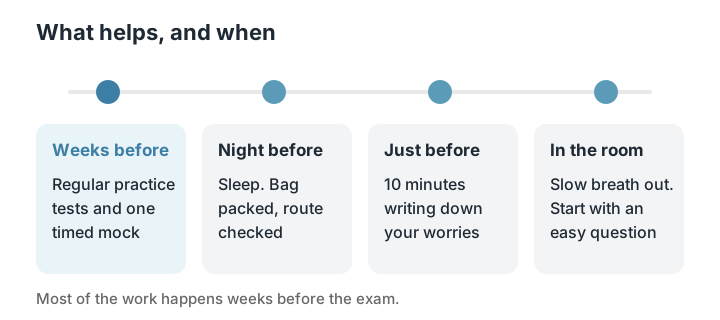
To deal with test anxiety, prepare with regular practice tests, including at least one under real exam conditions. Sleep well before the exam, write down your worries beforehand, reframe nerves as readiness, and use slow breathing and an easy first question in the room.
Is test anxiety a symptom of ADHD?
Test anxiety is not itself a symptom of ADHD, but students with ADHD may be more likely to feel anxious about exams, for example because of past difficulties with timing or focus. If you suspect either, a doctor can help work out what is going on.
Does test anxiety ever go away?
For many students it eases with experience, good preparation, and practice under exam conditions. If it does not, or it is getting worse, support from a counsellor or doctor can help a lot.
Why does my mind go blank in exams?
Stress makes retrieving memories harder, and worry uses up working memory. Skipping the question and coming back later often helps. Practising retrieval regularly before the exam makes memories more resistant to stress.
Calm Study
Calm Study helps with the preparation side of test anxiety. It turns your notes into regular low-stakes quizzes and writes mock exams in the format of your real papers, so by exam day you have answered these kinds of questions many times and the format holds no surprises.