Mnemonic Devices: 9 Types, With Examples for Studying
· 9 min read
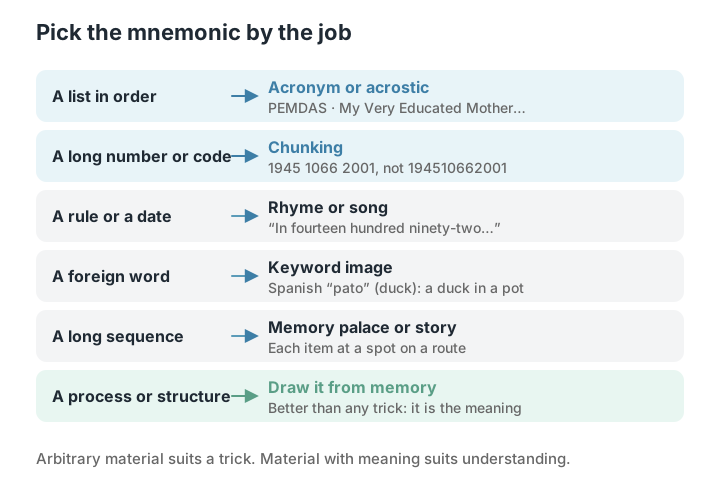
A mnemonic device is a memory trick that turns hard-to-remember information into something easier to recall: a word, a sentence, a rhyme, a picture, or a route. PEMDAS for the order of operations and “Every Good Boy Deserves Fudge” for the lines of the treble staff are both mnemonic devices. They work best for arbitrary information, such as lists, sequences, and foreign words, and worst as a stand-in for understanding. This guide covers the nine main types, with examples, and when each one is worth your time.
What is a mnemonic device?
A mnemonic (the first “m” is silent: nee-MON-ik) is any technique that makes information easier to remember by giving it a structure it does not have on its own. The word comes from the Greek for “mindful”, and the techniques are old. Greek and Roman orators used imagined buildings to remember long speeches, a method still taught today as the memory palace.
In a 1981 review, the psychologist Francis Bellezza sorted mnemonic devices into a few families: ones that organise information (like chunking a number), ones that attach it to cues you already know (like the letters of a word, or rooms in your house), and ones that turn it into vivid images. What they share is that they give your memory a way back in. Arbitrary material, such as the order of the planets, has no internal logic to follow, so a mnemonic lends it one.
Why mnemonics work
Remembering is mostly a matter of cues. You recall something when a cue leads to it: a question, a smell, the first word of a sentence. Material that connects to lots of things you know has lots of cues. A list of unrelated terms has almost none, which is why it slips away.
Mnemonics add cues on purpose. A rhyme adds rhythm, so a wrong word sounds wrong. An acronym adds a word that cues each item in turn. An image adds a picture, and pictures are remembered better than words. A story adds a sequence, so each item leads to the next. In a classic 1969 study by Gordon Bower and Michelle Clark, students who linked lists of ten words into little stories recalled 93% of the words later, against 13% for students who simply studied the lists.
Some mnemonics also work around the limits of working memory. Your mind can hold only about four meaningful chunks at once, according to a 2001 review by Nelson Cowan (the popular “seven, plus or minus two” is an older estimate). Grouping material into bigger, meaningful chunks lets more fit in.
Types 1 and 2: acronyms and acrostics
An acronym makes a word, or something you can say, from the first letters of the items. An acrostic makes a sentence instead, which helps when the first letters do not spell anything useful. These are the most common mnemonic devices students use, and the easiest to make.
- PEMDAS (or BODMAS in the UK): the order of operations in maths.
- HOMES: the Great Lakes, Huron, Ontario, Michigan, Erie, and Superior.
- ROY G BIV: red, orange, yellow, green, blue, indigo, violet.
- SOH CAH TOA: the sine, cosine, and tangent ratios in trigonometry.
- My Very Educated Mother Just Served Us Noodles: the planets, Mercury to Neptune.
- King Philip Came Over For Good Soup: kingdom, phylum, class, order, family, genus, species.
- Every Good Boy Deserves Fudge, and FACE: the lines and spaces of the treble staff.
Try this: Before you trust an acronym, cover your notes and say what every letter stands for. If you can only recite the word, it is not doing its job yet.
Type 3: rhymes, songs, and rhythm
Rhymes and songs hold words in place because the rhythm and rhyme make any wrong word stick out. “Thirty days hath September” and “In fourteen hundred ninety-two, Columbus sailed the ocean blue” have lasted for generations for this reason. The alphabet song does the same job for small children.
Music helps most when the tune is simple and repeated. In a 1994 study, Wanda Wallace found that people recalled a text better when it was sung to a melody they heard several times, but not when the melody was hard to learn. A song you have to learn on top of the facts is two jobs, not one.
Rhymes can also carry errors. “I before e except after c” is catchy and wrong more often than you would like, think of “science”, “their”, and “weird”. Check a rhyme against the real rule before you let it in.
Type 4: chunking
Chunking means grouping information into fewer, larger units. A phone number split into 3-3-4 is easier than ten loose digits. Try this string: 149162536496481. As fifteen digits, it is hard. As 1, 4, 9, 16, 25, 36, 49, 64, 81, the square numbers, it is almost impossible to forget.
Chunking works best when the chunks mean something. Chemistry students group the periodic table by family, history students group events by cause, and language learners memorise whole phrases instead of single words. Experts in any field are, in part, people who have built up very large chunks, so they see a whole pattern where a beginner sees ten separate pieces.
Type 5: the keyword method
The keyword method is a mnemonic for vocabulary and paired facts. You find a word in your own language that sounds like the new word, then picture the two meanings interacting. The Spanish word “pato” means duck. It sounds like “pot”, so you picture a duck sitting in a cooking pot.
It can work well. In a 1975 study by Richard Atkinson and Michael Raugh, students learning Russian vocabulary with keywords recalled 72% of the words on a later test, against 46% for students who used their own methods. The catch is durability. A 1992 study by Alvin Wang and colleagues found that keyword-learned words were forgotten faster once a week or so had passed, and a major 2013 review of study techniques rated the keyword method of low overall usefulness for that reason and because it is slow to apply to many items.
Use keywords for the handful of words that will not stick any other way, then practise retrieving those words until you no longer need the picture.
Types 6 to 8: memory palace, story, and peg methods
These three methods all turn a list into a series of images joined in a fixed order.
- Memory palace (method of loci): place each item at a spot along a route you know well, such as your home, then walk the route in your mind to recall them.
- Story or link method: join the items into one strange story, where each item causes or meets the next.
- Peg system: learn a set of “pegs” once, such as one-bun, two-shoe, three-tree, then hang each new item on a peg with an image.
How powerful these methods can be
The memory palace is what memory champions use, and it can be learned. In a 2017 study in the journal Neuron, Martin Dresler and colleagues trained ordinary people in the method of loci for 30 minutes a day over six weeks. Their recall of a 72-word list rose from about 26 words to about 62, and much of the gain was still there four months later.
That is a striking result, but it is also a specific one. The method shines for ordered lists of concrete items. It is much less useful for the kind of material most exams ask about: explaining a process, comparing two theories, or applying a formula to a new problem.
Type 9: drawing and visual mnemonics
Turning words into a quick drawing is one of the simplest mnemonic devices there is, and it is reliable. In a 2016 series of experiments, Jeffrey Wammes, Melissa Meade, and Myra Fernandes found that people who drew each word on a list remembered far more of them than people who wrote the words out, often around twice as many. Drawing forces you to think about what something means and adds a picture to the memory.
For processes and structures, drawing is better than any trick. A labelled sketch of the heart, a flow diagram of a reaction, or a timeline of a war captures the real relationships, which is what an exam question will probe.
When mnemonics do not help
Mnemonics are a tool for getting arbitrary information into memory. They do not create understanding, and they can hide the lack of it. Knowing that “mitochondria” is the M in your cell organelle acronym is not the same as being able to explain what mitochondria do.
- Concepts you need to explain or apply: use elaboration, worked examples, and practice questions instead.
- Material with its own logic: if a process follows from cause and effect, learn the causes, not a sentence.
- Too many mnemonics at once: a dozen acronyms for one exam start to interfere with each other.
- One-off use: a mnemonic you made and never practised will fade like anything else.
How to make a mnemonic that sticks
Psychologist Andrew Putnam has argued that mnemonics are underused in education, and that they work best as part of a wider routine, not on their own. These steps make the difference.
- Make it yourself where you can. A sentence you invented is easier to recall than one you were handed.
- Make it vivid, personal, or silly. Unusual images and odd sentences stand out in memory.
- Check it against the source so you do not memorise a mistake.
- Test yourself from the cue: write the acronym, then the full list, without looking.
- Space that practice over several days, then test without the mnemonic at all.
- Drop the mnemonic once you know the material. It was scaffolding, not the building.
Try this: Stuck for a sentence? Write your list in order, then make each first letter into a word about something you care about, like a friend, a game, or your pet.
Common questions
What is a mnemonic device in simple terms?
A memory trick. It turns information that is hard to remember, like a list or an order, into something easy to remember, like a word, a sentence, a rhyme, or a picture.
What are the most common types of mnemonic devices?
Acronyms, acrostic sentences, rhymes and songs, chunking, the keyword method, the memory palace, stories, peg systems, and drawings or other visual images.
Do mnemonic devices actually work?
Yes, for the right material. They reliably improve recall of lists, sequences, and paired facts such as vocabulary. They work less well over long delays unless you practise them, and they do not help you understand ideas.
What is the difference between an acronym and an acrostic?
An acronym is a word made from first letters, like HOMES for the Great Lakes. An acrostic is a sentence whose words start with those letters, like My Very Educated Mother Just Served Us Noodles for the planets.
What is a good mnemonic for the planets?
My Very Educated Mother Just Served Us Noodles: Mercury, Venus, Earth, Mars, Jupiter, Saturn, Uranus, Neptune. Older versions ended in “Nine Pizzas” for Pluto, which was reclassified as a dwarf planet in 2006.
Can you use mnemonics for a whole topic?
Not well. Use mnemonics for the lists and terms inside a topic, and use explanation, diagrams, and practice questions for the ideas that connect them.
Calm Study
Calm Study handles the part a mnemonic cannot. Once your trick gets a list in, the flashcards and quizzes written from your own notes test you on what each item means, bring it back on later days, and stop asking once you know it cold.
References
- Bellezza, F. S. (1981). Mnemonic devices: Classification, characteristics, and criteria. Review of Educational Research, 51(2), 247–275. https://doi.org/10.3102/00346543051002247
- Bower, G. H., & Clark, M. C. (1969). Narrative stories as mediators for serial learning. Psychonomic Science, 14(4), 181–182. https://doi.org/10.3758/BF03332778
- Cowan, N. (2001). The magical number 4 in short-term memory: A reconsideration of mental storage capacity. Behavioral and Brain Sciences, 24(1), 87–114. https://doi.org/10.1017/S0140525X01003922
- Wallace, W. T. (1994). Memory for music: Effect of melody on recall of text. Journal of Experimental Psychology: Learning, Memory, and Cognition, 20(6), 1471–1485. https://doi.org/10.1037/0278-7393.20.6.1471
- Atkinson, R. C., & Raugh, M. R. (1975). An application of the mnemonic keyword method to the acquisition of a Russian vocabulary. Journal of Experimental Psychology: Human Learning and Memory, 1(2), 126–133. https://doi.org/10.1037/0278-7393.1.2.126
- Wang, A. Y., Thomas, M. H., & Ouellette, J. A. (1992). Keyword mnemonic and retention of second-language vocabulary words. Journal of Educational Psychology, 84(4), 520–528. https://doi.org/10.1037/0022-0663.84.4.520
- Dunlosky, J., Rawson, K. A., Marsh, E. J., Nathan, M. J., & Willingham, D. T. (2013). Improving students’ learning with effective learning techniques. Psychological Science in the Public Interest, 14(1), 4–58. https://doi.org/10.1177/1529100612453266
- Dresler, M., Shirer, W. R., Konrad, B. N., Müller, N. C. J., Wagner, I. C., Fernández, G., Czisch, M., & Greicius, M. D. (2017). Mnemonic training reshapes brain networks to support superior memory. Neuron, 93(5), 1227–1235. https://doi.org/10.1016/j.neuron.2017.02.003
- Wammes, J. D., Meade, M. E., & Fernandes, M. A. (2016). The drawing effect: Evidence for reliable and robust memory benefits in free recall. Quarterly Journal of Experimental Psychology, 69(9), 1752–1776. https://doi.org/10.1080/17470218.2015.1094494
- Putnam, A. L. (2015). Mnemonics in education: Current research and applications. Translational Issues in Psychological Science, 1(2), 130–139. https://doi.org/10.1037/tps0000023