Metacognition for Students: Examples and Strategies That Work
· 8 min read
Metacognition is thinking about your own thinking: knowing what you know, noticing what you do not, and choosing how to study as a result. For a student it comes down to three questions asked again and again. What do I need to learn? How will I know when I have learned it? What should I change? It sounds abstract, but it is one of the best-supported ideas in education, and it explains why so many students feel ready for exams that then go badly.
What is metacognition?
The developmental psychologist John Flavell introduced the term in the 1970s, describing it as knowledge and awareness of one’s own thinking. Researchers now usually split it into two parts.
The first is metacognitive knowledge: what you know about yourself as a learner, about different kinds of tasks, and about which strategies suit them. Knowing that you understand graphs faster than paragraphs, or that an essay exam needs different preparation from a multiple-choice one, is metacognitive knowledge.
The second is metacognitive regulation: using that knowledge to steer your learning. You plan how to tackle a topic, monitor whether it is working while you study, and evaluate the result afterwards. Most of the benefit for students comes from this second part.
Metacognition examples
Metacognition is not a special exercise. It is a habit of noticing and adjusting, and it shows up in small moments like these.
- Realising you have read the same paragraph three times without taking anything in, and switching to writing questions about it.
- Covering the answer before you check a flashcard, because recognising it does not prove you know it.
- Noticing that your flashcards test definitions, while the exam asks you to explain and compare.
- Predicting your score on a practice quiz, then comparing it with your real score.
- Sorting the mistakes on a returned test into “did not know”, “misread the question”, and “ran out of time”.
- Deciding to start a session with the topic you are avoiding, because avoidance is a sign it is weak.
Why it matters for your grades
The Education Endowment Foundation, which reviews school research in the UK, rates teaching metacognition and self-regulation as one of its highest-impact approaches, worth an average of about seven months of extra progress over a school year.
Even a light-touch version helps. In a 2017 study, Patricia Chen and colleagues sent college statistics students a short online survey a week or so before each exam. It asked them to think about what the exam would cover, which resources would help them prepare, and how they would use those resources. Students who did it scored about a third of a letter grade higher than students who did not, and felt more in control of their studying.
The illusions that fool students
The hard part of metacognition is that your feelings about your learning are often wrong, in predictable ways.
The first illusion is fluency. When you reread notes, they get easier to read, and that ease feels like knowledge. Asher Koriat and Robert Bjork showed in 2005 that people overestimate how much they will remember when the answer is in front of them while they study. Even trivial fluency fools us: in a 2008 study by Matthew Rhodes and Alan Castel, people predicted they would remember words printed in a large font better than small ones, though they did not.
The second is that effective methods feel worse. In a 2008 study by Nate Kornell and Robert Bjork, most participants learned better by mixing examples from different categories, yet most of them believed the blocked, one-category-at-a-time approach had worked better. In a 2019 physics study at Harvard, Louis Deslauriers and colleagues found students learned more from active classes but felt they had learned more from polished lectures.
The third is overconfidence where knowledge is weakest. In Justin Kruger and David Dunning’s 1999 studies, people who scored in the bottom quarter on tests of logic and grammar estimated, on average, that they had done better than most people. The skills you need to answer well are the same ones you need to spot a poor answer.
Try this: When a study session feels smooth and easy from start to finish, ask what you were actually testing. Smooth usually means familiar.
Judge your learning from a test, not a feeling
The fix for these illusions is simple: base your judgement on evidence. The best evidence is whether you can produce the answer without looking, after some time has passed.
Timing matters. In a 1991 study, Thomas Nelson and John Dunlosky asked people to predict whether they would remember word pairs. Predictions made immediately after studying were poor. Predictions made a few minutes later, after trying to recall the answer, were remarkably accurate. A short delay forces you to retrieve from memory instead of from what is still in front of you.
In practice, that means testing yourself at the start of a session on yesterday’s material, using practice questions you have not seen, and keeping score. A rough record of what you got right is worth more than any amount of confidence.
The plan, monitor, evaluate cycle
A simple way to build metacognition into your studying is to run the same short cycle every time.
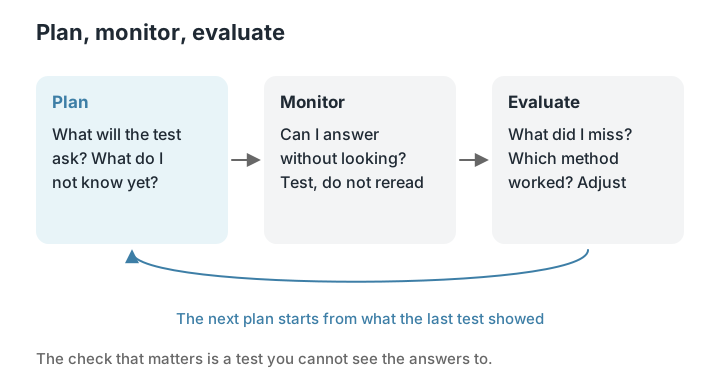
- Plan: What is this session for? What will the exam ask about it? What do I already know, and what do I not?
- Monitor: Can I answer this without my notes? Am I understanding, or just reading? Is this method working?
- Evaluate: What did I get wrong, and why? What will I do differently next time?
Five metacognitive strategies for students
These strategies are easy to start and each one gives you better information about your own learning.
- Write an exam playbook: a week or two before an exam, write what it will cover, what format it takes, which resources will help, and when you will use them.
- Predict, then test: before a practice quiz, write the score you expect. Over time, close the gap between prediction and result.
- Rate topics by results, not feelings: keep a list of topics marked by your last quiz score, and study the lowest first.
- Explain it out loud: if you cannot explain a topic simply without notes, you have found a gap.
- Analyse your errors: after every test, sort each mistake by cause, then change the thing that caused it.
An exam wrapper you can copy
An exam wrapper is a short set of questions you answer around an exam, so each one teaches you something about how you study. Teachers use them, but you can run one yourself.
| When | Ask yourself |
|---|---|
| Before you start studying | What will this exam ask, and in what format? What do I already know? |
| During each session | Can I answer without my notes? Which topics keep tripping me up? |
| After a practice quiz | What did I get wrong, and was it knowledge, reading, or time? |
| After the real exam | Which methods paid off? What will I change for the next one? |
Why students pick weak study methods
Metacognition explains why rereading and highlighting stay popular even though research rates them poorly. In a 2009 survey by Jeffrey Karpicke and colleagues, 84% of college students said they reread their notes or textbook, and 55% named it as their main strategy. Very few said they tested themselves.
Robert Bjork, John Dunlosky, and Nate Kornell, reviewing the research in 2013, put it down to what students can see while they study. Rereading produces a quick feeling of progress. Testing and spacing produce struggle and mistakes, which feel like failure, even though they lead to far better memory later. Good metacognition means trusting the evidence over the feeling.
Common metacognition mistakes
These habits look like self-awareness but give you the wrong answer.
- Rating your confidence straight after reading, when everything still feels familiar.
- Treating “I recognise this” as “I know this”.
- Only reviewing topics you enjoy, then deciding you are ready.
- Keeping no record of mistakes, so the same ones repeat.
- Switching methods every week without checking whether the last one worked.
Common questions
What is metacognition in simple terms?
Thinking about your own thinking. For studying, it means knowing what you know and what you do not, and changing how you study because of it.
What are some examples of metacognition?
Checking whether you can answer a question without notes, predicting your quiz score and comparing it with the result, noticing you have stopped taking in what you read, and sorting test mistakes by their cause.
What are the three stages of metacognition?
Planning, monitoring, and evaluating. You decide how to approach the task, check how it is going while you work, and review what worked afterwards.
Is metacognition the same as self-regulated learning?
They overlap. Self-regulated learning is the wider idea of managing your own learning, including motivation and time. Metacognition is the part about monitoring and steering your thinking.
Can you improve your metacognition?
Yes. The quickest improvements come from testing yourself instead of rereading, predicting scores and comparing them with results, and reviewing your mistakes after every test.
Why do I feel ready for exams but then do badly?
Usually because your sense of readiness came from familiarity. Rereading makes notes feel known. Testing yourself without notes, a day or more after studying, gives a much more accurate picture.
Calm Study
Calm Study is built around the honest check that metacognition needs. It quizzes you from your own notes instead of letting you reread them, keeps track of which cards you miss, and moves its study plan toward the topics your answers show are weak, not the ones that feel weak.
References
- Flavell, J. H. (1979). Metacognition and cognitive monitoring: A new area of cognitive–developmental inquiry. American Psychologist, 34(10), 906–911. https://doi.org/10.1037/0003-066X.34.10.906
- Education Endowment Foundation. Metacognition and self-regulation. Teaching and Learning Toolkit. https://educationendowmentfoundation.org.uk/education-evidence/teaching-learning-toolkit/metacognition-and-self-regulation
- Chen, P., Chavez, O., Ong, D. C., & Gunderson, B. (2017). Strategic resource use for learning: A self-administered intervention that guides self-reflection on effective resource use enhances academic performance. Psychological Science, 28(6), 774–785. https://doi.org/10.1177/0956797617696456
- Koriat, A., & Bjork, R. A. (2005). Illusions of competence in monitoring one’s knowledge during study. Journal of Experimental Psychology: Learning, Memory, and Cognition, 31(2), 187–194. https://doi.org/10.1037/0278-7393.31.2.187
- Rhodes, M. G., & Castel, A. D. (2008). Memory predictions are influenced by perceptual information: Evidence for metacognitive illusions. Journal of Experimental Psychology: General, 137(4), 615–625. https://doi.org/10.1037/a0013684
- Kornell, N., & Bjork, R. A. (2008). Learning concepts and categories: Is spacing the “enemy of induction”? Psychological Science, 19(6), 585–592. https://doi.org/10.1111/j.1467-9280.2008.02127.x
- Deslauriers, L., McCarty, L. S., Miller, K., Callaghan, K., & Kestin, G. (2019). Measuring actual learning versus feeling of learning in response to being actively engaged in the classroom. Proceedings of the National Academy of Sciences, 116(39), 19251–19257. https://doi.org/10.1073/pnas.1821936116
- Kruger, J., & Dunning, D. (1999). Unskilled and unaware of it: How difficulties in recognizing one’s own incompetence lead to inflated self-assessments. Journal of Personality and Social Psychology, 77(6), 1121–1134. https://doi.org/10.1037/0022-3514.77.6.1121
- Nelson, T. O., & Dunlosky, J. (1991). When people’s judgments of learning (JOLs) are extremely accurate at predicting subsequent recall: The “delayed-JOL effect.” Psychological Science, 2(4), 267–270. https://doi.org/10.1111/j.1467-9280.1991.tb00147.x
- Karpicke, J. D., Butler, A. C., & Roediger, H. L. (2009). Metacognitive strategies in student learning: Do students practise retrieval when they study on their own? Memory, 17(4), 471–479. https://doi.org/10.1080/09658210802647009
- Bjork, R. A., Dunlosky, J., & Kornell, N. (2013). Self-regulated learning: Beliefs, techniques, and illusions. Annual Review of Psychology, 64, 417–444. https://doi.org/10.1146/annurev-psych-113011-143823