Multiple-Choice Test-Taking Strategies That Actually Work
· 7 min read
The best multiple-choice test strategies start before the test. Study by recalling answers, not by recognising them, because good multiple-choice exams are built to catch students who only half know the material. On the day, read each question and try to answer it before you look at the options, eliminate the ones you know are wrong, and do not be afraid to change an answer when you have a good reason. Research consistently finds that changed answers go from wrong to right more often than the reverse.
Why multiple-choice tests are harder than they look
Multiple choice looks easy because the answer is on the page. You only have to recognise it, not produce it. But well-written tests use that against you. The wrong options, called distractors, are built from the mistakes students commonly make: a similar term, a half-true statement, the right answer to a slightly different question.
In a 2018 review of best practice, Andrew Butler noted that good multiple-choice questions use plausible distractors and test understanding, not just recognition. If you have only reread your notes, every option can look familiar. The student who can explain why each wrong option is wrong is the one who scores well.
How to study for multiple-choice tests
It seems logical to practise for multiple choice with multiple choice. Research suggests recall is better preparation. In a 2007 study in an online college course, Mark McDaniel and colleagues found that weekly short-answer quizzes improved later exam performance more than multiple-choice quizzes did, including on multiple-choice exam questions.
A 2014 study by Megan Smith and Jeffrey Karpicke found that short-answer, multiple-choice, and hybrid practice all improved retention compared with no practice. The lesson is not to avoid multiple choice, but to make recall the core of your studying, then use multiple-choice practice to get used to the format.
- Use flashcards and short-answer questions where you must produce the answer.
- Write out definitions, processes, and explanations from memory.
- For each practice question, explain why the right answer is right and why each wrong option is wrong.
- Do timed practice tests in the real format during the last week or two.
Learn the differences, not just the facts
Distractors often swap in a related concept: mitosis for meiosis, a correlation for a cause, one economic policy for its opposite. To beat them, you need to know how similar things differ.
Make comparison tables for concepts that are easy to confuse, and quiz yourself on the differences. There is a bonus here. In a 2012 study, Jeri Little and colleagues found that multiple-choice questions with competitive options, where you have to think about why each one is wrong, improved memory for the related information in the wrong options too.
Try this: Whenever two terms keep tripping you up, write a one-line rule that separates them, such as “mitosis makes two identical cells; meiosis makes four different ones.”
Practise with real questions, and check every answer
Past papers and question banks from your course are the best practice, because they match the style and difficulty of the real test. Do some under timed conditions so the pacing is familiar.
Always check your answers and read the explanations. In a 2005 study, Henry Roediger and Elizabeth Marsh found that multiple-choice practice helps memory overall, but it can also lead students to remember wrong options as true, especially when there are many options. Checking your answers straight afterwards undoes most of that.
On test day: a step-by-step method
A consistent routine for each question stops you rushing into a tempting wrong answer.
- Read the whole question carefully, and underline key words like NOT, EXCEPT, BEST, and MOST.
- Cover the options with your hand and answer the question in your head first.
- Read every option, even if the first one looks right.
- Look for the option that matches your answer.
- If none does, eliminate the ones you know are wrong, and choose from what is left.
- Mark any question you are unsure about, and move on. Come back at the end.
How to eliminate wrong answers
When you cannot recall the answer, removing wrong options is the next best thing. These clues help, though none is a guarantee.
- Options that are true statements but do not answer the question asked.
- Absolute words like “always” and “never”, which are wrong more often than not in subjects full of exceptions.
- Options that do not fit the question grammatically.
- Two options that say opposite things: often one of them is right.
- Two options that say the same thing in different words: if only one answer can be right, neither is likely to be it.
- “All of the above”: if you are sure two options are true, it is likely the answer.
Should you change your answers?
Many students believe in sticking with their first instinct. The research says otherwise. In a 2005 study, Justin Kruger, Derrick Wirtz, and Dale Miller looked at the eraser marks on over 1,500 psychology exams. About half of all answer changes went from wrong to right, a quarter from right to wrong, and the rest from one wrong answer to another. Yet most students believed that changing answers usually hurt.
Why the myth? Changing a right answer to a wrong one feels far more painful, so it is remembered. A 2016 study by Justin Couchman and colleagues added a useful detail: when students felt confident in their first answer, it was usually right, and when they did not, changing it tended to help.
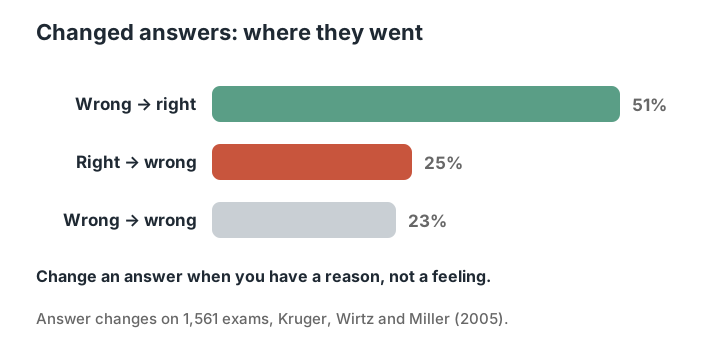
Try this: Change an answer when you have a reason: you misread the question, you remembered a fact, or another question gave you a clue. Do not change it because of a vague feeling.
Guessing: when and how
First, check the rules. If there is no penalty for wrong answers, never leave a question blank; a guess can only help.
Some exams take marks off for wrong answers, known as negative marking. A random guess usually comes out about even under these rules, but every option you can eliminate tips the odds in your favour. If you can rule out one or two options, guessing between the rest is usually worth it. If you have no idea at all, leaving it blank may be safer.
Managing your time
Running out of time costs more marks than any single hard question. Plan your pace before you start.
- Divide the time by the number of questions to get your rough time per question.
- Do a first pass, answering everything you know quickly and marking the rest.
- Do a second pass on the marked questions.
- Do not spend five minutes on a one-mark question while easy marks wait.
- Leave a few minutes at the end to check you have answered everything, and that answers on a separate sheet line up with the right numbers.
Myths about multiple-choice tests
A few popular tricks do not hold up.
- “When in doubt, pick C”: professionally written tests balance the position of correct answers. There is no reliable favourite letter.
- “The longest answer is right”: this sometimes works on poorly written tests, but well-written ones avoid it.
- “Never change your first answer”: changes based on good reasons help more often than they hurt.
- “Look for patterns in the answer letters”: runs of the same letter happen by chance.
Keep going
Common questions
What is the best strategy for multiple-choice tests?
Answer each question in your head before looking at the options, then find the matching option. If none matches, eliminate the ones you know are wrong. Mark uncertain questions and come back to them at the end.
Should I go with my first instinct on multiple choice?
Not automatically. Studies of real exams found that changed answers went from wrong to right about twice as often as from right to wrong. Change an answer when you have a clear reason.
Is C the most common answer on multiple-choice tests?
Not on well-made tests. Professional test writers balance where the correct answers fall. Picking C is no better than any other guess.
How do I study for a multiple-choice exam?
Study by recalling, with flashcards and short-answer questions, then practise with past multiple-choice questions in the real format. For each practice question, explain why every wrong option is wrong.
Should I guess on multiple-choice questions?
If wrong answers are not penalised, always guess rather than leave a blank. If they are, guess when you can eliminate at least one or two options.
How can I get faster at multiple-choice tests?
Know the material well enough to recall answers before reading options, practise under timed conditions, and use two passes: answer the easy questions first, then return to the hard ones.
Calm Study
Calm Study writes practice questions from your own notes, including multiple-choice questions with believable wrong options and written questions that make you recall. Every answer comes with why the right option is right and why the most tempting wrong one is wrong, and the weak topics come back before the real test.
References
- Butler, A. C. (2018). Multiple-choice testing in education: Are the best practices for assessment also good for learning? Journal of Applied Research in Memory and Cognition, 7(3), 323–331. https://doi.org/10.1016/j.jarmac.2018.07.002
- McDaniel, M. A., Anderson, J. L., Derbish, M. H., & Morrisette, N. (2007). Testing the testing effect in the classroom. European Journal of Cognitive Psychology, 19(4–5), 494–513. https://doi.org/10.1080/09541440701326154
- Smith, M. A., & Karpicke, J. D. (2014). Retrieval practice with short-answer, multiple-choice, and hybrid tests. Memory, 22(7), 784–802. https://doi.org/10.1080/09658211.2013.831454
- Little, J. L., Bjork, E. L., Bjork, R. A., & Angello, G. (2012). Multiple-choice tests exonerated, at least of some charges: Fostering test-induced learning and avoiding test-induced forgetting. Psychological Science, 23(11), 1337–1344. https://doi.org/10.1177/0956797612443370
- Roediger, H. L., & Marsh, E. J. (2005). The positive and negative consequences of multiple-choice testing. Journal of Experimental Psychology: Learning, Memory, and Cognition, 31(5), 1155–1159. https://doi.org/10.1037/0278-7393.31.5.1155
- Kruger, J., Wirtz, D., & Miller, D. T. (2005). Counterfactual thinking and the first instinct fallacy. Journal of Personality and Social Psychology, 88(5), 725–735. https://doi.org/10.1037/0022-3514.88.5.725
- Couchman, J. J., Miller, N. E., Zmuda, S. J., Feather, K., & Schwartzmeyer, T. (2016). The instinct fallacy: The metacognition of answering and revising during college exams. Metacognition and Learning, 11(2), 171–185. https://doi.org/10.1007/s11409-015-9140-8