How to Study for Finals: A Plan for Several Exams at Once
· 6 min read
Knowing how to study for finals is mostly about managing several exams at once. Rank your courses by date, weight, and how ready you are, build a plan backwards from the first exam, study most courses on most days, and spend your time testing yourself rather than rereading. This guide gives you a step-by-step plan, a sample two-week schedule, and finals study tips for the week itself.
Why finals are different
A single exam is a study problem. Finals are a scheduling problem. You have three to six exams, often cumulative across a whole term, packed into one or two weeks, sometimes with papers or projects due at the same time. The temptation is to study for whichever exam is next and hope the others work out.
That approach leaves the later exams crammed into the gaps between earlier ones. A better answer to how to study for finals is a plan that spreads your preparation across all of them from the start, weighted by what matters most.
Step 1: Map your finals
Make a simple table of every final: the course, date and time, how much it counts towards your grade, your current grade, and how ready you feel from one to five. Then decide a priority. A final that counts for 40% of a course you are borderline in deserves more time than one worth 15% in a course you are comfortable with.
| Course | Date | Weight | Ready (1 to 5) | Priority |
|---|---|---|---|---|
| Biology | Mon, 9am | 35% | 2 | High |
| Statistics | Wed, 2pm | 40% | 3 | High |
| History | Thu, 9am | 25% | 4 | Medium |
| Spanish | Fri, 11am | 20% | 4 | Lower |
Step 2: Gather your material early
Before you start studying, collect everything for each course: the syllabus, lecture slides and notes, any study guide or review sheet from the professor, past exams if they are available, and problem sets with solutions. Note what format each exam will take: multiple choice, short answer, problems, or essays.
Go to any review sessions and use office hours, especially for your highest-priority courses. Professors and teaching assistants often say a lot about what the final emphasises, if you ask.
Step 3: Build your finals plan backwards
Start from the date of each exam and work back. Two to three weeks out is a good time to begin structured preparation for most students, earlier for very heavy courses. Divide the time into three phases: review and fill gaps, practise with exam-style questions, and a final light review.
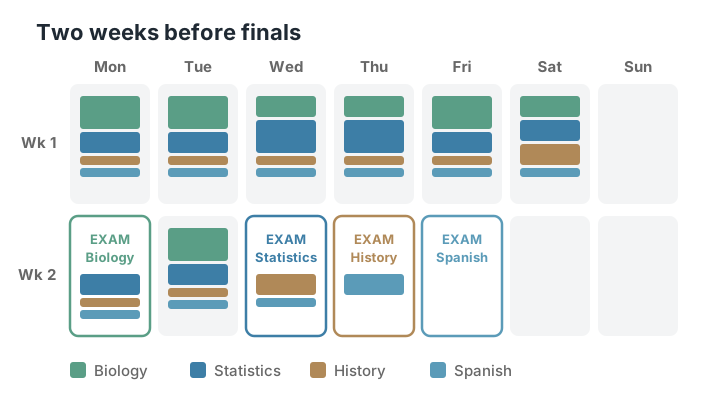
Every day should include sessions on two or three courses. The exam that is nearest or highest priority gets the largest share, but the others keep ticking over. When an exam is done, its time goes to the next ones.
Step 4: Study every course most days
It feels efficient to give each course its own day. It is not. Studying biology only on Mondays leaves a week between sessions, and by the time you return, much of it has faded. Shorter sessions on several days are more effective for memory because of spacing, and switching between courses keeps each session fresh.
A typical day in the first week might be: two hours on your top-priority course in the morning, ninety minutes on your second course in the afternoon, and forty-five minutes of flashcards across the rest in the evening.
Step 5: Test yourself in every session
Finals reward what you can recall and apply under time pressure. Each study session should be built around questions: past exams, end-of-chapter problems, practice questions you write from the syllabus, or flashcards. Read your notes only to fix what you got wrong.
For cumulative finals, start with early material, because it has had the most time to fade. Write a list of every topic on the syllabus and quiz yourself on each one; the gaps you find decide where your reading time goes. At least once per course, sit a full practice exam under timed conditions.
Try this: For each course, write the ten questions you would put on the final if you were the professor. Then answer them from memory.
How to study for final exams in two weeks
If your first final is two weeks away, here is how the time might divide for the four courses in the table above. Adjust the hours to your own day; the shape is what matters.
| Days | Biology (Mon) | Statistics (Wed) | History and Spanish |
|---|---|---|---|
| Days 1 to 4 | 2 hours: quiz every topic, list gaps | 1.5 hours: mixed problem sets | 45 minutes: flashcards for both |
| Days 5 to 8 | 2 hours: fix gaps, past exam | 1.5 hours: past exam, mistake log | 1 hour: essay plans, vocabulary |
| Days 9 to 11 | 1.5 hours: second past exam | 2 hours: timed practice exam | 1 hour: mixed review |
| Days 12 to 13 | Light review, summary sheet | 1 hour: weak problem types | 1 hour: mixed review |
| Finals week | Exam Monday | Exam Wednesday | Thursday and Friday |
How to study during finals week
Once exams begin, the plan shifts. After each exam, take a real break of an hour or two, then move straight to the next one. Do not spend the evening going over what you think you got wrong; that exam is finished.
The day before each exam is for light review: mixed questions on the whole course, a look at your list of weak spots, and a summary sheet written from memory. If you have two exams on the same day, prepare for both the day before, and use the gap between them for a short review of the second.
Finals study tips for the week itself
Small habits make a big difference when you are running several exams back to back.
- Sleep seven to nine hours. All-nighters before finals are linked with worse performance, not better.
- Eat proper meals and drink water. Long study days on snacks and caffeine wear you down.
- Check every exam’s time, room, and allowed materials. Lay out what you need the night before.
- Study somewhere with few distractions, and leave your phone in another room for each block.
- Use study groups for quizzing each other, not for rereading notes together.
- Keep a short daily walk or exercise session. It helps focus and mood.
Keep going
Common questions
When should I start studying for finals?
Two to three weeks before your first final is a good starting point for structured study, with lighter review throughout the term. If you have many finals or very cumulative courses, start earlier.
How many hours a day should I study for finals?
Four to six focused hours a day across two or three courses is plenty for most students during finals preparation. More hours with poor sleep is usually worse than fewer hours with good sleep.
How do I study for a cumulative final?
List every topic on the syllabus, quiz yourself on each, and spend most of your time on the gaps, starting with the earliest material. Finish with at least one full practice exam covering the whole course.
What should I do if two finals are on the same day?
Prepare for both in the days before, with the day before split between them. Use the break between the exams for a short review of key points for the second one, not new learning.
How do I ace a test?
Practise with exam-style questions over several days, check every miss, sit a timed practice test, and sleep well before the exam. Read each question carefully in the exam and answer the easiest ones first.
Calm Study
Calm Study is built for finals. Add every course and exam date, and its plan spreads your preparation across all of them, weighted towards the nearest exam, with quizzes, flashcards, and a mock exam for each course written from your own notes. Each exam shows as ahead, on track, or behind, so you know where the time should go.