Failing a Class in College: What Happens and What to Do Now
· 10 min read
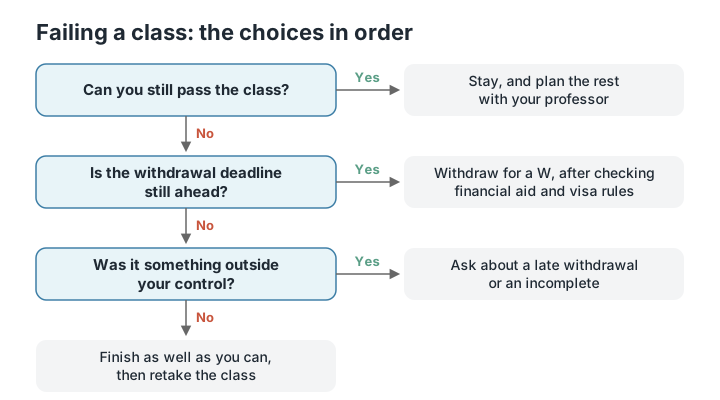
Failing a class in college is more common than it feels, and one F rarely decides anything on its own. What matters is what you do in the next few weeks. You might still be able to pass. If you can’t, withdrawing before the deadline usually does less damage than an F, though it has costs of its own, especially for financial aid. This guide goes through the choices in the order you’ll face them, along with the rules that tend to catch people out.
Check whether you’re really failing
Start with the numbers, because panic tends to round down. Get your current grade from the course page and the weight of everything still to come from the syllabus. Then work out what you need on the rest.
Say you have 52% with 70% of the course marked, and the final is worth the other 30%. To finish on 60%, the usual line for a D-, you need 78.7% on the final. That’s hard but possible. To reach a C- at 70% you’d need 112%, so that one’s off the table. Knowing which of those you’re facing changes everything that follows.
Check what passing means for this class, too. A D is a pass at most colleges, but a class for your major, or a prerequisite for the next one, may need a C or better.
Try this: Put your syllabus weights into our weighted grade calculator. It shows what you need on the remaining work for each letter grade.
Talk to your professor this week
It’s an awkward conversation, and professors have it every term. Have it in week 6, not week 14, while there’s still work left to change the outcome. Go to office hours if you can, because it’s easier to talk properly in person than over email. Bring your numbers and ask specific questions.
- Is it realistic for me to pass from here?
- Is there any work I can still hand in or redo?
- Are any low scores dropped, or can the final replace one?
- What would you focus on in the time that’s left?
Try this: Write down what they say, then send a short thank-you email that repeats it. If anything was offered, you’ll have it in writing.
Withdraw or stay: a W versus an F
If you can’t pass, the big decision is whether to withdraw. Most colleges have two deadlines. Before the drop deadline, usually in the first week or two, a class disappears from your record. After that, up to the withdrawal deadline, you get a W instead. On a 15-week semester that second deadline often falls somewhere around week 8 to 10, but your academic calendar has the real dates.
A W doesn’t touch your GPA. An F does, and badly. Take a 15-credit term where your other four classes average a 3.3. With a W in the fifth, your term GPA stays at 3.3 on 12 credits. With an F, it’s 2.64.
| W (withdraw) | F (fail) | |
|---|---|---|
| Your GPA | Not affected | 0 points on the full credits |
| Your transcript | Shows a W | Shows an F, often with a note if you retake |
| Financial aid progress | Attempted, not completed | Attempted, not completed |
| Tuition | Rarely refunded this late | Not refunded |
| Full-time status | May drop you below full time | Unchanged for this term |
Try this: Check with financial aid before you withdraw, and with your international student office or athletics department if either applies to you. Dropping below full time can matter more than the grade.
What an F does to your GPA over time
An F hurts most early on, when there are few credits for it to hide among, and it fades as you add more. A 3-credit F can pull a 3.3 term down to 2.64. By the end of a 120-credit degree with everything else at 3.3, that same F is worth less than a tenth of a point.
If your college replaces the grade when you retake the class, the F can drop out of the calculation completely, though it usually stays visible on your transcript with a note beside it. Our guide to calculating your GPA shows how to run the numbers either way.
Retaking the class
Most colleges let you retake a failed class, and if it’s required for your major, you’ll have to. What happens to the old grade depends on the college. At UC Davis, undergraduates can repeat a class they got a D+ or below in, and the new grade replaces the old one in their GPA for up to 16 units, after which both grades count. At MIT, every attempt counts in your GPA. Your registrar’s page on repeated courses will say which applies, and whether you need to file anything for the replacement to happen.
Federal aid will pay for you to retake a class you failed. The Federal Student Aid Handbook is stricter about a class you passed: you can retake a passed class once and still have it count towards your enrolment for aid like Pell Grants and Direct Loans, and “passed” means any grade above an F, even if your major wanted a C. Fail that second attempt and it still uses up your one retake.
The second attempt should look different from the first, or you’ll get a similar result.
- Retake it soon, while the material is still familiar.
- Take a lighter load that term, say 12 credits instead of 15, so this class gets real time.
- Go to office hours from the first week, not the tenth.
- Study with practice questions instead of rereading. A 2017 meta-analysis by Olusola Adesope and colleagues found that practice tests beat restudying across more than 100 studies.
Financial aid: the rules that catch people out
To keep federal aid, you have to make what’s called satisfactory academic progress, or SAP. Colleges check it at least once a year, and often every term. It has three parts, set out in federal rules at 34 CFR 668.34, and your college fills in the exact numbers.
This is why a W isn’t free. Once you’re past the add/drop period, it counts as credits attempted but not completed, exactly like an F. One example in the federal handbook describes a student who failed one class and withdrew from another in each of two semesters. Their GPA was 1.71, but they still lost aid, because they’d completed 15 of 27 credits and their college required 18.
If you fall short, your college may give you one warning term, during which you keep your aid. After that, you can usually appeal on grounds like illness, injury or a death in the family, explaining what went wrong and what has changed. A successful appeal puts you on probation for one term, sometimes with an academic plan you agree to follow.
| Part | The federal rule | What colleges often set |
|---|---|---|
| GPA | At least a C average by the end of year 2, for programs longer than 2 years | 2.0 cumulative, sometimes rising from 1.5 in year 1 |
| Pace | Colleges must set one and check it | Pass about 67% of the credits you attempt |
| Time limit | No more than 150% of the program’s length | 180 attempted credits for a 120-credit degree |
Try this: Look up your college’s satisfactory academic progress policy before grades come out. It lists the exact GPA and pace it uses, and how to appeal.
Don’t just stop going
When a class, or a whole term, goes badly, it’s tempting to stop turning up and let it run out. That’s the most expensive way out. If you finish a term with nothing but Fs, your college has to work out whether you earned them or simply stopped attending. If you stopped attending, you’re treated as having withdrawn partway through the term.
Federal aid is earned in proportion to how much of the term you were there for, up to the 60% point, which is about week 9 of a 15-week semester. Leave before that and part of your aid is unearned, so it has to go back. The college returns its share, and you can end up owing the college for charges that aid had been covering. Withdrawing properly, through the registrar, gets you Ws, a clear date, and the chance to ask about refunds.
If something outside your control caused it
Illness, a family emergency, a mental health crisis: these happen to a lot of students, and most colleges have routes for them. All of these work better before grades are final, and most need evidence, like a doctor’s note.
- An incomplete (I), if most of the work is done and the problem came late in the term. You finish the rest by an agreed date. Miss it and the I often becomes an F.
- A late or medical withdrawal, after the normal deadline. You usually apply through the dean of students or the registrar.
- A grade appeal, if you think the grade was worked out wrongly or the syllabus wasn’t followed. It isn’t for disagreeing with how hard the class was.
- Your campus counselling service, if stress has reached the point where you’re not sleeping, eating or coping. They see this every term. If you’re in crisis in the US, you can call or text 988 at any hour.
In the UK: failing a module
UK universities handle it differently. You’re usually offered a resit, often in August, and the resit mark is often capped at the pass mark, which is 40% on most undergraduate courses. Some universities will condone a narrow fail if your other marks are strong enough, letting you progress without retaking it. If illness or a crisis affected the assessment, you apply under your university’s extenuating or mitigating circumstances policy, ideally before results come out. Your university’s assessment regulations set out the details.
Stopping it happening again
Be honest with yourself about why it happened. Was it the material, the workload, or something going on outside class? Each has a different fix. If you’d stopped going to lectures, start there. A 2010 meta-analysis by Marcus Credé and colleagues found attendance was more strongly linked to college grades than SAT scores or study skills.
Then change how you study, not just how long. Testing yourself and spreading study out over weeks are the two best-supported methods there are, and our guide to getting better grades shows how to use them.
Keep going
Common questions
Is it better to fail or withdraw from a class?
Usually it’s better to withdraw, if you can no longer pass and the deadline hasn’t gone. A W leaves your GPA alone and an F doesn’t. Both count against your financial aid progress, and withdrawing can drop you below full time, so check with financial aid first.
Will failing one class ruin my GPA?
No. It hurts most in your first year, when a 3-credit F can take a 3.3 term down to about 2.6. Over a whole degree it’s worth less than a tenth of a point, and a retake may replace it.
Can I still graduate if I fail a class?
Yes. If the class is required, you retake it. If it was an elective, you can take a different one. You might need an extra term if the class is a prerequisite for others, so talk to your adviser early.
Does an F stay on your transcript?
Usually, yes, even after a retake. Where a college replaces the grade, the old one tends to stay listed with a note saying it’s excluded from your GPA.
Will I lose financial aid if I fail a class?
Usually not from a single F. Aid depends on your overall GPA and how many of your attempted credits you pass. Several Fs or Ws in a year can put you below your college’s standard, and then you get a warning or have to appeal.
What happens if I fail a class twice?
Most colleges let you try again, though some want approval first. At UC Davis, for example, taking a class for the third time needs permission in advance. Federal aid will cover retaking a class you failed. Talk to your adviser about what went wrong both times before you sign up again.
Calm Study
If a retake is coming, Calm Study can help it go differently. Upload the class notes and slides, and it writes flashcards, quizzes and mock exams from them, then plans what to do each day so you’re testing yourself from the first week.
References
- US Department of Education (2026). 2026-2027 Federal Student Aid Handbook, Volume 1, Chapter 1: School-determined requirements. https://fsapartners.ed.gov/knowledge-center/fsa-handbook/2026-2027/vol1/ch1-school-determined-requirements
- US Department of Education (2026). 2026-2027 Federal Student Aid Handbook, Volume 5, Chapter 1: General requirements for withdrawals and the return of Title IV funds. https://fsapartners.ed.gov/knowledge-center/fsa-handbook/2026-2027/vol5/ch1-general-requirements-withdrawals-and-return-title-iv-funds
- UC Davis Office of the University Registrar. Internal transcript guide: repeat notations. https://registrar.ucdavis.edu/faculty-staff/itg/repeat
- MIT Registrar’s Office. Calculating GPA: what you need to know. https://registrar.mit.edu/classes-grades-evaluations/grades/calculating-gpa
- Adesope, O. O., Trevisan, D. A., & Sundararajan, N. (2017). Rethinking the use of tests: A meta-analysis of practice testing. Review of Educational Research, 87(3), 659–701. https://doi.org/10.3102/0034654316689306
- Credé, M., Roch, S. G., & Kieszczynka, U. M. (2010). Class attendance in college: A meta-analytic review of the relationship of class attendance with grades and student characteristics. Review of Educational Research, 80(2), 272–295. https://doi.org/10.3102/0034654310362998