How to Memorize Things Fast (and Actually Keep Them)
· 7 min read
If you want to know how to memorize things fast, start by testing yourself straight away instead of reading the material over and over. Then break it into small chunks, give it meaning, and come back to it after a gap. Those steps make memorizing quicker in the moment and, more importantly, make what you learn last past the test.
Fast to learn is not the same as fast to forget
Most ways of memorizing quickly work in the short term. Repeating something over and over can hold it for an hour. The trouble is that the same methods that feel fastest often fade fastest. Cramming is the classic example: it can get you through a test tomorrow, but most of it is gone a week later.
The good news is that the methods that make memories durable are also efficient. You do not have to trade speed for retention. You just have to stop doing the things that feel productive but are not, mainly rereading, and start doing the things that feel harder but are.
Test yourself from the first minute
The fastest way to memorize something is to try to recall it as soon as you have seen it once. Read the definition, cover it, say it. Look at the list, close it, write it down. Then check, and try again on what you missed.
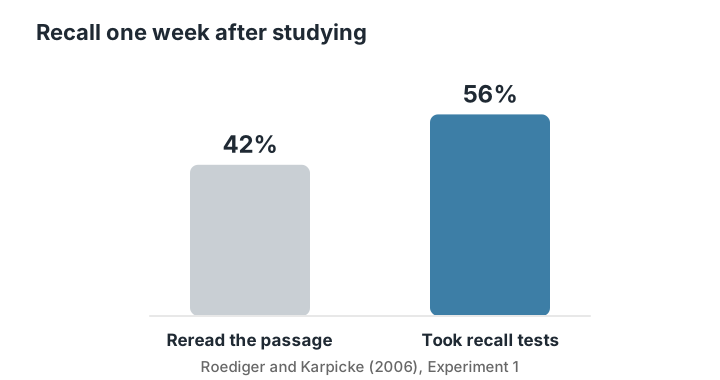
In a well-known 2006 experiment, Roediger and Karpicke had students either reread a passage or take recall tests on it. A week later, the students who had tested themselves remembered 56% of the passage, against 42% for those who reread it. In a later study with foreign vocabulary, students who kept testing themselves on words they had already learned remembered roughly 80% a week later, while those who stopped testing remembered around 35%.
Break it into chunks
Your working memory, the part that holds things while you use them, can handle only a few items at once. Modern estimates put it at around four meaningful chunks. That is why a phone number is written in groups and not as one long string of digits.
Use the same trick on anything you need to memorize. Split a list of twelve items into three groups of four, ideally grouped by something they share. Learn one group until you can recall it, then the next, then recall all of them together. A chunk can be a single fact or a whole familiar pattern, so the more you know about a subject, the larger your chunks become.
Give it meaning
Information that means something to you is far easier to memorize than information that does not. Before trying to memorize a fact, ask why it is true, how it connects to something you already know, or where you have seen an example of it.
This is called elaboration. A date in history is hard to hold on its own, but easy if you know what caused the event and what it led to. A biological process is easier to remember as a story of what happens and why than as a list of stages. When you understand the structure, each piece reminds you of the next.
Use a mnemonic for arbitrary lists
Some things have no meaning to hold on to: the order of the planets, the cranial nerves, a sequence of steps. For these, memorization techniques called mnemonics give the information a structure it does not naturally have.
- Acronyms and first-letter sentences: one word or phrase whose letters stand for the items.
- The keyword method: link a foreign word to a similar-sounding word and a vivid image.
- The memory palace: place each item at a point along a route you know well.
- Rhymes and rhythm: why song lyrics stick so well.
- Chunked number patterns: turn digits into dates, ages, or other familiar numbers.
Try this: Mnemonics get information in fast, but they still need recall practice. Test yourself on the list, not just the mnemonic.
Space your repetitions
Repetition works, but not all at once. Recall something three times in a row and it will feel solid, but much of that is short-term. Recall it once now, again tomorrow, and again in a few days, and it will last far longer, even though the total time is the same.
Researchers call one version of this successive relearning: in your first session, keep testing until you get each item right, then come back in later sessions and relearn it to the same standard. Each later session is quicker because less has been forgotten.
Sleep on it
Memories are consolidated during sleep. Material learned in the evening and followed by a full night’s sleep is often better retained than material learned in the morning and followed by a busy day. Staying up late to memorize more usually backfires: you lose the consolidation that makes the earlier work stick.
A useful pattern is a short recall session in the evening, sleep, then a quick recall session the next morning to see what held.
How to memorize things fast for an exam
Exams add a complication: you need to memorize a lot of material, not one list, and recall it under pressure weeks later. The techniques are the same, but the scale changes how you use them. Start by listing what actually needs to be memorized word for word, such as definitions, formulas, key quotes, and dates, and what only needs to be understood. The second group does not need flashcards; it needs explanation and practice questions.
For the first group, make one card or line per item and work through them in small daily batches. Each day, start with the items you missed yesterday, then add a few new ones. In the final week, switch from learning new items to mixed recall of everything, so you practise pulling each one out without the others around it as clues.
If you are short of time, prioritise. Memorizing quickly is easier when you are not trying to memorize everything. Focus on the items most likely to be examined and the ones you keep getting wrong.
A 20-minute routine to memorize something fast
Use this when you have a specific set of information, such as definitions, a list, a formula sheet, or key quotes, and limited time.
- Minutes 0 to 3: read the whole set once and split it into chunks of three or four.
- Minutes 3 to 10: for each chunk, read it, cover it, recall it out loud, then check.
- Minutes 10 to 15: add a mnemonic or a “because” sentence to anything that will not stick.
- Minutes 15 to 20: recall the whole set from a blank page and mark what you missed.
- Later that day and tomorrow morning: one quick blank-page recall each time.
Common questions
How many times do you have to repeat something to memorize it?
There is no fixed number. A good rule is to keep recalling it until you get it right once, then recall it again in at least two or three later sessions spread over days. Correct recalls on separate days matter more than the number of repeats in one sitting.
Is it possible to improve your memory?
You can improve how well you remember things by using better methods: self-testing, spacing, chunking, and sleep. Brain-training games show little evidence of improving everyday memory, but good study techniques reliably do.
What is the 7-3-2-1 method of memorization?
It is usually described as a countdown review schedule: go over the material seven days, three days, two days, and one day before a test. It is spaced review squeezed into a week. It works for a short deadline, but starting earlier with wider gaps holds for longer.
What are the best memorization techniques?
Self-testing and spaced review are the most reliable for almost everything. Chunking helps with long lists, mnemonics help with arbitrary sequences, and explaining why something is true helps with anything you need to understand rather than just recite.
How can I memorize faster without forgetting?
Recall it instead of rereading it, then recall it again after a gap. Speed comes from active recall; staying power comes from the gap. Skipping the second recall is the main reason quickly memorized material disappears.
How can I memorize something in five minutes?
Split it into small chunks, recall each chunk aloud with the source covered, and finish by writing the whole thing from memory. Then recall it once more later that day. Five minutes can get it in, but only a later recall keeps it.
Calm Study
Calm Study does the setup for fast memorizing. It turns your notes into short flashcards and questions, quizzes you before you see the answer, and brings back the ones you miss on later days, so what you memorize quickly is still there in the exam.