Finals Week: A Day-by-Day Survival Guide
· 7 min read
Finals week is a triage problem. You have a fixed number of hours and more to cover than will fit, so the students who come through it best tend to be the ones who decide early where each hour goes, then sleep enough to use what they know. This guide is for the week itself: how to rank your exams, what each day should look like, and what to do when two finals land back to back. If you still have a few weeks, start with our longer guide on how to study for finals.
Start with a 30-minute map
Before you open a single set of notes, get everything onto one page. A lot of finals panic comes from not knowing how bad things are, and it’s usually less bad once it’s written down.
- Date, time and room for every exam. Rooms change, so use the official schedule and not your syllabus.
- The format: multiple choice, short answer, essay, or a mix.
- What each final is worth, and your grade going in.
- Whether it’s cumulative, and whether you’re allowed a sheet of notes.
Try this: Run each class through our free final grade calculator now. Knowing you need a 64 to keep your B changes how you spend the week.
Decide where your hours go
Your exams don’t all deserve the same time. A final worth 35% in a class where you’re sitting on the edge of a B matters more this week than a final worth 15% in a class you’re acing. With four classes, it might look like this.
| Class | Going in | Final worth | How much time |
|---|---|---|---|
| Statistics | 79% | 35% | The most. A few marks decide the letter. |
| Biology | 91% | 30% | Steady. Enough to hold the A. |
| History | 84% | 25% | Some. Essay plans, no rereading. |
| Elective | 95% | 15% | The least. An 80 on the final still leaves you above 92. |
What each day should look like
A good day in finals week is shorter than you’d think. Three or four focused blocks on two different classes will get you further than ten hours in the library with your phone on the table. Something like this works for most people:
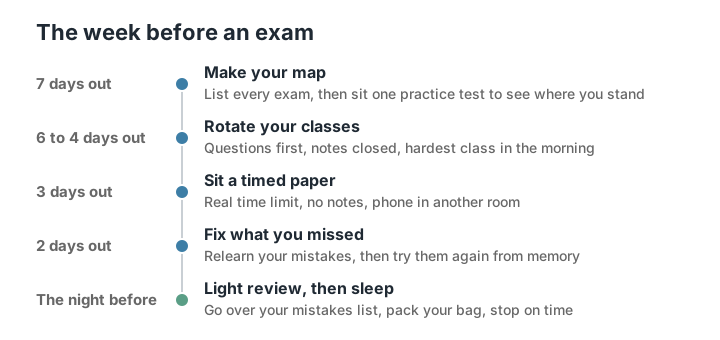
- 9:00 to 10:30: your hardest class. Practice questions, with your notes closed.
- 10:30 to 11:00: walk, eat, leave your phone behind.
- 11:00 to 12:30: same class. Look up what you missed, then try again from memory.
- 2:00 to 3:30: your second class, same pattern.
- 4:00 to 5:00: mixed questions from earlier in the week.
- Evening: one light hour at most, then stop at a set time.
Study with questions
Rereading feels calm, and that’s the problem with it. It makes the page look familiar without showing you what you can do on your own. A 2017 meta-analysis by Olusola Adesope and colleagues found that practice testing beat restudying across more than a hundred studies, and the gap holds up in real classes as well as labs.
You don’t need much to start. Try last year’s exam if your department shares it, then your professor’s review sheet, the end-of-chapter questions, and any old quizzes. No questions at all? Write the headings from your syllabus on a blank page and fill in everything you can remember. The empty parts are your to-do list.
Sleep is part of the plan
When a week gets tight, sleep is the first thing students cut, and it’s usually a bad trade. In a 2013 study of high school students by Cari Gillen-O’Neel and colleagues, nights of extra studying at the expense of sleep were followed by more academic problems the next day. A 2007 brain imaging study by Seung-Schik Yoo and colleagues found that one night without sleep sharply reduced people’s ability to form new memories.
Pick a stop time at the start of the week and stick to it. If you need more hours, take them from the evening scroll, because those aren’t hours you were using anyway.
And if nerves keep you awake the night before an exam, try not to spiral. In a 2019 study of MIT chemistry students, Kana Okano and colleagues found that sleep over the weeks before exams lined up with grades, while the single night before didn’t.
Food, coffee and moving around
None of this will raise your grade by itself, but all of it can drag you down if you ignore it. Eat real meals at normal times, and keep some water nearby. Stick to your usual amount of coffee, particularly on exam mornings, when your nerves are already doing the same job. A ten-minute walk between blocks does more for your focus than another scroll through your phone.
Our guides to brain food for studying and to staying awake while studying go into more detail if you need them.
When finals land back to back
Two exams in a day is rough, but it’s manageable if you plan for it a few days out.
- Do most of the work for the later exam before the earlier one. There won’t be time in between.
- Between the two, eat something and look only at a short list of what you always forget.
- Don’t talk through the first exam in the corridor. You can’t change it now, and it’ll eat into the next one.
- If you have three in 24 hours, ask your registrar. Some colleges let you move one.
If you’re seriously behind
Forget about covering everything. Find the topics that came up most in class, in review sessions and on old exams, and learn those well enough to answer a question on them. Partial knowledge of the whole course tends to score worse than solid knowledge of the most likely 60%.
Go to any review session that’s still running, and go to office hours with specific questions. If illness or something outside your control has knocked you off course, talk to your dean of students before the exam, while there’s still time to arrange something. Afterwards is usually too late.
If stress has stopped you sleeping or eating for days, or you feel you can’t cope, your campus counselling service is there for exactly this. They expect to be busy in finals week, and nobody will think it’s an overreaction.
On the morning, and after
Eat your normal breakfast and get there early. Avoid the group going over answers outside the door, because it won’t teach you anything now and it can rattle you. If you’re a nervous test-taker, try writing down exactly what you’re worried about for ten minutes beforehand. In a 2011 study, Gerardo Ramirez and Sian Beilock found that this simple exercise improved exam scores among anxious students.
Once it’s over, it’s over. Eat something, take a real break for an hour, and start on the next one.
Keep going
Common questions
When is finals week?
Usually the last week of term. At most US colleges on a semester system, that means mid-December and early May. Your registrar publishes the exact schedule, and it often differs from your normal class times.
How many hours a day should I study during finals week?
Five to seven focused hours is plenty for most people, split into blocks with real breaks. Past that, most of what you do is poorly remembered, and it starts cutting into your sleep.
Should I pull an all-nighter during finals?
Almost never. You’d sit the exam tired and remember less of what you studied. Even if you’re behind, a few hours of sleep will serve you better than none.
What should I do the night before a final?
Go through your list of mistakes, pack your bag, check the time and room, and stop at your normal time. Don’t try to learn anything new that evening.
How do I study for finals when I have no time?
Work out what each final is worth and what you need on it, spend your time on the classes where it changes your grade, and study with practice questions on the topics most likely to come up.
What if I have two finals on the same day?
Do most of the work for the second exam before the first one. Between the two, eat and review only a short list. If you have three in 24 hours, ask your registrar whether one can be moved.
Calm Study
Add your exam dates and Calm Study plans what to study each day from your own notes, with flashcards, quizzes and a mock for each class. In finals week, that saves you the hour you’d spend working out where to start.
References
- Adesope, O. O., Trevisan, D. A., & Sundararajan, N. (2017). Rethinking the use of tests: A meta-analysis of practice testing. Review of Educational Research, 87(3), 659–701. https://doi.org/10.3102/0034654316689306
- Gillen-O’Neel, C., Huynh, V. W., & Fuligni, A. J. (2013). To study or to sleep? The academic costs of extra studying at the expense of sleep. Child Development, 84(1), 133–142. https://doi.org/10.1111/j.1467-8624.2012.01834.x
- Yoo, S.-S., Hu, P. T., Gujar, N., Jolesz, F. A., & Walker, M. P. (2007). A deficit in the ability to form new human memories without sleep. Nature Neuroscience, 10(3), 385–392. https://doi.org/10.1038/nn1851
- Okano, K., Kaczmarzyk, J. R., Dave, N., Gabrieli, J. D. E., & Grossman, J. C. (2019). Sleep quality, duration, and consistency are associated with better academic performance in college students. npj Science of Learning, 4, 16. https://doi.org/10.1038/s41539-019-0055-z
- Ramirez, G., & Beilock, S. L. (2011). Writing about testing worries boosts exam performance in the classroom. Science, 331(6014), 211–213. https://doi.org/10.1126/science.1199427