How to Create a Study Schedule You Will Actually Keep
· 6 min read
Knowing how to create a study schedule that works comes down to a few steps: start from your exam dates, count the hours you really have, and give each subject short, fixed slots spread across the week. Then decide in advance what each slot is for, so you never sit down wondering where to start. This guide walks through the six steps and includes a revision timetable template you can copy.
What a good study schedule does
A study schedule has one main job: to remove the daily decision about what to study. That decision takes more time and energy than most students realise. Without a plan, an evening can disappear into choosing a subject, gathering materials, and wondering whether it is the right one.
A good schedule also builds in the two study habits with the most evidence behind them. It spreads each subject across several days, which is spaced practice, and it plans for testing yourself, not just reading. And it is realistic. A timetable that assumes six focused hours every evening will be abandoned by Wednesday.
Step 1: List every exam and deadline
Write down every exam and major deadline with its date, how much it counts towards your grade, and the topics it covers. Use the course syllabus or exam specification, not memory. This list is the foundation of everything else.
Next to each, note how confident you feel, from one to five. A heavily weighted exam in a subject you find hard needs more time than a lightly weighted one you are already good at. You are not deciding the schedule yet, only gathering what it must account for.
Step 2: Count the time you actually have
Draw a weekly grid and block out everything fixed: classes, work shifts, travel, sport, meals, and sleep. What is left is the time you can study. Be honest. If you are always exhausted after a late shift, that evening is not study time.
Most students find they have less free time than they thought, which is useful to know now rather than in the week before the exam. During term, two to three hours of independent study on a weekday is a solid target for most. In exam season, four to six hours a day across several blocks is plenty.
Step 3: Choose fixed study slots
Pick specific times in your grid for study, and keep them the same each week where you can. “Tuesday 4 to 5pm” is easier to stick to than “some time on Tuesday”. Make each slot 25 to 50 minutes, with a short break between slots.
Put your hardest subject in the time of day you focus best. For many people that is the morning or straight after classes. Save lighter tasks, such as flashcard reviews or listening to notes, for low-energy times like the evening or travel.
Try this: Treat a study slot like a class: it is in your calendar, it has a start time, and you show up.
Step 4: Spread every subject across the week
A common mistake is to give each subject its own day: Monday is maths, Tuesday is history. This leaves six days between sessions on each subject, which is too long early on and gives you no practice switching between subjects as you will in exams.
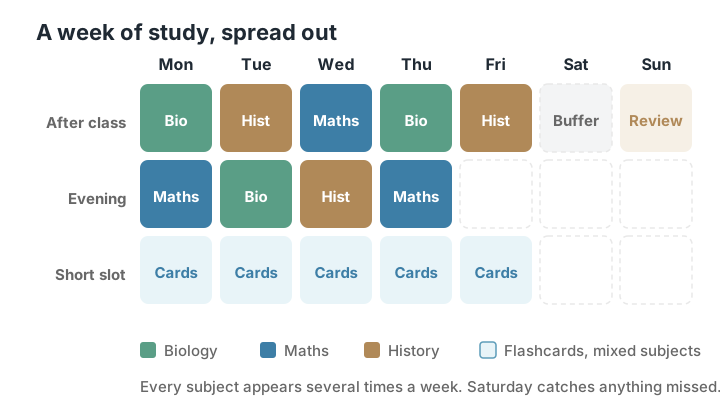
Instead, give each subject two to four shorter slots spread through the week. Studying several subjects a day also makes the week more varied and easier to sustain. The subject with the nearest or heaviest exam gets more slots, but every subject appears at least twice.
Step 5: Decide what each slot is for
A slot labelled “chemistry” still leaves you deciding what to do when you sit down. Name the task instead: “chemistry: quiz on bonding, then fix misses” or “history: timed essay plan on causes of the war”. When the slot starts, you start.
Most slots should involve testing yourself: flashcards, practice questions, blurting a topic, or a past-paper section. Reading new material is fine early on, but keep it to a minority of your slots, and follow each reading slot with a recall slot on a later day.
Step 6: Work back from the exam date
What you do in each slot should change as the exam gets closer. Work backwards from the date and divide the time into phases.
| Time before exam | Focus | Typical slot |
|---|---|---|
| 8+ weeks | Learn and understand each topic | Read, make questions, short quiz |
| 8 to 4 weeks | Spaced recall on everything learned | Flashcards and mixed questions |
| 4 to 2 weeks | Practice papers and fixing weak spots | Timed paper, then mark and fix |
| Final 2 weeks | Mixed review, weak topics first | Short mixed quizzes and a final mock |
| Last 2 days | Light review and rest | Quick recall of key points, early night |
A revision timetable template
Here is a simple weekly study timetable for a student with three exams during term. Swap in your subjects and adjust the slots to your fixed commitments.
| Day | After classes | Evening | Short slot |
|---|---|---|---|
| Monday | Biology: new topic and questions | Maths: mixed problems | Flashcards, 15 minutes |
| Tuesday | History: essay plan from memory | Biology: recall Monday’s topic | Flashcards, 15 minutes |
| Wednesday | Maths: new method, worked examples | History: key dates quiz | Flashcards, 15 minutes |
| Thursday | Biology: past-paper questions | Maths: recall Wednesday’s method | Flashcards, 15 minutes |
| Friday | History: source questions | Free | Flashcards, 15 minutes |
| Saturday | Buffer: catch up on anything missed | Free | Optional |
| Sunday | Review the week and plan the next | Free | None |
How to keep to your schedule
Plans fail in predictable ways. A missed slot leads to doubling up the next day, which leads to an overloaded evening, which leads to skipping it altogether. Prevent this with a buffer slot each week. If you miss a slot, move that task to the buffer instead of stacking it onto tomorrow.
Each Sunday, spend ten minutes looking back at the week. What got done? What did a quiz show you are weak on? Adjust the next week to match. A study schedule is a draft that improves each week, not a contract you signed in September.
- Tick off each slot when it is done. Seeing progress helps.
- Keep your materials ready, so starting takes seconds.
- Protect sleep. Never schedule study in the hours you need for it.
- If a whole week falls apart, restart from the next day. Do not try to make it all up.
Common questions
How do I make a revision timetable for GCSEs or A-levels?
List each subject, its exam dates, and its spec points. Block out school and fixed commitments, then give each subject two to four short slots a week, more for subjects with earlier or harder exams. Name the spec point and the task in each slot, and move to past papers in the final month.
Is it better to study one subject a day or several?
Several. Studying each subject in shorter blocks across the week spaces your practice and keeps each subject fresh. One subject per day leaves long gaps between sessions.
When should I start my study schedule?
As early as you can, ideally from the start of term with light sessions. For final exams, a structured schedule should start at least six to eight weeks out. Starting earlier means each day can be shorter.
What should I do if I fall behind my schedule?
Use your buffer slot, then cut low-priority topics rather than adding hours. If you are consistently behind, the plan is too ambitious; reduce it to what you can keep.
How many hours a day should a study schedule include?
Two to three hours of independent study on a school or university day is a realistic target for most students, and four to six in exam season, split into blocks. Quality matters more than hours.
Calm Study
Calm Study writes your study schedule for you. Add your classes and exam dates and it builds a plan from your own notes, names each day’s tasks, moves from learning to spaced review to mock exams as the dates get closer, and shows whether each exam is ahead, on track, or behind.