Casper Test: Format, Scoring and How to Prepare (2026)
· 4 min read
Casper is an online situational judgement test that many medical, nursing, teaching and other professional programmes ask applicants to take. Since the 2025/26 cycle it has 11 scenarios, 4 answered on video and 7 typed, and takes about 65 to 85 minutes. Trained human raters score your answers, and you get a quartile rather than a number. There are no facts to learn, but the format rewards practice. Here’s what to expect and how to prepare.
What is the Casper test?
Casper is run by Acuity Insights. It’s an open-response situational judgement test: you see a short scenario, then explain what you would do and why. It’s designed to show social intelligence and professionalism, which Acuity breaks down into collaboration, communication, empathy, ethics, fairness, motivation, problem solving, resilience and self-awareness.
Programmes in medicine, nursing, teaching and other professional fields use it, mainly in Canada, the US and Australia. Each programme decides how much weight to give it, so check what yours says.
The Casper format
The standard test is in two parts, with two optional breaks.
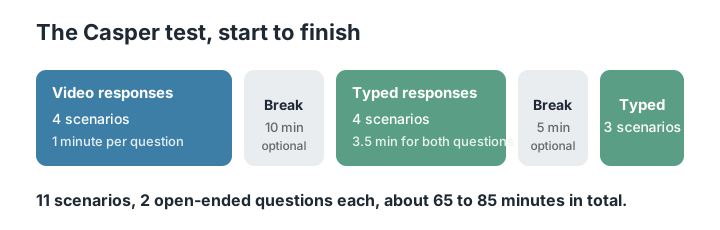
- Video responses: 4 scenarios with 2 open-ended questions each. You record a 1-minute answer to each question.
- Typed responses: 7 scenarios with 2 questions shown together, and 3.5 minutes to answer both.
- Some programmes, including Australian teacher education programmes, use a shorter version.
How Casper is scored
Certified human raters score Casper, and Acuity says it doesn’t use AI to rate answers. Each scenario goes to a different rater, who sees your responses without your name. The ratings are averaged and then standardised against everyone who sat the same test, so your result shows where you stand relative to them.
You receive that result as a quartile, from first to fourth, a few weeks after the test, and the programmes you chose receive your score directly. Because it’s relative, there’s no pass mark to aim for. A third or fourth quartile means you did better than at least half of that sitting.
What a strong answer does
Take a scenario like this one: you’re in a group project, one teammate hasn’t replied for a week, and it’s due on Friday. A weak answer jumps straight to a verdict, like reporting them to the tutor. A stronger one shows its reasoning.
- Find out what’s going on before judging. They may be ill or dealing with something at home.
- Think about everyone affected: the teammate, the rest of the group, and the quality of the work.
- Say what you’d do first and why, like messaging them privately and offering to split their part.
- Say what you’d do if that didn’t work, like agreeing a plan with the group and letting the tutor know early.
- Be honest about the trade-off, such as fairness to the group against kindness to one person.
How to prepare in the last two weeks
There’s nothing to revise, so preparation is about format, timing and habits of thought.
- Take the official practice test as soon as you’ve booked, then again a few days before.
- Time your typing. At 40 words a minute, 3.5 minutes is about 140 words across both answers, so aim for three or four clear sentences each.
- Practise 1-minute video answers with your phone’s timer, saying your first step within 15 seconds.
- Use a simple shape for every answer: what’s happening, who’s affected, what you’d do first, and why.
- Read a news story or a dilemma each day and ask how each person in it sees the situation.
- The day before, check your webcam, microphone, internet and ID, and find a quiet room.
Try this: Don’t memorise model answers. Raters see scenario after scenario, and a script that doesn’t quite fit the question reads worse than a plain, honest answer that does.
Common mistakes
Most lost marks come from a few habits.
- Spending all 3.5 minutes on the first question and rushing the second.
- Choosing an extreme action, like quitting or reporting someone, before gathering information.
- Answering only for yourself and leaving out everyone else in the scenario.
- Describing the ideal of your profession instead of what you’d actually do.
Keep going
Common questions
How long is the Casper test?
About 65 to 85 minutes in its standard form, including two optional breaks. It has 11 scenarios.
How is Casper scored?
Trained human raters score each scenario, a different rater for each. Scores are standardised against others who sat the same test, and you receive a quartile.
Can you study for Casper?
Not in the usual sense, because there’s no content to learn. You can practise the format, the timing, and explaining your reasoning clearly.
What is a good Casper score?
A third or fourth quartile puts you in the top half of your sitting. Programmes use Casper in different ways, so a good score for one may weigh less at another.
How much does Casper cost?
It depends on your programme. You’ll see the fee when you reserve a test, fees aren’t refundable, and Acuity runs a fee assistance programme.
Calm Study
Casper is one part of an application with plenty of revision around it. If you’re also preparing for the MCAT or your final exams, Calm Study turns your notes into a day-by-day plan, flashcards and mock exams, so the rest of your preparation runs on its own.
References
- Acuity Insights. About Casper. https://acuityinsights.app/casper/
- Acuity Insights. Understanding Casper: How are Casper tests rated? https://acuityinsights.com/understanding-casper-test-rating/
- Acuity Insights. 2025/26 changes to the Casper test. https://acuityinsights.app/2025-26-changes-to-the-casper-test/