Learning Styles: Are They Real? What the Research Says
· 7 min read
Learning styles are the idea that each person learns best in one mode, usually visual, auditory, reading and writing, or kinesthetic, and that teaching or studying in your style improves learning. It is one of the most popular beliefs in education. It is also one of the most tested, and the evidence does not support it: people have real preferences, but matching study to those preferences does not make them remember more. Here are the types of learning styles, what the studies found, and what works for everyone instead.
What are learning styles?
A learning style is a supposed preferred way of taking in information. The idea has two parts. First, that people can be sorted into types, such as visual or auditory learners. Second, that people learn more when teaching or study matches their type. The second part is called the meshing hypothesis, and it is the part that matters for how you study.
There is not one theory of learning styles but dozens of competing models. Some sort people by the senses (visual, auditory, kinesthetic). Some sort them by personality-like traits, such as reflective or active, or by preferring the big picture or the details. The model most students meet is VARK.
The types of learning styles
VARK was developed by Neil Fleming, a teacher in New Zealand, and described in a 1992 paper with Colleen Mills. Interestingly, the authors presented it as a tool to get students reflecting on how they learn, not as a fixed diagnosis.
| Style | What it claims | Typical advice |
|---|---|---|
| Visual | You learn best from images and diagrams | Use charts, colour coding, and mind maps |
| Auditory | You learn best by listening and speaking | Listen to lectures, discuss, read aloud |
| Reading and writing | You learn best from text | Read, take written notes, rewrite lists |
| Kinesthetic | You learn best by doing and moving | Use hands-on activities and real examples |
How popular the idea is
Belief in learning styles is close to universal. In a 2012 survey of teachers by Sanne Dekker and colleagues, 93% of teachers in the UK and 96% in the Netherlands agreed that people learn better when they receive information in their preferred learning style.
A 2020 systematic review by Philip Newton and Atharva Salvi pooled surveys from around the world and found that about 89% of educators believed in matching teaching to learning styles. Many students have been told their style at school, and plenty of study advice online is still organised around it.
What the research says
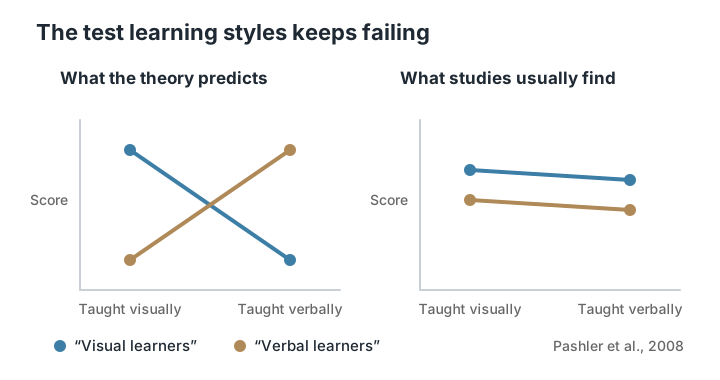
In 2008, four leading learning scientists, Harold Pashler, Mark McDaniel, Doug Rohrer, and Robert Bjork, reviewed the evidence for the journal Psychological Science in the Public Interest. They set out what a fair test would look like. You would sort people by style, teach each group in both styles, and look for a crossover: visual learners doing better with visual teaching, and verbal learners doing better with verbal teaching.
They found that very few studies had used this design, and those that had mostly did not find the crossover. Their conclusion was that there was no adequate evidence to justify basing education on learning styles.
The studies since
Later studies tested the idea directly and came to the same answer.
- Rogowsky, Calhoun, and Tallal (2015) sorted adults into visual and auditory learners and gave them a passage to read or listen to. Matching style to format made no difference to comprehension.
- Knoll and colleagues (2017) found that people’s learning style predicted how well they thought they had learned, but not how well they actually did.
- Husmann and O’Loughlin (2019) followed 426 undergraduate anatomy students. Most did not study in line with their VARK results, and those who did scored no better.
- Cuevas (2015) reviewed the newer research and found no stronger case for learning styles than in 2008.
Why learning styles feel true
If the evidence is so weak, why does the idea feel so right? Partly because some of it is true. People do have preferences, and enjoying a method makes you more likely to use it. People also differ in abilities: some are better at spatial reasoning, others at verbal tasks. But ability is not style, and a strong visual thinker still learns words best from words.
Another reason is that some material is naturally visual, auditory, or physical. Geography needs maps, pronunciation needs sound, and a lab technique needs your hands. Matching the format to the material helps everyone. That is easily mistaken for matching it to the person.
Finally, learning style quizzes feel accurate because their results are flattering and broad. Almost anyone can recognise themselves in “you like to see the big picture”.
Does believing in learning styles do any harm?
Mostly the harm is in wasted effort and missed opportunities. Time spent turning notes into colourful posters “because I am a visual learner” is time not spent testing yourself. Students who decide they are “not reading people” may avoid textbooks they need. And a label can turn into a limit: a student told they learn by doing may decide lectures are simply not for them.
Newton and Salvi pointed out that teachers also spend time designing different versions of lessons for different styles. That effort could go into methods with strong evidence behind them.
What works for everyone instead
The good news is that the methods with the strongest evidence work regardless of preference.
- Match the method to the material: maps for geography, audio for pronunciation, practice problems for maths.
- Combine words and pictures for everyone. Dual coding, pairing a diagram with an explanation, helps all learners.
- Test yourself instead of rereading. Retrieval practice is one of the best-supported methods in learning research.
- Spread your study over several days rather than cramming it into one.
- Ask why things are true, and explain topics in your own words.
Use your preferences, but add testing
Preferences are not useless. They can make studying more enjoyable, and anything that gets you started has value. The key is to add an active step to whatever format you like.
If you like listening, listen to a recording and then answer questions on it without replaying. If you like diagrams, draw them from memory instead of copying them. If you like moving, walk while you quiz yourself aloud. The format can be yours; the recall is what makes it stick.
Try this: Want to know what works for you? Study two similar topics two different ways, test yourself on both three days later, and compare the scores, not the feelings.
Common questions
What are the 4 types of learning styles?
In the VARK model, they are visual, auditory, reading and writing, and kinesthetic. Other models use different categories, such as active and reflective learners.
Are learning styles a myth?
The idea that you learn more when teaching matches your style is not supported by the research. People do have preferences, but careful studies have not found that matching them improves learning.
What is the VARK model?
A questionnaire created by Neil Fleming that sorts people by their preferred ways of taking in information: visual, auditory, reading and writing, and kinesthetic. It was designed to prompt reflection on learning.
How do I find out my learning style?
A quiz can tell you your preferences, but not how you learn best. A better test is to try methods like self-testing and spacing on real material, then compare your scores a few days later.
Why do teachers still talk about learning styles?
The idea is intuitive, widely taught in teacher training for years, and contains a grain of truth: varied, multi-sensory teaching often helps. That benefit comes from matching the material and engaging everyone, not from matching styles.
Is it wrong to say I am a visual learner?
Saying you prefer visuals is fine. The risk is in using it as a reason to avoid reading or testing yourself. Everyone benefits from pictures with words, and everyone benefits from recall.
Calm Study
Calm Study does not ask what kind of learner you are. It uses methods that work for everyone, built from your own notes: flashcards and quizzes that make you recall, a plan that spaces each topic out, and audio versions of your notes for when listening is the only option.
References
- Pashler, H., McDaniel, M., Rohrer, D., & Bjork, R. (2008). Learning styles: Concepts and evidence. Psychological Science in the Public Interest, 9(3), 105–119. https://doi.org/10.1111/j.1539-6053.2009.01038.x
- Fleming, N. D., & Mills, C. (1992). Not another inventory, rather a catalyst for reflection. To Improve the Academy, 11(1), 137–155. https://doi.org/10.1002/j.2334-4822.1992.tb00213.x
- Dekker, S., Lee, N. C., Howard-Jones, P., & Jolles, J. (2012). Neuromyths in education: Prevalence and predictors of misconceptions among teachers. Frontiers in Psychology, 3, 429. https://doi.org/10.3389/fpsyg.2012.00429
- Newton, P. M., & Salvi, A. (2020). How common is belief in the learning styles neuromyth, and does it matter? A pragmatic systematic review. Frontiers in Education, 5, 602451. https://doi.org/10.3389/feduc.2020.602451
- Rogowsky, B. A., Calhoun, B. M., & Tallal, P. (2015). Matching learning style to instructional method: Effects on comprehension. Journal of Educational Psychology, 107(1), 64–78. https://doi.org/10.1037/a0037478
- Knoll, A. R., Otani, H., Skeel, R. L., & Van Horn, K. R. (2017). Learning style, judgements of learning, and learning of verbal and visual information. British Journal of Psychology, 108(3), 544–563. https://doi.org/10.1111/bjop.12214
- Husmann, P. R., & O’Loughlin, V. D. (2019). Another nail in the coffin for learning styles? Disparities among undergraduate anatomy students’ study strategies, class performance, and reported VARK learning styles. Anatomical Sciences Education, 12(1), 6–19. https://doi.org/10.1002/ase.1777
- Cuevas, J. (2015). Is learning styles-based instruction effective? A comprehensive analysis of recent research on learning styles. Theory and Research in Education, 13(3), 308–333. https://doi.org/10.1177/1477878515606621