Dual Coding: How to Combine Words and Visuals to Learn
· 6 min read
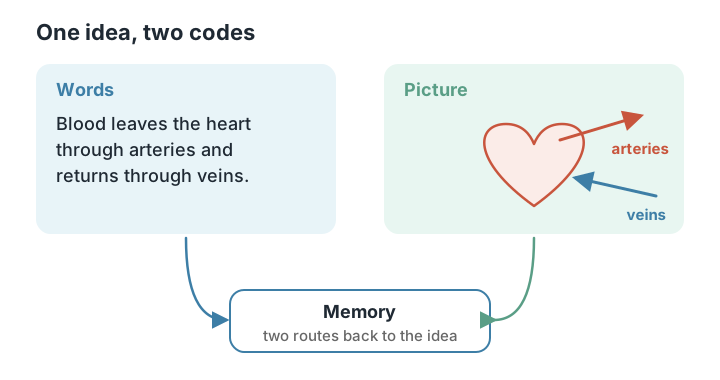
Dual coding is a learning strategy where you combine words with visuals, such as diagrams, timelines, flow charts, or simple drawings, to represent the same idea in two ways. It is based on the idea that we process verbal and visual information through partly separate channels, so pairing them gives you two routes back to the memory. It works for every student, not just those who think of themselves as visual learners.
What is dual coding?
Dual coding means representing information in both words and images. A labelled diagram of the heart with a short explanation of blood flow is dual coded. So is a timeline of events with a sentence on each, or a flow chart of a process with arrows and labels.
The important word is combine. A decorative picture beside a paragraph is not dual coding. The visual and the words need to show the same information in different forms, so that each one helps you understand and recall the other.
Dual coding theory in plain words
The Canadian psychologist Allan Paivio proposed dual coding theory in his 1971 book Imagery and Verbal Processes. He argued that the mind has two connected systems: one for language and one for images. Concrete words like “apple” activate both, because you can picture an apple. Abstract words like “justice” mostly activate one.
This explains a long-known finding: concrete words and pictures are generally remembered better than abstract words. When information is stored in both systems, there are two ways to retrieve it. If one route fails, the other may still work.
What the research shows
Two lines of research support dual coding. The first is the picture superiority effect: in memory experiments, people tend to remember pictures better than the equivalent words, and concrete words better than abstract ones. That fits Paivio’s idea that information stored in two forms is easier to retrieve.
The second comes from Richard Mayer’s work on multimedia learning. Across many experiments, Mayer and colleagues found that people learn more deeply from words and relevant pictures together than from words alone, especially when the two are placed close to each other and explain the same thing. They called this the multimedia principle. Dual coding is now one of the six strategies for effective learning promoted by the Learning Scientists, a group of cognitive psychologists who translate this research for teachers and students.
Dual coding is not learning styles
Dual coding is often confused with the idea of visual learners. They are very different. Learning styles theory claims each person learns best in one preferred mode and should be taught that way. A 2008 review by Harold Pashler and colleagues found no good evidence that matching teaching to learning styles improves results.
Dual coding claims the opposite: everyone benefits from combining words and visuals, whatever their preference. You do not need to be a visual learner, or good at drawing, to use it.
Dual coding examples by subject
Different subjects suit different kinds of visuals. The best visual is the one that shows the structure of the idea.
| Subject | Visual | What it shows |
|---|---|---|
| Biology | Labelled diagram | Structures and where processes happen |
| History | Timeline | Order of events and how they connect |
| Geography | Annotated map or cross-section | Where things are and why |
| Chemistry | Flow chart | Steps in a reaction or process |
| Economics | Graph with labels | How one variable affects another |
| English literature | Character or theme map | Relationships and recurring ideas |
| Psychology | Comparison table | Studies, methods, and findings side by side |
How to use dual coding when you revise
You can turn almost any set of notes into dual-coded notes with a simple routine.
- Pick a section of your notes and ask what its structure is: a sequence, a cycle, a comparison, a hierarchy, or a location.
- Choose the visual that fits: a timeline for a sequence, a cycle diagram for a cycle, a table for a comparison.
- Draw it, then label it in words. Keep the labels short.
- Explain the visual out loud or in a few sentences, without looking at your notes.
- A day or two later, draw it again from memory, then check it against the original.
Try this: Stick figures, boxes, and arrows are enough. The thinking you do to turn words into a picture matters more than the picture.
Five visuals you can draw in five minutes
You do not need special software or artistic skill. These five formats cover most of what you will need to revise.
- Timeline: a line with dates and one short label each. For history, plots, and processes over time.
- Flow chart: boxes and arrows for steps and decisions. For processes, methods, and algorithms.
- Cycle: a circle of stages with arrows. For anything that repeats, such as the water cycle or the cardiac cycle.
- Comparison table: rows and columns. For theories, case studies, and anything you need to tell apart.
- Labelled sketch: a simple drawing with arrows to labels. For structures, landforms, and apparatus.
Combine it with retrieval practice
Drawing a diagram while looking at your notes is useful, but drawing it from memory is much more powerful. It combines dual coding with retrieval practice, the most reliable study method there is.
Try this: study a diagram for a minute, cover it, and redraw it on a blank page with all its labels. Then compare and fix what you got wrong in a different colour. This is a visual form of the blurting method, and it works especially well for processes, structures, and cycles.
You can also go the other way. Look at a diagram from your notes and explain it in writing, as if to someone who cannot see it. Turning the picture back into words checks that you understand what it shows, not just what it looks like.
Try this: Pick one diagram a day from your notes and redraw it from memory before you look. It takes five minutes and builds a habit.
Common dual coding mistakes
Visuals can also get in the way. Research on multimedia learning has found that interesting but irrelevant images, sometimes called seductive details, can reduce learning by pulling attention from the main point. A cartoon on a slide is not dual coding.
Other mistakes include visuals crowded with text, so the words do all the work, and spending an hour making beautiful mind maps without ever testing yourself on them. Keep visuals simple, relevant, and in service of recall.
Common questions
What is the dual coding revision technique?
It means turning your notes into a combination of words and visuals, such as diagrams, timelines, or flow charts, and then practising redrawing and explaining them from memory.
What is dual coding in geography?
In geography, dual coding often means pairing explanations with annotated maps, labelled cross-sections, or process diagrams, such as the stages of coastal erosion with a sketch of each landform.
Is dual coding the same as being a visual learner?
No. Dual coding helps everyone by combining words and visuals. The idea that some people are visual learners who should be taught only visually is not supported by research.
Are mind maps an example of dual coding?
They can be, if they combine short words with structure, arrows, and simple images that show how ideas connect. A mind map that is just text in bubbles is mostly verbal. Adding icons, sketches, or a clear spatial layout makes it dual coded.
Does dual coding work for maths?
Yes. Graphs, number lines, area models, and annotated worked examples are all dual coding. Sketching the situation in a word problem before writing any equations is one of the most useful habits in maths.
Do I need to be good at drawing to use dual coding?
No. Boxes, arrows, simple shapes, and stick figures are enough. The value comes from deciding how to represent an idea visually, not from artistic quality.
Calm Study
Calm Study gives you the words side of dual coding from your own materials: flashcards, quizzes, and a podcast of your notes. Pair them with your own diagrams drawn from memory, and ask its tutor when a part of your notes does not make sense yet.