How to Study With ADHD: Practical Tips That Work
· 7 min read
Learning how to study with ADHD is less about finding special techniques and more about making the proven ones easier to start and stick with. Research suggests that students with ADHD benefit from self-testing about as much as anyone. What changes is the setup: smaller first steps, shorter sessions, more active study, and more structure from outside your own head. This guide covers practical ADHD study tips and the evidence behind them.
Why studying can feel harder with ADHD
ADHD affects executive functions: the mental skills involved in starting tasks, keeping attention on them, holding information in mind, and managing time. Studying leans on all of these. You have to start a task with no immediate reward, keep at it while more interesting things compete for attention, and plan around a deadline that may feel far away until it is suddenly close.
None of this is laziness or a lack of intelligence. It does mean that the standard advice of “just sit down and study for three hours” is a poor fit. Working out how to study with ADHD means changing the shape of studying so it works with how your attention works.
The proven methods still work
A 2016 study by Laura Knouse and colleagues compared college students with and without ADHD on a memory task. Both groups learned more when they practised retrieving information than when they restudied it, and the benefit was similar in size. A later study found that retrieval practice also helped students with ADHD who were not taking medication, though it did not fully close the gap with their peers.
So the core ADHD study techniques are the same as for anyone: test yourself instead of rereading, space sessions over days, and mix topics. These methods also happen to be more engaging than reading, because each question is a small challenge with immediate feedback.
Make starting tiny
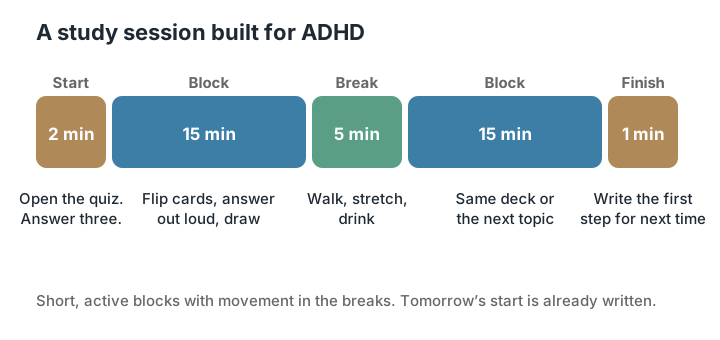
For many people with ADHD, starting is the hardest part. A vague task like “revise chemistry” gives your brain nothing to grab onto. A tiny, specific one does: “open the chemistry quiz and answer three questions.” Once you have started, continuing is often much easier.
Reduce the friction to almost zero. Leave your notes open on the desk. Keep a list of the next small task for each subject so you never have to decide. Use if-then plans, such as “when I get home and put my bag down, I open my flashcards.” Plans like these, called implementation intentions, have been shown to help people follow through on goals.
Try this: End each session by writing the first step for next time on a sticky note. Tomorrow’s start is already decided.
Use short, timed sessions
Long open-ended sessions are hard to sustain. Short, timed ones are easier to start and easier to finish. Many students with ADHD find 10 to 25 minutes works well, followed by a short break that involves moving: a walk around the room, a stretch, or getting a drink.
A visible timer helps make time concrete. The Pomodoro Technique is a popular structure, but adjust the lengths to suit you. Some days a 10-minute block is the right size; on others you might happily go for 40.
Make studying active
Passive reading is the hardest mode for attention. Your eyes move across the page while your mind wanders. Active study gives you something to do every few seconds: answer a question, flip a card, explain a concept out loud, draw a diagram from memory, or write on a whiteboard.
Movement can help too. Some students study better standing, walking while reviewing flashcards, or explaining ideas aloud while pacing. Listening to your notes as audio can work as a second pass during a walk, as long as it is followed by recall practice.
Add structure from outside
If internal motivation is unreliable, borrow structure from the outside world. Put study sessions in your calendar at fixed times. Study in a library or a café rather than your bedroom. Set deadlines earlier than the real ones, and tell someone about them.
Body doubling, studying alongside another person who is also working, is popular in the ADHD community. Evidence is mostly from personal reports rather than controlled studies, but it is low-cost and many people find it helps. A study group, a friend on a video call, or a quiet shared workspace all count.
Reduce distractions
Distractions cost more when attention is already hard to hold. Put your phone in another room, not just face down. Use a website blocker during study blocks. Close every tab you do not need.
Some people with ADHD focus better with background sound, such as instrumental music, brown noise, or a café hum; others need silence. Experiment, and use whatever helps you stay with the questions. Music with lyrics in a language you understand tends to be more distracting for most people.
ADHD study techniques for exam season
Exam season concentrates every difficulty: more material, less structure, and a deadline that suddenly feels very close. A few adjustments help. Start earlier than feels necessary, because the extra time absorbs bad days. Turn the syllabus into a checklist of small topics and tick them off as you quiz yourself, so progress is visible.
Practise under exam conditions at least a few times, including the timing and the room if you can, especially if you have accommodations such as extra time. Knowing how long a paper actually takes you is useful information. And plan the day of each exam in detail: when to leave, what to bring, and what to eat, so your attention is not spent on logistics.
Plan the week, not just the day
Time can feel elastic with ADHD, so deadlines sneak up. Make them visible: a wall calendar, a weekly plan you look at every morning, or reminders on your phone. Break each assignment or exam into small tasks with their own dates.
Review the plan once a week. What did you actually do? What slipped? Adjust the next week to be realistic. A plan you follow 70% of the time is far more useful than a perfect one you ignore.
Accommodations and support
If you have an ADHD diagnosis, you may be entitled to exam accommodations such as extra time, rest breaks, or a quieter room. Contact your school or university’s disability or student support service early in the term, as arrangements often need evidence and time to set up.
Treatment, including medication and coaching, is a conversation for you and your doctor. Study strategies work alongside treatment, not instead of it. If you think you may have ADHD but have not been assessed, your doctor or student health service is a good place to start.
Common questions
How do people with ADHD study effectively?
With the same core methods as everyone, self-testing and spaced review, set up to fit their attention: tiny starting steps, short timed sessions, active tasks, fewer distractions, and outside structure like scheduled sessions or study partners.
Is the Pomodoro Technique good for ADHD?
It helps many people because it makes time visible and breaks work into short blocks. Adjust the lengths: shorter blocks of 10 to 15 minutes may suit some days better than the standard 25.
What is body doubling?
Body doubling means working alongside another person, in person or on a video call, while each of you does your own task. Many people with ADHD find it helps them start and stay on task, though research on it is still limited.
Should I listen to music while studying with ADHD?
It depends on you. Some people with ADHD focus better with instrumental music or steady background noise; others find any sound distracting. Try a few sessions each way and compare how many questions you get through.
Can I get extra time in exams if I have ADHD?
Often, yes. Many schools and universities offer extra time, breaks, or a separate room for students with a diagnosis. Contact your disability or student support service early, as evidence and deadlines usually apply.
Calm Study
Calm Study removes several of the hardest steps for students with ADHD. The plan names each day’s tasks so there is nothing to decide, quizzes and flashcards from your notes make every session active, sessions are short by design, and a podcast of your notes gives you a second pass while you walk.