How to Study Biology: Terms, Processes, and Exam Questions
· 8 min read
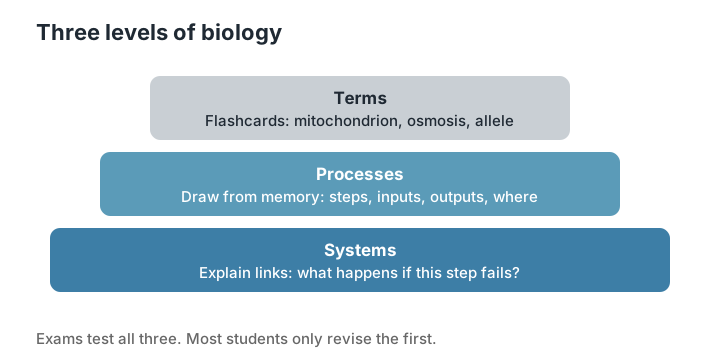
The best way to study biology is to work at three levels: learn the vocabulary with spaced flashcards, learn the processes by drawing and explaining them from memory, and learn how systems connect by asking what happens when something changes. Most students only do the first, then struggle when the exam asks them to explain or apply. This guide covers how to study biology day to day, and how to study for a biology test in the week or two before it.
Why biology needs more than memorising
Biology has a reputation as the memorising science, and there is a lot to remember. But exams test far more than recall. A typical paper asks you to describe a structure, explain a process, apply an idea to an unfamiliar example, interpret a graph, and evaluate an experiment. Students who only learned definitions hit a wall on everything after the first few questions.
Active study pays off in science more than almost anywhere. In a 2014 meta-analysis of 225 studies in science, engineering, and maths courses, Scott Freeman and colleagues found that exam scores rose by about 6% in classes using active learning, and students in traditional lecture courses were 1.5 times more likely to fail. The same principle applies to how you study on your own: doing beats reading.
Level 1: Learn the language
Biology introduces a huge number of new words, and you cannot explain a process if you are unsure what its terms mean. Start flashcards for each topic’s vocabulary in the first week, not the week before the exam.
Learning common word roots makes new terms far easier, because many of them are built from the same parts.
| Root | Meaning | Examples |
|---|---|---|
| hydro- | water | hydrolysis, hydrophobic |
| -lysis | splitting, breaking down | hydrolysis, glycolysis, lysis |
| photo- | light | photosynthesis, phototropism |
| hyper- / hypo- | above / below | hypertonic, hypotonic |
| -cyte | cell | erythrocyte, leucocyte |
| -ase | an enzyme | amylase, lactase, ligase |
| auto- / hetero- | self / other | autotroph, heterotroph |
How to make vocabulary stick
Write flashcards in both directions: term on the front and definition on the back, and also a description on the front asking for the term. Test yourself before you flip, and keep cards you miss in rotation until you get them right on separate days.
There is research on how much practice is enough. In a 2011 study, Katherine Rawson and John Dunlosky found that a good target is to recall each item correctly about three times in your first session, then to relearn it in a few later sessions spread over days. After that, extra practice in the same session adds little.
Try this: Put an example on the back of each definition card. “Osmosis: diffusion of water across a partially permeable membrane. Example: a plant cell in pure water swells.” Examples are what exams ask you to apply.
Level 2: Draw processes from memory
Processes such as photosynthesis, respiration, protein synthesis, the cardiac cycle, and the nephron are where many marks sit. The best way to learn them is to draw them from memory, check against your notes, and draw them again.
Drawing is a strong memory tool. In a 2016 series of experiments, Jeffrey Wammes and colleagues found that drawing items led to far better recall than writing them out. Logan Fiorella and Richard Mayer list drawing among eight evidence-based “generative” strategies, where you build your own representation of the material.
- For each process, note the inputs, the outputs, where it happens, and the main steps in order.
- Turn it into a flow diagram with arrows, not a paragraph.
- Close your notes and draw it. Then check and add what you missed in another colour.
- Redraw it a few days later, starting with the parts you missed.
Level 3: Connect the systems
The highest-mark questions ask you to link ideas: how a change in one part of a system affects another. The best preparation is to ask yourself “what happens if…?” and answer it.
What happens if an enzyme’s active site changes shape? If the pancreas stops making insulin? If a mutation changes one base in a gene? If a species is removed from a food web? Answering these forces you to use the processes you have learned, which is exactly what application questions do. Asking “why” about each fact helps too: in a 2010 study, Bradley Smith and colleagues found that college biology students understood their textbook better when they answered why questions as they read.
Comparison tables for topics students mix up
Exams love asking you to compare similar things, and wrong answers often swap one for another. A one-line rule for each pair helps.
| Pair | The key difference |
|---|---|
| Mitosis vs meiosis | Mitosis makes two genetically identical cells; meiosis makes four genetically different cells with half the chromosomes. |
| Aerobic vs anaerobic respiration | Aerobic uses oxygen and releases much more energy; anaerobic does not use oxygen and produces lactate in animals or ethanol in yeast. |
| DNA vs RNA | DNA is double-stranded with deoxyribose and thymine; RNA is usually single-stranded with ribose and uracil. |
| Diffusion vs osmosis | Diffusion is any particles moving down a concentration gradient; osmosis is water moving across a partially permeable membrane. |
| Prokaryotic vs eukaryotic cells | Prokaryotic cells have no nucleus or membrane-bound organelles; eukaryotic cells have both. |
Practise applying, not just recalling
Two question types catch out students who have only memorised: data questions and practical questions. Data questions give you a graph or table you have never seen and ask you to describe a trend, calculate a change, or explain a pattern using biology. Practical questions ask about variables, controls, reliability, and sources of error.
Practise both with past-paper questions. For data questions, always quote numbers from the graph and link the pattern to a biological reason. For practicals, learn the purpose and method of each required experiment on your course, not just its result.
A weekly routine for studying biology
A little biology most days beats long sessions once a week.
- After each lesson or lecture: five minutes writing down the main points from memory.
- Daily: 10 to 15 minutes of flashcards on vocabulary and key facts.
- For each new process: draw it from memory once that week, then again the next week.
- Weekly: a set of mixed questions on this week’s topic and one older topic.
- Monthly: blurt each topic on a blank page to see what has faded.
How to study for a biology test
In the week or two before a biology test, shift from learning new material to practising exam questions.
- List every topic the test covers, from the syllabus or specification.
- Blurt each topic on a blank page to find what you have forgotten.
- Make flashcards for the terms and facts you missed, and review them daily.
- Redraw the key diagrams and processes from memory.
- Do past-paper questions topic by topic, then sit at least one full paper under timed conditions.
- Mark your answers with the mark scheme, and note the exact wording that earns marks.
- Keep a mistakes list and redo those questions two days later.
- The night before: a quick look at your mistakes list and diagrams, then sleep.
Answering longer biology questions
Longer questions are marked against a list of points, and the command word tells you what kind of points. “Describe” wants what happens; “explain” wants why it happens; “evaluate” wants strengths, weaknesses, and a judgement. A description in answer to an explain question loses most of the marks, however accurate it is.
Use precise terms: “water potential”, not “water level”; “active site”, not “the enzyme’s shape”. For six-mark questions, spend 30 seconds jotting the points in order before you write, and make sure each step leads to the next: point, mechanism, consequence.
Common mistakes when studying biology
These habits feel productive but leave gaps that exams find.
- Copying textbook diagrams instead of drawing them from memory.
- Memorising definitions word for word without being able to use them.
- Skipping the practical and data questions.
- Studying each topic in isolation, with no “what if” links between them.
- Leaving vocabulary until the last week.
- Highlighting and rereading as the main way of studying.
Common questions
What is the best way to study biology?
Work at three levels: learn terms with spaced flashcards, learn processes by drawing them from memory, and connect systems by asking what happens when something changes. Then practise with past-paper questions.
How do I memorise biology terms?
Use flashcards in both directions, learn common word roots, add an example to each definition, and review the cards on several different days. Start in the first week of each topic.
How can I study for a biology test in one night?
Focus on the topics most likely to come up, blurt each one to find the gaps, fix the biggest gaps with your notes, do a handful of past questions, and still get some sleep. It works far better spread over a week or two.
How many hours should I study biology?
Short daily sessions work better than long weekly ones: 20 to 30 minutes of active work most days, with longer sessions of practice questions in the weeks before an exam.
Is biology hard to study?
It has a lot of content, which makes it feel hard if you rely on rereading. With spaced flashcards for terms, drawing for processes, and regular practice questions, it becomes much more manageable.
How do I get better at biology exam questions?
Do past-paper questions and mark them with the mark scheme. Learn what each command word asks for, use precise terms, and practise data and practical questions, which catch out students who have only memorised.
Calm Study
Calm Study fits biology well because so much of it is terms and processes already in your notes. It turns your lecture slides into spaced flashcards for the vocabulary, quizzes you on how processes work, and writes mock exam questions with command words like explain and evaluate.
References
- Freeman, S., Eddy, S. L., McDonough, M., Smith, M. K., Okoroafor, N., Jordt, H., & Wenderoth, M. P. (2014). Active learning increases student performance in science, engineering, and mathematics. Proceedings of the National Academy of Sciences, 111(23), 8410–8415. https://doi.org/10.1073/pnas.1319030111
- Rawson, K. A., & Dunlosky, J. (2011). Optimizing schedules of retrieval practice for durable and efficient learning: How much is enough? Journal of Experimental Psychology: General, 140(3), 283–302. https://doi.org/10.1037/a0023956
- Wammes, J. D., Meade, M. E., & Fernandes, M. A. (2016). The drawing effect: Evidence for reliable and robust memory benefits in free recall. Quarterly Journal of Experimental Psychology, 69(9), 1752–1776. https://doi.org/10.1080/17470218.2015.1094494
- Fiorella, L., & Mayer, R. E. (2016). Eight ways to promote generative learning. Educational Psychology Review, 28(4), 717–741. https://doi.org/10.1007/s10648-015-9348-9
- Smith, B. L., Holliday, W. G., & Austin, H. W. (2010). Students’ comprehension of science textbooks using a question-based reading strategy. Journal of Research in Science Teaching, 47(4), 363–379. https://doi.org/10.1002/tea.20378
- Dunlosky, J., Rawson, K. A., Marsh, E. J., Nathan, M. J., & Willingham, D. T. (2013). Improving students’ learning with effective learning techniques. Psychological Science in the Public Interest, 14(1), 4–58. https://doi.org/10.1177/1529100612453266