Does Music Help You Study? What to Play, and When to Turn It Off
· 7 min read
Does music help you study? It depends on the music and the task. Music with lyrics tends to hurt reading, writing, and memorising, because the words compete with the words you are trying to process. Instrumental music has mixed effects: it can lift your mood and make studying more pleasant, but it rarely improves learning itself, and silence is usually best for the hardest work. The famous Mozart effect turned out to be a brief boost in mood and alertness, not a lasting gain in intelligence.
The short answer from the research
Studies of background music and learning point in different directions, which is why you will find confident claims both ways. The overall picture is clearer than it looks. In a 2011 meta-analysis of studies on adults, Juliane Kämpfe, Peter Sedlmeier, and Frank Renkewitz found that background music had close to no effect on average, but that average hid real differences: music tended to harm reading and memory tasks, while it improved mood and some physical performance.
A 2020 systematic review by Enrique de la Mora Velasco and Atsusi Hirumi reached a similar conclusion: whether music helps depends on the kind of music, the task, and the person. So the useful question is not “does music help?” but “does this music help with this task?”
Why lyrics get in the way
When you read or memorise, you use an inner voice to hold words in mind. Speech you can hear, including sung lyrics, gets into that same system automatically, whether you want it to or not. Psychologists call this the irrelevant speech effect.
In a 1989 study, Pierre Salamé and Alan Baddeley found that vocal music disrupted people’s memory for sequences of numbers more than instrumental music did. In 2014, Nick Perham and Harriet Currie tested reading comprehension with quiet, instrumental music, lyrical music people liked, and lyrical music they disliked. Both lyrical conditions lowered scores compared with quiet. Liking the song did not protect people from the cost.
Another study by Perham and Joanne Vizard found that both liked and disliked music hurt memory for ordered lists compared with quiet, even though people preferred studying with the music they liked.
The Mozart effect: what really happened
In 1993, Frances Rauscher, Gordon Shaw, and Katherine Ky published a one-page paper in Nature. College students who listened to ten minutes of a Mozart sonata scored better on a spatial reasoning task than after silence or relaxation instructions. The effect lasted about 10 to 15 minutes. The press turned this into “Mozart makes you smarter”, and products for babies followed.
Other researchers struggled to repeat it. A 1999 report in Nature by Kenneth Steele and colleagues failed to find the effect. In 2001, William Forde Thompson, Glenn Schellenberg, and Gabriela Husain showed what was going on: an upbeat Mozart piece improved performance, but a slow, sad piece by Albinoni did not, and once they accounted for people’s mood and alertness, the effect disappeared. A 2010 meta-analysis by Jakob Pietschnig and colleagues, combining about 40 studies, found the effect was small, no bigger for Mozart than for other music, and probably inflated by unpublished null results.
The lesson is still useful: music that makes you feel more awake and positive can give a small, short boost. It just has nothing to do with Mozart, and it wears off quickly.
Is classical or lofi music good for studying?
Both are popular for a sensible reason: they usually have no lyrics. Instrumental music avoids the biggest problem with background music, so it is the safer choice if you want sound while you work.
Within instrumental music, steadier is better. Lofi playlists are built to be repetitive and predictable, with no sudden changes, which suits background listening. Classical music varies more. A quiet piano piece is easy to ignore; a symphony that swings from soft to very loud is not. Researchers have not studied lofi in particular, but its appeal fits what is known: low volume, no words, few surprises.
One practical catch: free streaming services and video sites interrupt with adverts, which are often spoken and loud. A downloaded or ad-free playlist avoids that.
Music depends on the task
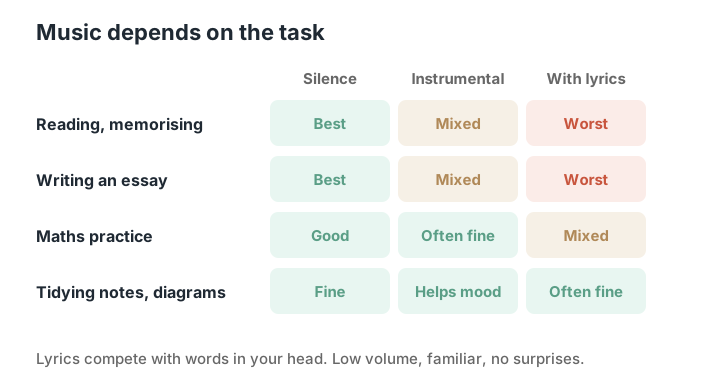
The more a task relies on words and memory, the more music costs. Reading a textbook, memorising definitions, and writing an essay are the tasks most affected. Practising maths problems you already know how to do, tidying notes, or drawing diagrams are much less affected, and here the lift in mood from music you enjoy can make the work feel shorter.
Does music help some people more than others?
There are individual differences. In a 1997 study, Adrian Furnham and Anna Bradley found that introverts’ memory and reading comprehension were more disrupted by background pop music than extraverts’. A small 2007 study by Göran Söderlund and colleagues found that white noise helped children with attention difficulties on a memory task, while it slightly hurt children without them.
Habit matters too. If you always study with music, silence may feel strange at first, and that feeling can be distracting in its own right. But preference is not the same as performance: in the studies above, people often preferred the music that was costing them points.
Music, background noise, or silence?
Each option suits a different situation.
- Silence: best for the hardest reading, memorising, and writing, and closest to exam conditions.
- Steady background noise, like brown noise, white noise, or rain: good for masking conversations in a busy library, café, or shared house.
- Instrumental music at low volume: fine for practice problems and routine tasks, and helpful if it makes you more willing to start.
- Music with lyrics: best kept for breaks, the walk to the library, or very routine tasks like formatting.
How to choose music for studying
If you want music while you study, these choices keep the cost low.
- No lyrics, or at least none in a language you understand.
- Familiar music, so nothing surprises you or grabs your attention.
- A steady tempo and volume, without dramatic changes.
- Low volume: quiet enough that you would hear someone say your name.
- No adverts: use a downloaded or ad-free playlist.
- Choose the playlist before you start, so you are not picking songs mid-session.
Try this: Try it for yourself: study one chapter with your playlist and a similar chapter in silence, then test yourself on both two days later. Trust the scores more than the feeling.
Use music to start, not to stay
Music may be most useful around studying rather than during it. An upbeat song can get you out of a slump and into your chair, much like the mood effect behind the Mozart findings. A particular playlist can become a cue that study time has started.
Then, when you reach the part of the session that needs your full attention, such as a dense chapter or a timed practice paper, turn it down or off. Exams are silent, and practising in similar conditions has its own advantages.
Common questions
Is it good to listen to music while studying?
It depends. Music with lyrics tends to hurt reading and memorising. Instrumental music at low volume is often fine for routine tasks and can lift your mood. Silence is usually best for the hardest material.
What is the best music to study to?
Familiar instrumental music with a steady tempo, played quietly and without adverts. Many students use lofi, ambient, or calm piano music for this reason.
Does classical music make you smarter?
No. The Mozart effect was a small, short boost in spatial reasoning that later studies traced to mood and alertness. Any music that lifts your mood can give a similar short boost.
Is lofi good for studying?
Lofi is a reasonable choice if you want music, because it usually has no lyrics and changes little. It is still unlikely to beat silence for demanding reading or memorising.
Is it better to study in silence?
For reading, memorising, and writing, usually yes. If your space is noisy, steady background noise can block out distracting speech better than music.
Why do I feel like I focus better with music?
Music can improve mood and alertness, block out other noise, and make studying feel less boring. Those are real benefits, but studies often find people still learn less from reading with lyrics playing than in quiet.
Calm Study
Calm Study keeps the studying itself active, which matters more than the soundtrack. Its quizzes and flashcards from your own notes ask for an answer every few seconds, and when you do want something in your ears, it can turn your notes into a podcast for the walk.
References
- Kämpfe, J., Sedlmeier, P., & Renkewitz, F. (2011). The impact of background music on adult listeners: A meta-analysis. Psychology of Music, 39(4), 424–448. https://doi.org/10.1177/0305735610376261
- de la Mora Velasco, E., & Hirumi, A. (2020). The effects of background music on learning: A systematic review of literature to guide future research and practice. Educational Technology Research and Development, 68(6), 2817–2837. https://doi.org/10.1007/s11423-020-09783-4
- Salamé, P., & Baddeley, A. (1989). Effects of background music on phonological short-term memory. The Quarterly Journal of Experimental Psychology Section A, 41(1), 107–122. https://doi.org/10.1080/14640748908402355
- Perham, N., & Currie, H. (2014). Does listening to preferred music improve reading comprehension performance? Applied Cognitive Psychology, 28(2), 279–284. https://doi.org/10.1002/acp.2994
- Perham, N., & Vizard, J. (2011). Can preference for background music mediate the irrelevant sound effect? Applied Cognitive Psychology, 25(4), 625–631. https://doi.org/10.1002/acp.1731
- Rauscher, F. H., Shaw, G. L., & Ky, K. N. (1993). Music and spatial task performance. Nature, 365(6447), 611. https://doi.org/10.1038/365611a0
- Steele, K. M., Bella, S. D., Peretz, I., et al. (1999). Prelude or requiem for the “Mozart effect”? Nature, 400(6747), 827. https://doi.org/10.1038/23611
- Thompson, W. F., Schellenberg, E. G., & Husain, G. (2001). Arousal, mood, and the Mozart effect. Psychological Science, 12(3), 248–251. https://doi.org/10.1111/1467-9280.00345
- Pietschnig, J., Voracek, M., & Formann, A. K. (2010). Mozart effect–Shmozart effect: A meta-analysis. Intelligence, 38(3), 314–323. https://doi.org/10.1016/j.intell.2010.03.001
- Furnham, A., & Bradley, A. (1997). Music while you work: The differential distraction of background music on the cognitive test performance of introverts and extraverts. Applied Cognitive Psychology, 11(5), 445–455. https://doi.org/10.1002/(SICI)1099-0720(199710)11:5<445::AID-ACP472>3.0.CO;2-R
- Söderlund, G., Sikström, S., & Smart, A. (2007). Listen to the noise: Noise is beneficial for cognitive performance in ADHD. Journal of Child Psychology and Psychiatry, 48(8), 840–847. https://doi.org/10.1111/j.1469-7610.2007.01749.x