First Class Degree: What It Means and How to Get One
· 5 min read
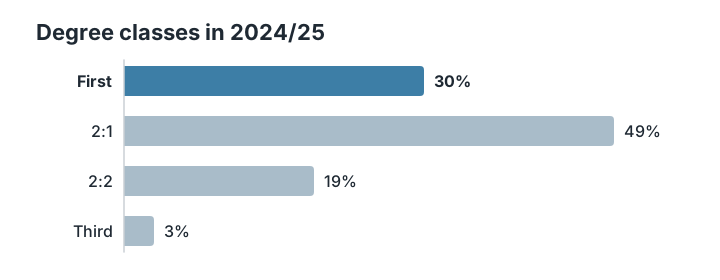
A first class degree is the top undergraduate classification in the UK, usually awarded for an overall average of 70% or above. About 30% of graduates got one in 2024/25, roughly double the share in 2010-11. How your average gets worked out varies by university, and that detail can decide your result. This guide covers the boundaries, the weighting rules, what employers think, and what it takes to get marks over 70.
What is a first class degree?
UK honours degrees are classified into bands based on your overall percentage. The figures below are standard, though Prospects notes they can vary slightly between universities.
| Class | Often called | Overall mark |
|---|---|---|
| First-class honours | A First | 70% and above |
| Upper second-class | A 2:1 | 60% to 69% |
| Lower second-class | A 2:2 | 50% to 59% |
| Third-class | A Third | 40% to 49% |
How common is a First?
More common than you might expect. Prospects, citing HESA data, reports that in 2024/25, 30% of graduates got a First, 49% a 2:1, 19% a 2:2 and 3% a Third.
It’s changed a lot. The Office for Students reported that 15.5% of students got a First in 2010-11, and that this climbed to 37.4% in 2020-21 during the pandemic before coming back down. It has also said a large part of the rise can’t be explained by things like students’ entry grades or subjects, which is why you’ll see the phrase “grade inflation” in the news.
How your degree class gets worked out
This is where universities differ most. Most give later years more weight, and many don’t count first year at all. A few real examples show the range.
- Leeds weights years two and three at a ratio of 1:2.
- Edinburgh classifies most degrees on the average of the third and fourth years, weighted by credits.
- Nottingham uses standard weightings between years, and any exceptions are written into the programme specification.
| Second year | Weighting | Needed in final year for a First |
|---|---|---|
| 65% | 40 / 60 | 73.4% |
| 65% | 33 / 67 | 72.5% |
| 62% | 40 / 60 | 75.4% |
| 58% | 33 / 67 | 76% |
Try this: Search your university’s site for “degree classification” or “academic regulations”, or check your programme handbook. Then put your marks into our free UK degree calculator.
Borderlines and discretion
Finishing just under a boundary doesn’t always settle it. Nottingham treats rounded marks of 69, 59 and 49 as borderline, and awards the higher class if two-thirds or more of your final-stage credits are in that class, or two-thirds of your final and penultimate stage credits. Other universities use their own versions of this, and some look at how you improved over time.
So if you’re heading for a 69, it may be worth knowing exactly how your university’s rule works before you choose how to spend your final weeks.
Does a First matter to employers?
Less than it can feel like in third year. Prospects says employers “rarely focus on degree classifications alone”, and that many leading employers accept graduates with a 2:2, naming BAE Systems, the Civil Service, EY, Network Rail, the NHS and Tesco.
It can matter more in some places. Some graduate schemes still ask for a 2:1, and Masters courses, funding and academic careers often look closely at your marks. If you’re aiming for one of those, check the specific requirements. For most other jobs, a good 2:1 with relevant experience will open the same doors.
What separates a 70 from a 65
Marking criteria vary by subject, but in essay-based courses the jump into the 70s tends to come down to what you do with the material. Your department publishes its criteria, so read them. Common differences look like this.
| Mid 2:1 | First | |
|---|---|---|
| Argument | Clear, and mostly describes the debate | Takes a position and defends it |
| Reading | The set texts, used accurately | Goes beyond the list, and weighs sources against each other |
| Analysis | Explains what scholars said | Asks why it matters and where it falls down |
| Structure | Organised by topic | Each section moves the argument forward |
How to get a First
Most of it comes down to a few dull habits, started early.
- Read the marking criteria before you start each assignment, and write to them.
- Act on feedback. A 2007 review by John Hattie and Helen Timperley found feedback is among the strongest influences on learning, though its effect varies a lot with the type of feedback. Take your last essay’s comments into the next one.
- Go to everything. A 2010 meta-analysis led by Marcus Credé found attendance strongly predicts university grades.
- Practise exam questions under timed conditions. A 2017 meta-analysis by Olusola Adesope and colleagues found practice testing beats restudying.
- Start your dissertation early, if you have one, because it often carries a lot of credits.
- Keep your sleep regular across the whole term, and don’t just fix it the night before.
You don’t need 70 on everything
It’s an average, so a 75 in a subject you love pays for a 65 in one you don’t. Look at which modules carry the most credits and put your effort there. Knowing your numbers also tells you when you can relax. If you’re safely on course, one bad essay won’t sink you, and you don’t have to treat it as though it will.
Keep going
Common questions
What percentage is a first class degree?
Usually 70% or above overall. A 2:1 is 60% to 69%, a 2:2 is 50% to 59%, and a Third is 40% to 49%. Your university’s regulations have the final word.
How many people get a First?
About 30% of UK graduates in 2024/25, according to HESA data reported by Prospects. A 2:1 is the most common result, at 49%.
Is a First hard to get?
It takes sustained work, and it’s harder in some subjects than others, but it’s far from rare. Roughly three in ten graduates now get one.
Is a 2:1 good?
Yes. It’s the most common class, and it meets the requirement for most graduate schemes and many Masters courses.
Does first year count towards my degree?
At many universities it doesn’t, as long as you pass. Some courses count it for a small share. Check your programme specification.
Can I get a First with a 69?
Possibly. Many universities have a borderline rule, such as looking at how many of your final-year credits are at First level. Some also round 69.5 up to 70. Check your own regulations.
Calm Study
If you’re chasing a First, most of the marks come from the weeks of steady revision before each exam. Calm Study turns your lecture notes into flashcards, quizzes and mock exams in the shape of your university’s paper, with feedback on each written answer, and plans them around your exam dates.
References
- Prospects. Understanding university grades in the UK. https://www.prospects.ac.uk/applying-for-university/university-life/understanding-university-grades-in-the-uk/
- Office for Students (2023). University grade inflation starts to drop, but half of top grades still unexplained. https://www.officeforstudents.org.uk/news-blog-and-events/press-and-media/university-grade-inflation-starts-to-drop-but-half-of-top-grades-still-unexplained/
- University of Edinburgh. Degree classification. https://registryservices.ed.ac.uk/academic-services/staff/assessment/degree-classification
- University of Nottingham Quality Manual. Undergraduate degree classification. https://www.nottingham.ac.uk/qualitymanual/assessment-awards-and-deg-classification/ug-deg-class-sept20.aspx
- Hattie, J., & Timperley, H. (2007). The power of feedback. Review of Educational Research, 77(1), 81–112. https://doi.org/10.3102/003465430298487
- Credé, M., Roch, S. G., & Kieszczynka, U. M. (2010). Class attendance in college: A meta-analytic review of the relationship of class attendance with grades and student characteristics. Review of Educational Research, 80(2), 272–295. https://doi.org/10.3102/0034654310362998
- Adesope, O. O., Trevisan, D. A., & Sundararajan, N. (2017). Rethinking the use of tests: A meta-analysis of practice testing. Review of Educational Research, 87(3), 659–701. https://doi.org/10.3102/0034654316689306