Study Breaks: How Long, How Often, and What to Do
· 7 min read
Study breaks are not time off from studying; they are part of what makes a long session work. A good rule of thumb is a short break of 5 to 10 minutes after every 25 to 50 minutes of focused work, and a longer break of 20 to 30 minutes every couple of hours. What you do on the break matters as much as how long it lasts: moving, getting outside, and quiet rest restore attention, while scrolling your phone often does not.
Why study breaks help
Attention fades when you do one thing for a long time. In a 2011 study, Atsunori Ariga and Alejandro Lleras gave people a dull 50-minute task that needed constant attention. As usual, performance slipped over time for most people. But people who were given two very brief interruptions during the task did not slip. Briefly switching off from the goal and coming back to it kept them sharp.
A 2022 meta-analysis by Patricia Albulescu and colleagues pulled together research on micro-breaks of 10 minutes or less. Breaks reliably made people feel more energetic and less tired. The boost to performance was smaller and depended on the task, and the authors suggested that mentally demanding work may need longer breaks than routine work.
Breaks can help memory, too. In a 2012 study, Michaela Dewar and colleagues found that people who rested quietly for ten minutes after hearing a story remembered more of it a week later than people who spent those ten minutes on a visual puzzle.
How long should study breaks be?
The right length depends on how long and how hard you have been working. These ranges suit most students.
| Break | Length | When to take it |
|---|---|---|
| Micro-break | 1 to 2 minutes | Whenever your eyes or focus tire; look away, stretch |
| Short break | 5 to 10 minutes | After each 25 to 50 minute block |
| Long break | 20 to 30 minutes | After two to four blocks, or about every two hours |
| Real stop | 45 to 60 minutes | Every three to four hours, for a meal and a change of scene |
How often to take breaks
There is no single right interval, but there are clear signs you need a break: rereading the same line, making more small mistakes, feeling restless, or checking the time. If those show up after 20 minutes, your blocks are too long for that task. If you are still sharp after an hour, you can stretch them.
Harder material usually needs more frequent breaks. Dense reading or new problem types might suit 25-minute blocks, while practising something you know well can run for 50 minutes or more.
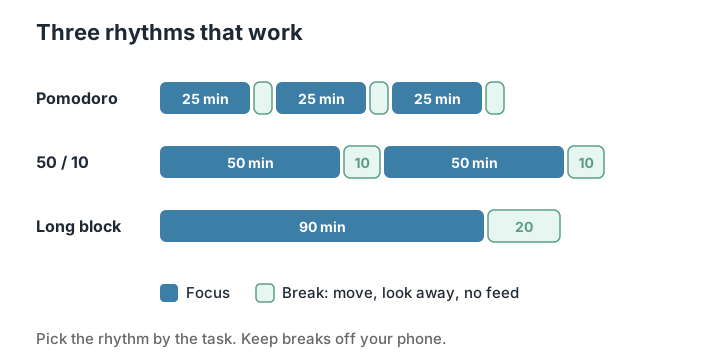
Pomodoro, 52/17, or flowtime?
The Pomodoro Technique uses 25 minutes of focus and a 5-minute break, with a longer break after four rounds. The “52/17 rule”, 52 minutes on and 17 off, came from a productivity app company’s analysis of its users’ data in 2014, not from a controlled study, so treat it as one option rather than a magic number. The flowtime technique skips the fixed timer: you work until your focus starts to dip, note how long that was, then take a break roughly in proportion.
One study compared fixed and flexible breaks directly. In 2023, Felicitas Biwer and colleagues had students study using either Pomodoro-style fixed breaks or breaks they chose themselves. The fixed-break group reported less fatigue and more motivation across the session, and got through as much work. Students choosing their own breaks tended to keep going too long and then take longer breaks.
A sensible approach is to start with a fixed rhythm, since it is easier to stick to, then adjust the lengths once you know how long you can really focus on each kind of task.
What to do on a study break
The best study breaks give your mind a genuine rest from focused work and your body a change of position.
- Move: walk, climb some stairs, or stretch. A 2012 meta-analysis by Yu-Kai Chang and colleagues found short bouts of exercise give a small boost to cognitive performance.
- Get outside if you can. In a 2008 study by Marc Berman and colleagues, a walk in a park restored attention better than a walk down a busy street.
- Rest your eyes by looking at something far away, or close them for a minute.
- Drink water and have a small snack if you are hungry.
- Rest quietly without a screen, even for a few minutes.
- Talk to someone, in person, about anything except the material.
- Set up the next block: open the right page, write the next task down.
What not to do on a study break
Some breaks feel restful but leave you worse off. Phone breaks are the main one. In a 2019 study by Sanghoon Kang and Terri Kurtzberg, people who took a short break on their phones solved fewer puzzles afterwards than people who took a break on paper or a computer, or no break at all.
- Scrolling social media, which is designed to keep you scrolling.
- Starting a TV episode or video, which has no natural stopping point under 20 minutes.
- Checking messages that hand you new problems to think about.
- A heavy meal right before a hard block.
- Lying on your bed “for a minute”.
Try this: If you do want your phone on a break, set a timer first and pick one thing to check. Open the app, check it, close it.
Study break ideas by length
Pick a break that fits the time you have, so it ends on its own.
- 2 minutes: stand up, stretch, refill your water, look out of the window.
- 5 minutes: walk around the building or down the corridor, make a cup of tea, do a few stairs.
- 10 minutes: a short walk outside, quiet rest with your eyes closed, a snack.
- 20 to 30 minutes: a proper walk, a shower, cooking something simple, a call with a friend.
- A whole evening off: plan it in advance, so it is a reward and not a guilty escape.
How to stop a break turning into an hour
The hardest part of a break is ending it. These habits help.
- Set a timer for the break, not just the study block.
- Before you get up, write the first thing you will do when you sit back down.
- Stop mid-task when you know what comes next, so restarting is easy.
- Keep breaks away from your phone and your bed.
- Stay close to your study space for short breaks.
Longer breaks: sleep and days off
The most important break is sleep. Memory consolidation happens largely overnight, and a short night makes the next day’s focus worse. If you are studying late and fading, the best break might be going to bed and finishing in the morning.
Short naps can help, too. In a 2006 study, Amber Brooks and Leon Lack found that a 10-minute afternoon nap improved alertness and performance soon after waking, while longer naps of 20 to 30 minutes left people groggy at first. Taking at least part of a day off each week also helps; spreading study across the week works better for memory than squeezing it into fewer, longer days.
Common questions
How long should a study break be?
For most students, 5 to 10 minutes after each 25 to 50 minute block, and 20 to 30 minutes after every two to four blocks. Take a longer stop for a meal every few hours.
How often should you take breaks when studying?
Every 25 to 50 minutes is a good starting point. Take one sooner if you notice yourself rereading, making small mistakes, or checking the time.
Is it OK to use my phone on a study break?
It is better not to. Research suggests phone breaks leave people less refreshed than breaks without one, and they easily run long. If you do, set a timer and check one thing.
What is the 52/17 rule?
A rhythm of 52 minutes of work followed by a 17-minute break. It came from one company’s analysis of how its most productive users worked, not from a controlled study, so treat it as one option among several.
What is the flowtime technique?
A flexible alternative to Pomodoro. You work until your focus starts to fade, note how long that was, then take a break roughly in proportion, such as 5 minutes for 25 minutes of work or 10 to 15 minutes for an hour.
Are naps good study breaks?
Short ones can be. A 10 to 20 minute nap can restore alertness, especially after a poor night. Set an alarm, since longer naps can leave you groggy, and avoid napping late in the evening.
Calm Study
Calm Study makes it easy to stop and start again. Its plan splits each day into short steps from your own notes, such as the cards that are due or a quiz on a slipping topic, so after a break you pick up exactly where you left off.
References
- Ariga, A., & Lleras, A. (2011). Brief and rare mental “breaks” keep you focused: Deactivation and reactivation of task goals preempt vigilance decrements. Cognition, 118(3), 439–443. https://doi.org/10.1016/j.cognition.2010.12.007
- Albulescu, P., Macsinga, I., Rusu, A., Sulea, C., Bodnaru, A., & Tulbure, B. T. (2022). “Give me a break!” A systematic review and meta-analysis on the efficacy of micro-breaks for increasing well-being and performance. PLOS ONE, 17(8), e0272460. https://doi.org/10.1371/journal.pone.0272460
- Dewar, M., Alber, J., Butler, C., Cowan, N., & Della Sala, S. (2012). Brief wakeful resting boosts new memories over the long term. Psychological Science, 23(9), 955–960. https://doi.org/10.1177/0956797612441220
- Biwer, F., Wiradhany, W., oude Egbrink, M. G. A., & de Bruin, A. B. H. (2023). Understanding effort regulation: Comparing “Pomodoro” breaks and self-regulated breaks. British Journal of Educational Psychology, 93(S2), 353–367. https://doi.org/10.1111/bjep.12593
- Chang, Y. K., Labban, J. D., Gapin, J. I., & Etnier, J. L. (2012). The effects of acute exercise on cognitive performance: A meta-analysis. Brain Research, 1453, 87–101. https://doi.org/10.1016/j.brainres.2012.02.068
- Berman, M. G., Jonides, J., & Kaplan, S. (2008). The cognitive benefits of interacting with nature. Psychological Science, 19(12), 1207–1212. https://doi.org/10.1111/j.1467-9280.2008.02225.x
- Kang, S., & Kurtzberg, T. R. (2019). Reach for your cell phone at your own risk: The cognitive costs of media choice for breaks. Journal of Behavioral Addictions, 8(3), 395–403. https://doi.org/10.1556/2006.8.2019.21
- Brooks, A., & Lack, L. (2006). A brief afternoon nap following nocturnal sleep restriction: Which nap duration is most recuperative? Sleep, 29(6), 831–840. https://doi.org/10.1093/sleep/29.6.831