How to Study Math: From Worked Examples to Test Day
· 6 min read
If you want to know how to study math, the short answer is: do problems, not reading. Start with worked examples and explain each step to yourself, then solve similar problems without help, then mix different problem types together. Keep a log of your mistakes and redo them. Maths (or math, depending on where you are) rewards practice more than almost any other subject, and the order of that practice matters.
Why maths needs a different approach
In most subjects, recalling the material is a large part of the exam. In maths, knowing a method is only the start; you need to recognise when to use it and carry it out correctly under time pressure. That is a skill, and skills come from practice, not reading.
Many students study maths by reading through worked solutions until they make sense. This creates a strong illusion of understanding. Following someone else’s solution is far easier than producing your own, so a solution that looked obvious when you read it can be impossible to start in the exam.
Maths is also cumulative. Algebra underpins calculus, and calculus underpins much of physics and statistics. A shaky foundation shows up later as confusion that seems to be about a new topic but is really about an old one. Learning how to study math well therefore includes going back to fix gaps, not just pushing on to the next chapter.
Start with worked examples
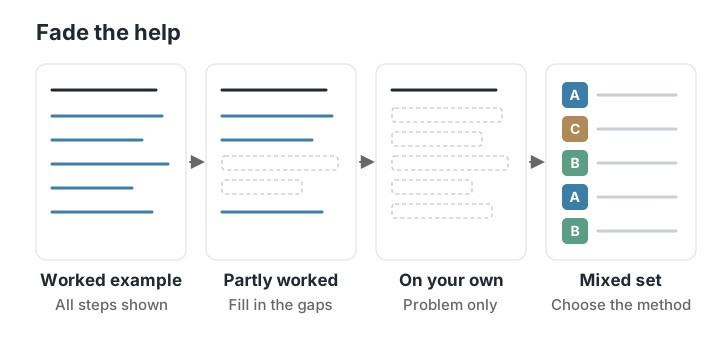
When learning a new method, studying worked examples is more efficient than diving straight into problems. Research going back to John Sweller and Graham Cooper in the 1980s found that beginners learn more from studying worked examples than from solving the same number of problems unaided, because they can focus on the steps instead of struggling to find a route.
The key is to study examples actively. For each step, explain to yourself why it was done: what rule was used, and why it was the right move here. Research on self-explanation has found that students who explain worked examples to themselves learn more than those who simply read them.
Then solve problems without the example
After one or two worked examples, cover them and solve a similar problem on your own. If you get stuck, give yourself a few minutes of genuine effort before looking back. That struggle is productive: it shows you exactly which step you have not understood yet.
As you improve, move from problems that closely match the example to ones that vary it: different numbers, a different context, or an extra step. If you can only solve problems that look exactly like the example, you have learned the example, not the method.
Try this: Before you start any problem, write one line saying which method you will use and why. It is the step most often skipped, and the one exams test.
Mix problem types
Textbooks usually group problems by topic, so you always know which method is needed. Exams do not. Once you know a few methods, practise problems from different topics mixed together. This is called interleaving.
In a 2007 study by Rohrer and Taylor, students who practised geometry problems mixed together scored 63% on a test a week later, compared with 20% for students who practised them in blocks, even though the blocked group did better during practice. Mixed practice is harder, but it trains you to pick the right method, which is half the battle in a maths exam.
Keep a mistake log
Every wrong answer is useful information. Keep a notebook or document of the problems you get wrong, with a note on what went wrong. Sort mistakes into types: a concept you did not understand, the wrong method chosen, a step you did not know, or a careless slip such as a sign error.
Each week, redo the problems in your log without looking at your previous working. If you get one right twice on separate days, cross it off. Patterns will appear quickly, and they tell you exactly where to focus.
Understand why, not just how
Memorising steps without understanding them works until a question is phrased in an unfamiliar way. For each method, make sure you can explain why it works, not just what to do. Where you can, derive a formula rather than just memorising it, or check it with a simple example.
Draw diagrams. Sketch graphs. For word problems, draw the situation before you write any equations. Pictures often reveal what the question is really asking.
Use flashcards for the right things
Flashcards are not the main way to study maths, but they are useful for things that need to be recalled instantly: definitions, key formulas, theorems, identities, and the conditions for using each method. Knowing these automatically frees up attention for the problem itself.
Do not put whole problems on flashcards. Recognising a solved problem is not the same as being able to solve it. Keep problems for practice sessions.
Common traps when studying math
Most wasted maths study comes from a handful of habits that feel productive.
- Reading solutions instead of attempting problems first.
- Watching video explanations without solving anything afterwards.
- Doing only the easy problems at the start of each exercise set.
- Checking each answer immediately, before finishing the problem properly.
- Practising one topic at a time right up to the exam, so method choice is never tested.
- Copying out the textbook’s worked examples rather than redoing them from memory.
How to study for a math test
A week or two before a math test, or when working out how to study for a math exam at the end of term, shift from learning new methods to practising the full range of questions under realistic conditions.
- List every topic the test covers and rate your confidence in each.
- Do mixed problem sets covering all topics, with extra problems on your weakest ones.
- Sit at least one full practice test timed, without notes, then mark it carefully.
- Spend the next session on the mistakes, then redo those problems a day or two later.
- Write your formula sheet from memory, check it, and repeat until it is complete.
- The night before, do a few mixed problems to stay sharp, then sleep.
Common questions
What is the best study method for math?
Practice problems, done in the right order: study a worked example while explaining each step, solve similar problems unaided, then mix problem types together. Review your mistakes and redo them on later days.
How many practice problems should I do?
Enough to solve each type confidently without help, on at least two separate days. Quality matters: a problem you struggled with and then understood teaches more than five easy repeats.
Can I learn maths by watching videos?
Videos are a useful way to see a method explained, like a worked example. But you learn by doing. After each video, pause and solve a problem yourself without rewatching.
Should I study maths every day?
Little and often works well. Thirty minutes of problems on most days beats a three-hour session once a week, because it spaces your practice and keeps methods fresh. Mix new topics with a few problems from older ones.
How do I study for maths exams like GCSE or A-level?
Use past papers from your exam board, starting with topic questions and moving to full timed papers. Mark them with the mark scheme, log every mistake, and redo those questions a few days later. Learn the formulas not on the formula sheet by heart.
How do I stop making careless mistakes in maths?
Log them to see which kinds you make most, such as sign errors or copying numbers wrongly. Then build checks for those into your routine, like estimating the answer first or rechecking each line where you usually slip.
Calm Study
Calm Study helps with the parts of maths study that are not solving: it turns your notes into flashcards for formulas and definitions, writes mixed quizzes across your topics so you practise choosing the method, and builds a plan that spaces each topic out before your test.