How to Make Flashcards That Actually Work
· 6 min read
Learning how to make flashcards well is mostly about keeping each card small: one idea, phrased as a clear question, with a short answer you can mark right or wrong in a second. Cards like that are quick to review and easy to remember. Cards with paragraphs on the back are slow, vague, and easy to fool yourself with. Here are the rules for making good flashcards, with examples, and how to study them once they are made.
Why most flashcards do not work
Flashcards are one of the most effective study tools there is, because they make you retrieve answers from memory. But many decks undermine that. Cards with long answers cannot be recalled exactly, so students glance at the back and decide they “basically knew it”. Cards with a single term on the front can be answered by recognition rather than recall. And decks copied from someone else may not match what your course emphasises.
The fix is not more cards. It is better cards. A small deck of well-made flashcards beats a large deck of vague ones, and how to make good flashcards comes down to a handful of rules.
Rule 1: One idea per card
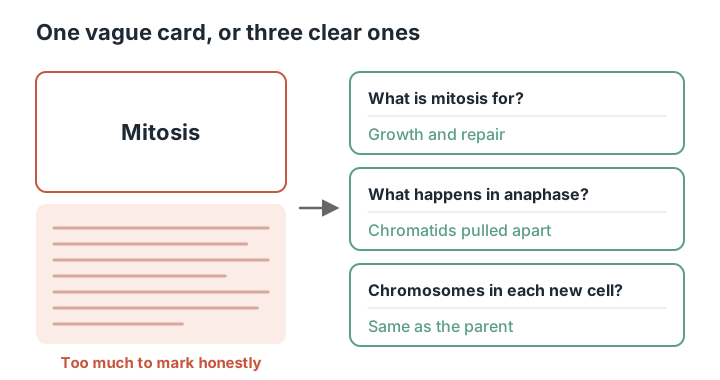
This is the most important rule. The software designer Piotr Woźniak, who created one of the first spaced repetition programs, called it the minimum information principle: make each item as simple as possible. Simple cards are faster to review, easier to mark honestly, and easier to remember.
If an answer has several parts, split it. “What are the three types of muscle?” can be a single card if the answer is three words. “Describe the structure and function of the three types of muscle” should be six or more cards.
Rule 2: Write a question, not a label
A card that just says “Osmosis” is ambiguous. Are you meant to define it, give an example, or explain why it happens? Write the question you want to answer: “What is osmosis?” or “Why do cells swell in pure water?” A clear question gives you a clear target and a clear way to mark yourself.
Questions also let you test understanding, not just definitions. Mix “what” cards with “why”, “how”, and “what would happen if” cards. Those are closer to the questions exams actually ask.
Rule 3: Your words, the exam’s terms
Write answers in your own words where you can. Putting an idea into your own language helps you understand it, and you will recall your phrasing more easily than a textbook’s. But keep key technical terms exactly as your course uses them, because the exam will use them too.
Keep answers short, ideally a word, a phrase, or one sentence. If you find yourself writing a paragraph, the card needs splitting.
Rule 4: Make cards in both directions where it matters
Knowing that “le chat” means “the cat” does not guarantee you can produce “le chat” from “the cat”. For vocabulary, definitions you need to produce, and key dates, make a card in each direction and treat them as separate cards.
You do not need reverse cards for everything. Make them when the exam could ask in either direction.
Rule 5: Use images and fill-in-the-blank
For diagrams, hide one label and ask what it is. This works well for anatomy, geography, and lab apparatus. Combining a visual with a word gives you two routes back to the memory.
Fill-in-the-blank cards, called cloze deletions, work well for sentences and formulas: “The mitochondria produce ___ through respiration.” Keep only one blank per card.
Try this: Add a short example to abstract cards: “What is opportunity cost? Example: the job you gave up to study.” Examples make abstract ideas stick.
What not to put on flashcards
Flashcards suit facts, terms, definitions, short explanations, formulas, and vocabulary. They suit some things poorly.
- Long lists: split them into smaller cards or use a mnemonic, then card the mnemonic.
- Essay answers: card the key arguments and evidence, then practise writing separately.
- Maths problems: card the formulas and methods, but practise solving problems separately.
- Things you do not understand yet: learn them first, then card them.
How to make flashcards from your notes
The best time to make cards is within a day of the lecture, while you still remember what the lecturer emphasised. Go through your notes and mark anything card-worthy: definitions, key terms, formulas, dates, steps in a process, and any point the lecturer said would be examined. Then write the cards in one sitting, following the rules above.
Aim for a steady flow of new cards, such as ten to thirty per lecture, rather than a huge batch at the end of term. Cards made week by week can be reviewed week by week, which spreads the work out and spaces your practice without extra effort. If you are making study cards on paper, number them by lecture so you can find the source quickly.
Paper or app?
Both work. The choice depends on how you study.
| Paper cards | Flashcard app | |
|---|---|---|
| Making cards | Slower, but writing helps learning | Faster to type; images easy to add |
| Scheduling | Manual, with a Leitner box | Automatic spaced repetition |
| Carrying them | A stack in your bag | On your phone, always with you |
| Distractions | None | Your phone’s notifications |
How to study your flashcards
A good deck still needs good study habits. Say or write your answer before you flip. Mark yourself honestly: a hesitation or partial answer counts as wrong. Shuffle the deck so you cannot rely on the order.
Study one larger mixed deck rather than several small ones. In Nate Kornell’s flashcard research, studying one big stack, which spaces each card out, was more effective than studying four smaller stacks one after another. And space your sessions over days, bringing back the cards you missed sooner than the ones you knew.
Finally, keep editing. When a card keeps tripping you up, the problem is often the card, not your memory. Rewrite it to be clearer, split it, or add an example. A deck should improve as you use it.
Try this: Say your answer out loud before you flip. It stops you from deciding afterwards that you “sort of knew it”.
Common questions
How do I make flashcards at home?
Cut index cards or paper into rectangles, write one question on the front and a short answer on the back. Keep each card to one idea, and store them in a box with dividers so you can sort them by how well you know them.
Can ChatGPT make flashcards?
Yes, if you paste in your notes and ask for question-and-answer pairs with one idea each. Check them against your notes, since AI can make mistakes, and rewrite any that are vague.
Is there a free way to create flashcards?
Paper cards cost almost nothing, and several flashcard apps have free versions. The method matters more than the tool: one idea per card, answered before you flip, reviewed on spaced days.
How do I make study cards for an essay subject?
Put one argument, piece of evidence, quote, or date on each card, with a question like “What evidence supports X?” Then practise essays separately, using the cards to recall the material you need.
How many flashcards should I make for an exam?
As many as it takes to cover the facts and terms you need to recall, which is often a few hundred for a course. Add them as you go through the term, not all at once, so reviews stay manageable.
Should I make my own flashcards or use premade ones?
Making your own helps you learn and matches your course. Premade decks save time but may not match your syllabus. A good middle ground is cards generated from your own notes, which you check and edit.
Calm Study
Calm Study makes flashcards from your own notes, slides, and PDFs, in the wording of your course, and you can edit any card that is not quite right. It asks you to answer before flipping, and Again, Hard, and Good bring the cards you miss back sooner.