How to Stay Awake While Studying (and When to Sleep Instead)
· 8 min read
To stay awake while studying, change your state before you reach for more coffee: stand up, get into bright light, move for a couple of minutes, and switch to something active like answering questions out loud. Caffeine works, but only if you time it so it does not wreck your sleep, and a 10 to 20 minute nap can reset you better than another hour of nodding over your notes. Just as important is knowing when to stop. Studying through heavy sleepiness produces hours you will barely remember, and sleep is when much of the day’s learning gets stored.
Why you get sleepy when you study
Sleepiness while studying usually has a few causes stacked together. The pressure to sleep builds the longer you are awake. Your body clock adds a dip in the early afternoon and a much bigger one late at night. Then studying itself adds fuel: sitting still, often in a warm room with dim light, doing something quiet like reading.
Most students also start the day short on sleep. In a 2014 review, Shelley Hershner and Ronald Chervin reported that up to half of college students say they feel sleepy in the daytime, and around 70% get less sleep than they need. If you are always fighting to stay awake over your notes, the root problem is probably your nights, not your study technique.
Quick fixes that work in minutes
When you feel your eyelids getting heavy, try changing your physical state before anything else.
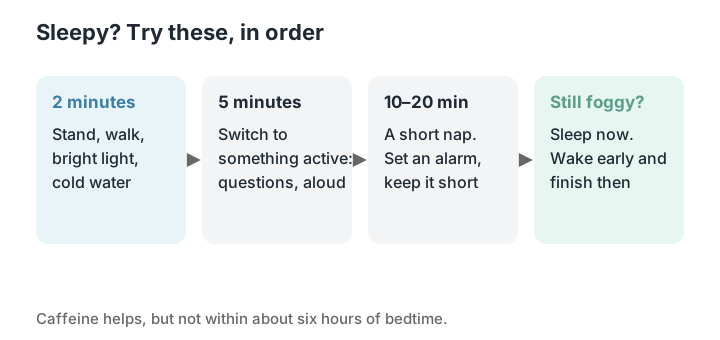
- Stand up and walk for two to five minutes, ideally somewhere with a change of air.
- Turn the lights up. Bright light, especially daylight or cool white light, increases alertness.
- Cool down: open a window, lower the heating, or splash cold water on your face. The lift is short, so pair it with something else.
- Study standing for a while, at a counter or a high table.
- Drink a glass of water. Mild dehydration makes you feel more tired.
Make the studying itself wake you up
Reading notes on your bed at midnight is close to a sleeping pill. Passive study gives your brain nothing to push against, so drowsiness wins. Active study is harder to fall asleep doing.
- Switch from reading to answering practice questions or flashcards.
- Explain the topic out loud, as if teaching someone.
- Walk around the room while you recite a list or a process.
- Write out what you remember on a blank page, then check it.
- Change subject, or move to a different room, for the next block.
- Study with a friend on a call, quizzing each other.
Try this: Save your most active work, like practice papers, for the times you know you will be tired, and keep reading for when you are fresh.
How to use caffeine without wrecking your sleep
Caffeine genuinely helps. A 2016 review by Tom McLellan, John Caldwell, and Harris Lieberman found that moderate doses improve alertness, attention, and reaction time, especially when people are short on sleep. The US Food and Drug Administration says up to 400 milligrams a day is not generally linked to harmful effects in healthy adults. Teenagers should have much less.
Timing is the catch. In a 2013 study, Christopher Drake and colleagues gave people 400 milligrams of caffeine at bedtime, three hours before, or six hours before. Even six hours before bed, it cut their sleep by more than an hour. A coffee at 9pm to finish an essay may cost you sleep you need far more.
| Drink | Typical caffeine | Note |
|---|---|---|
| Brewed coffee, 8 oz | 80 to 100 mg | Coffee shop sizes are often two or three times this |
| Black or green tea, 8 oz | 30 to 50 mg | Gentler, and easy to sip slowly |
| Cola, 12 oz can | 30 to 40 mg | Plus a lot of sugar |
| Energy drink, 8 oz | 40 to 250 mg | Varies hugely; check the label |
The 10 to 20 minute nap
A short nap is one of the most effective ways to restore alertness. In a 2006 study by Amber Brooks and Leon Lack, people who were short on sleep took afternoon naps of different lengths. A 10-minute nap improved alertness and performance almost immediately, with benefits lasting up to about two and a half hours. Naps of 20 to 30 minutes helped too, but people woke up groggy first.
There is also the “caffeine nap”. In a 2003 study by Mitsuo Hayashi and colleagues, drinking coffee just before a short nap kept people more alert afterwards than napping and then washing their face or sitting under bright light. Caffeine takes about 20 to 30 minutes to kick in, so it arrives as you wake up.
- Set an alarm for 10 to 20 minutes, not longer.
- Lie on top of the covers or nap sitting up, so you do not sink into a full sleep.
- Nap before late afternoon if you can, so it does not push back your bedtime.
- Get up straight away when the alarm goes, and get into bright light.
Should you pull an all-nighter?
Almost never. All-nighters are common: in a 2008 survey at one US university, Pamela Thacher found that about 60% of students had pulled at least one, and those who had tended to have slightly lower grades.
Being awake that long has real costs. In a 2000 study, Ann Williamson and Anne-Marie Feyer found that after 17 to 19 hours without sleep, people performed about as badly on some tests as people over the legal blood alcohol limit in many countries. In a 2007 brain imaging study, Seung-Schik Yoo and colleagues found that one night without sleep sharply reduced people’s ability to form new memories the next day.
If you are studying something new, an all-nighter means learning it in your worst state, then sitting the exam in a worse one. If you have no choice, our guide to cramming covers how to limit the damage, but a few hours of sleep is almost always better than none.
When to stop and sleep instead
Tiredness you can beat with a walk is different from tiredness you cannot. These are signs you have reached the second kind:
- You read the same line three times and still cannot say what it said.
- Your head drops or you lose a few seconds without noticing.
- You cannot recall anything from the last 20 minutes.
- A walk, light, and water all wore off within minutes.
Sleep is part of the plan
When those signs show up, the best study decision is to go to bed and set an alarm to finish in the morning. You will work faster and remember more after sleep than in an extra hour of fog.
Sleep over the whole term matters, not just the night before. In a 2019 study of MIT chemistry students who wore activity trackers, Kana Okano and colleagues found that sleep quality, length, and consistency over the weeks before exams were linked to higher grades. Sleep on the single night before a test was not. The American Academy of Sleep Medicine recommends 8 to 10 hours a night for teenagers and at least 7 for adults.
How to study at night without fighting sleep
Some people genuinely work better in the evening, and studying at night can be fine. The trick is to make it a plan, not an emergency.
- Do your hardest work early in the evening and lighter review later.
- Keep a caffeine cut-off about six hours before you plan to sleep.
- Study under bright light, then dim the lights for the last half hour before bed.
- Keep the same bedtime and wake time most days, including weekends.
- Stop at a set time, even mid-topic, and write down where to start tomorrow.
Common questions
How can I stay awake while studying at night?
Use bright light, stand or walk every so often, switch to active tasks like practice questions, and drink water. If you use caffeine, have it earlier in the evening. If you are still foggy after a short nap, sleep and finish in the morning.
What should I drink to stay awake while studying?
Water first, since dehydration adds to tiredness. Coffee or tea can help in moderation, but avoid them within about six hours of bedtime. Be careful with energy drinks, which can contain a lot of caffeine and sugar.
Is it better to sleep or study the night before an exam?
Sleep, in almost every case. Sleep helps you remember what you studied and think clearly in the exam. A short review in the evening followed by a full night is better than studying through the night.
How long should a power nap be?
About 10 to 20 minutes. Research found a 10-minute nap gave immediate benefits, while naps of 30 minutes or more often cause grogginess on waking.
Why do I get sleepy when I study but not when I watch videos?
Videos are designed to grab your attention with movement, sound, and novelty. Reading notes is quiet and demanding, so if you are already short on sleep, drowsiness wins. Active study, like answering questions, is more stimulating.
How many hours of sleep do students need?
The American Academy of Sleep Medicine recommends 8 to 10 hours for teenagers aged 13 to 18, and at least 7 hours for adults. Many students get much less, especially in exam season.
Calm Study
Calm Study helps you get the work done earlier, so late nights are rarer. Its plan spreads each topic across the weeks before your exam, from your own notes, and when you are studying tired, its flashcards and quizzes keep you answering instead of nodding over a page.
References
- Hershner, S. D., & Chervin, R. D. (2014). Causes and consequences of sleepiness among college students. Nature and Science of Sleep, 6, 73–84. https://doi.org/10.2147/NSS.S62907
- Cajochen, C. (2007). Alerting effects of light. Sleep Medicine Reviews, 11(6), 453–464. https://doi.org/10.1016/j.smrv.2007.07.009
- McLellan, T. M., Caldwell, J. A., & Lieberman, H. R. (2016). A review of caffeine’s effects on cognitive, physical and occupational performance. Neuroscience & Biobehavioral Reviews, 71, 294–312. https://doi.org/10.1016/j.neubiorev.2016.09.001
- US Food and Drug Administration. Spilling the beans: How much caffeine is too much? https://www.fda.gov/consumers/consumer-updates/spilling-beans-how-much-caffeine-too-much
- Drake, C., Roehrs, T., Shambroom, J., & Roth, T. (2013). Caffeine effects on sleep taken 0, 3, or 6 hours before going to bed. Journal of Clinical Sleep Medicine, 9(11), 1195–1200. https://doi.org/10.5664/jcsm.3170
- Brooks, A., & Lack, L. (2006). A brief afternoon nap following nocturnal sleep restriction: Which nap duration is most recuperative? Sleep, 29(6), 831–840. https://doi.org/10.1093/sleep/29.6.831
- Hayashi, M., Masuda, A., & Hori, T. (2003). The alerting effects of caffeine, bright light and face washing after a short daytime nap. Clinical Neurophysiology, 114(12), 2268–2278. https://doi.org/10.1016/S1388-2457(03)00255-4
- Thacher, P. V. (2008). University students and “the all nighter”: Correlates and patterns of students’ engagement in a single night of total sleep deprivation. Behavioral Sleep Medicine, 6(1), 16–31. https://doi.org/10.1080/15402000701796114
- Williamson, A. M., & Feyer, A.-M. (2000). Moderate sleep deprivation produces impairments in cognitive and motor performance equivalent to legally prescribed levels of alcohol intoxication. Occupational and Environmental Medicine, 57(10), 649–655. https://doi.org/10.1136/oem.57.10.649
- Yoo, S.-S., Hu, P. T., Gujar, N., Jolesz, F. A., & Walker, M. P. (2007). A deficit in the ability to form new human memories without sleep. Nature Neuroscience, 10(3), 385–392. https://doi.org/10.1038/nn1851
- Okano, K., Kaczmarzyk, J. R., Dave, N., Gabrieli, J. D. E., & Grossman, J. C. (2019). Sleep quality, duration, and consistency are associated with better academic performance in college students. npj Science of Learning, 4, 16. https://doi.org/10.1038/s41539-019-0055-z
- Watson, N. F., Badr, M. S., Belenky, G., et al. (2015). Recommended amount of sleep for a healthy adult: A joint consensus statement of the American Academy of Sleep Medicine and Sleep Research Society. Sleep, 38(6), 843–844. https://doi.org/10.5665/sleep.4716
- Paruthi, S., Brooks, L. J., D’Ambrosio, C., et al. (2016). Recommended amount of sleep for pediatric populations: A consensus statement of the American Academy of Sleep Medicine. Journal of Clinical Sleep Medicine, 12(6), 785–786. https://doi.org/10.5664/jcsm.5866