Note-Taking Methods: 6 Ways to Take Notes, Compared
· 7 min read
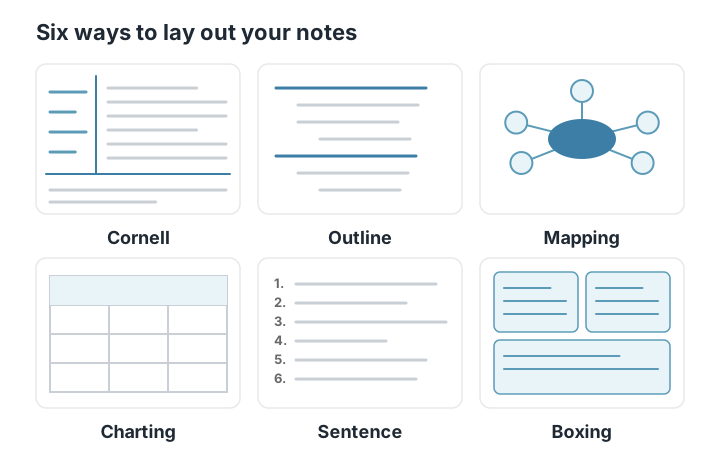
There are six note-taking methods most students choose between: Cornell, outline, mapping, charting, sentence, and boxing. Each suits a different kind of lecture or reading. The method matters less than what happens next, though. Notes help most when you put the lecture into your own words as you write, and then use the notes to test yourself rather than to reread.
What notes are actually for
Researchers have long described two jobs that notes do. Taking them helps you process the lecture as it happens, which is called the encoding function. Having them gives you something to study from later, which is the storage function. Good note-taking techniques serve both.
That means the aim is not a complete record. A transcript of every word is easy to produce and hard to learn from, because you did not have to think about what mattered. Notes that pick out the main ideas, put them in your words, and show how they connect are slower to write but far more useful later.
The Cornell method
Developed by Walter Pauk at Cornell University, the Cornell method divides the page into three parts. A wide right-hand column holds notes taken during the lecture. A narrow left-hand column holds cues: questions or keywords you add after class. A box at the bottom holds a short summary in your own words.
Its strength is that it builds in revision. You cover the right column, read the cue questions on the left, and answer from memory. It suits most lectures and is a good default if you are unsure which method to use.
The outline method
The outline method uses headings and indented points to show how ideas sit under one another. Main topics go at the left margin, supporting points are indented beneath them, and details are indented again. It is fast, needs no setup, and works well for lectures that follow a clear structure.
Its weakness is that it can turn into transcription if you are not careful, and it handles connections between distant ideas poorly. Use it for well-organised lectures and readings, and add a few questions in the margin afterwards.
The mapping method
Mapping puts the main topic in the centre of the page and branches out to subtopics, details, and examples, with lines showing how they connect. Mind maps and concept maps are both forms of it. It is good for subjects where ideas link in many directions, such as biology systems, literature themes, or causes of historical events.
Mapping is harder to do live in a fast lecture. Many students take quick linear notes in class and draw the map afterwards, which doubles as a review session.
The charting method
The charting method sets up a table before the lecture, with columns for the things you will compare. Studying three theories? Columns for the theory, the key thinker, the main claim, evidence, and criticisms. Studying a period of history? Columns for date, event, cause, and consequence.
Charts make comparisons and patterns obvious, and they are easy to quiz yourself from: cover a column and fill it from memory. They only work when you know the structure in advance, so they suit readings and well-signposted lectures.
The sentence and boxing methods
The sentence method is the simplest: each new idea gets its own numbered line or short sentence. It keeps up with fast, unstructured lectures, but the notes need reorganising afterwards to be useful.
The boxing method groups related notes into boxes on the page, one box per subtopic. It became popular with tablet note-taking because boxes are easy to move and colour. It makes the structure of a topic visible at a glance and suits reviewing one subtopic at a time, but like mapping, it is easier to do after class than during it.
Choosing between note-taking methods
There is no single best note-taking method. Match the method to the material.
| Method | Best for | Watch out for |
|---|---|---|
| Cornell | Most lectures; built-in revision | Takes discipline to add cues afterwards |
| Outline | Structured lectures and textbooks | Sliding into transcription |
| Mapping | Connected ideas and themes | Hard to keep up with live |
| Charting | Comparisons, timelines, theories | Needs the structure in advance |
| Sentence | Fast, unstructured lectures | Needs reorganising later |
| Boxing | Tablet notes, one topic at a time | Easier after class than during |
How to take notes in a lecture
The method you choose is only half of it. How you approach the lecture matters as much. Before it starts, skim the slides if they are available and set up the page for your method: draw the Cornell lines, the chart columns, or the central bubble for a map. If you already have the slides, do not copy them. Write only what the lecturer adds: explanations, examples, emphasis, and anything they say will be on the exam.
During the lecture, listen for signposts such as “the key point is”, “there are three reasons”, or “this comes up every year”. Use abbreviations and short phrases instead of full sentences. When you miss something, leave a gap and mark it rather than losing the next point while you catch up.
Within a day, fill the gaps from the slides or a recording, add your questions in the margin, and write a two or three line summary at the bottom. Those ten minutes turn a page of notes into something you can study from.
Laptop or paper?
A widely shared 2014 study by Mueller and Oppenheimer found that students who typed notes wrote more words verbatim and did worse on conceptual questions than students who wrote by hand. It led many people to ban laptops.
Later replications have softened that conclusion. A 2021 direct replication by Urry and colleagues found no reliable difference in quiz performance between laptop and longhand notes, though typed notes were still longer and more verbatim. The practical lesson is the same either way: whatever you use, summarise in your own words instead of copying the slides.
Turn your notes into questions
Whatever method you choose, the most valuable step comes after class. Within a day, go through your notes and write questions whose answers are in them. A Cornell cue column does this by design. For other methods, write the questions in the margin, on the back of the page, or as flashcards.
Then study by answering the questions with the notes covered. This turns your notes from something you reread into something you are tested on, and testing yourself is one of the most effective ways to remember what you learned.
Try this: Leave a wide margin on every page you write, whatever the method. That is where the questions go.
Keep going
Common questions
What are the 5 types of note-taking?
The five most often listed are the Cornell, outline, mapping, charting, and sentence methods. Boxing is a newer sixth that is popular with tablet users. Each suits different material, so many students use two or three.
Which note-taking method is best?
None is best for everything. Cornell is a strong default because it builds in self-testing. Use outline for structured content, charting for comparisons, and mapping for ideas that connect in many directions.
Is it better to handwrite notes?
Not necessarily. Recent replications find little difference in test scores between handwritten and typed notes. What matters more is writing in your own words rather than transcribing.
What is the most effective note-taking technique for exams?
Any method that ends in questions. The Cornell method builds them in, but you can add questions to outline, mapping, or charting notes. Exams reward recall, so notes you can test yourself from are worth more than neat notes.
Should I rewrite my notes after class?
Only if rewriting means reorganising and recalling, such as turning linear notes into a map from memory. Copying notes out neatly feels productive but is close to rereading.
How do I take notes from a textbook?
Survey the chapter first, turn headings into questions, read one section at a time, then close the book and write the answer to each question. This is the SQ3R method, and it works with any note format.
Calm Study
Calm Study works with whatever note-taking method you use. Upload your notes, slides, or a lecture recording and it turns them into flashcards and questions you answer from memory, with each miss linked back to the page in your notes.