Interleaving: Why Mixing Topics Helps You Learn
· 6 min read
Interleaving is a study method where you mix different topics or types of problem in one session instead of practising one type at a time. It feels harder and slower than blocked practice, and you will usually make more mistakes while you do it. But in study after study, students who interleave remember more and perform better on later tests, sometimes dramatically so.
What is interleaving?
Most textbooks and homework sets are blocked: twenty problems on one method, then twenty on the next. Interleaving shuffles them, so each problem may need a different method from the one before. The same applies to flashcards from different lectures, essay questions on different topics, or vocabulary from different units.
Interleaving does not mean doing less of each topic. The total amount of practice can stay exactly the same. Only the order changes.
What the research shows
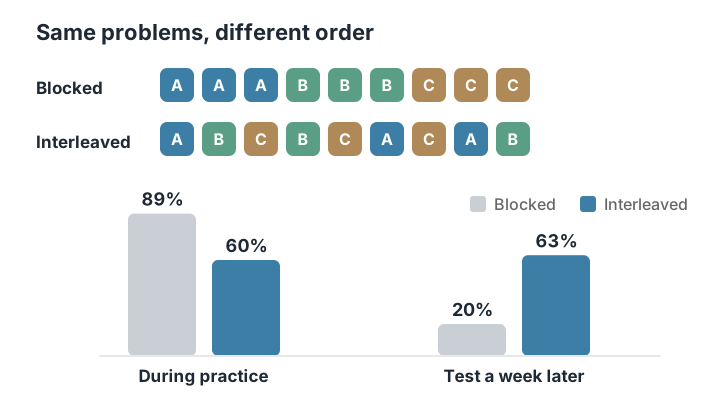
In a 2007 study by Doug Rohrer and Kelli Taylor, college students learned to calculate the volumes of four geometric solids. One group practised in blocks, one shape at a time. The other did the same problems mixed together. During practice, the blocked group did much better: 89% correct against 60%. But on a test a week later, the interleaved group scored 63% and the blocked group 20%.
Classroom studies have found the same pattern. In research with seventh-grade maths classes, students who did interleaved homework outperformed those who did blocked homework, and the gap was larger on a test a month later than on a test the next day. Interleaving has also helped people learn to tell apart painters’ styles, bird species, and medical images.
Why mixing topics works
In blocked practice, you know which method to use before you read the problem, because it is the same as the last one. That removes the hardest part of a real exam, which is working out what kind of problem you are looking at.
Interleaving forces you to make that choice every time. You have to notice the features that tell one problem type from another. It also spaces out each topic automatically, because a few other problems come between each attempt at the same type. You get the benefits of discrimination and spacing at once.
Why it feels worse while you do it
Interleaving produces more errors during practice, and students tend to judge their learning by how smoothly practice goes. In a study on learning painting styles, most participants believed blocked study had worked better for them, even though their test results showed the opposite.
Psychologists distinguish between performance, how well you do right now, and learning, what you can do later. Blocked practice boosts performance. Interleaving boosts learning. If your practice feels a little messy and effortful, that is often a sign it is working.
Try this: Judge a study method by your score on a mixed test a few days later, not by how practice felt.
How to use the interleaving study method
You can add interleaving to almost any revision routine with small changes.
- Learn a new topic on its own first, until you can do the basic problems.
- Once you have two or three topics, mix their problems or cards in each session.
- Shuffle past-paper questions instead of doing one topic’s questions in a row.
- For each problem, say which method it needs before you start solving it.
- Keep a list of the problem types you confuse, and mix those together on purpose.
A sample interleaved practice session
Say you are revising four statistics tests: the t-test, the chi-squared test, correlation, and ANOVA. A blocked session would be five t-test problems, then five chi-squared problems, and so on. You would get most of them right, because you always know which test is coming.
An interleaved session uses the same twenty problems in a shuffled order. Before solving each one, you write down which test it needs and why: two groups or more, categories or measurements, a difference or a relationship. Then you solve it. When you pick the wrong test, that is the most valuable moment of the session, because it is exactly the mistake you would make in the exam.
| Problem | Blocked order | Interleaved order |
|---|---|---|
| 1 to 5 | t-test, t-test, t-test, t-test, t-test | ANOVA, t-test, chi-squared, correlation, t-test |
| 6 to 10 | Chi-squared × 5 | Chi-squared, ANOVA, correlation, t-test, chi-squared |
| 11 to 15 | Correlation × 5 | Correlation, chi-squared, t-test, ANOVA, ANOVA |
| 16 to 20 | ANOVA × 5 | Mixed, weighted towards the tests you confused |
When to switch from blocked to interleaved practice
Blocked practice has a place. When a method is completely new, a few problems of the same type in a row help you learn the steps. The mistake is staying there. As soon as you can do a basic problem of a type without looking at an example, move it into the mix.
A simple rule: block on the day you learn a topic, interleave from the next session onwards. In the weeks before an exam, almost all of your practice should be interleaved, because the exam paper will be.
Where interleaving helps most
Interleaved practice helps most when topics look similar but need different approaches. That includes maths and physics problems, statistics tests, grammar rules, chemical reactions, and medical diagnoses. These are exactly the areas where students mix things up in exams.
It helps less when topics have nothing in common. Alternating between French vocabulary and chemistry is just switching subjects; it does not teach you to tell anything apart. It also helps less at the very start, when you do not yet know any method well enough to choose between them.
Interleaving in essay subjects
Interleaving is studied most in maths, but the idea carries over. In history, mix practice questions from different periods so you practise choosing the right evidence. In English literature, alternate between texts and themes. In languages, mix tenses rather than drilling one tense at a time.
The common thread is that the exam will not tell you which topic or tool a question needs. Your practice should not tell you either.
The same idea shows up outside the classroom. Musicians who mix pieces in a practice session, and athletes who vary their drills rather than repeating one, often show better long-term skill than those who practise one thing at a time, even though their practice looks less polished. In every case, the variety feels harder and pays off later.
Try this: Easiest win: shuffle your flashcard decks from different lectures into one, and shuffle past-paper questions instead of doing them in topic order.
Common questions
What is interleaved practice?
Interleaved practice is mixing different types of problem or topics in a single study session, rather than practising one type until it is done and then moving to the next.
Is interleaving the same as spaced repetition?
No, but they overlap. Spacing is about the gaps between reviews of the same material. Interleaving is about mixing different material. Interleaving does create spacing, because other topics come between each repeat.
Why does interleaving feel so hard?
Because each problem makes you work out which method to use before you can use it. That extra step causes more mistakes during practice, but it is the step the exam tests, so practising it is what produces the gains.
How many topics should I interleave at once?
Two to four is a sensible range. Mix topics that you might confuse in an exam, and only once you can handle each one on its own.
Does interleaving work with flashcards?
Yes. Study one shuffled deck covering several lectures instead of separate decks for each. Research on flashcards has found that larger mixed decks beat several small decks studied one at a time.
Is this the same as interleaving in computing?
No. In computing, interleaving refers to arranging data or memory in a non-contiguous way. In learning, it means mixing topics during practice. The words are the same; the ideas are unrelated.
Calm Study
Calm Study interleaves for you. Its quizzes and mock exams mix questions from across your lectures, so you practise choosing the right method the way the exam will ask you to, and every miss links back to the page in your notes.