Revision Techniques That Work: How to Revise Effectively
· 6 min read
The revision techniques that work best all have one thing in common: they make you pull information out of your memory and show you what you got wrong. Past papers, blurting, flashcards, and practice questions do this. Rereading, highlighting, and copying out notes do not. This guide covers how to revise effectively for GCSEs, A-levels, and university exams, and how to combine the best techniques into a week.
What makes a revision technique work
Decades of memory research point to two principles. The first is retrieval practice: actively recalling information strengthens memory far more than reviewing it. The second is spacing: coming back to a topic several times over weeks beats one long session. A major 2013 review of study techniques rated these two as the most useful, and rated rereading, highlighting, and summarising as low.
A quick test for any revision technique is to ask whether it makes you produce answers and shows you your mistakes. If it does, it is probably effective. If you could do it while half-thinking about something else, it probably is not.
Past papers and mark schemes
Past papers are the single most exam-like form of revision. Exam boards such as AQA, Edexcel, OCR, and WJEC publish past papers, mark schemes, and examiner reports for most GCSE and A-level subjects. Universities often share past papers through the library or course page.
Use them properly. Sit at least some under timed conditions without notes. Then mark your answers strictly against the mark scheme, which shows exactly which points earn marks and how answers are expected to be phrased. Examiner reports go further: they describe the most common mistakes students made on each question. Reading one is like getting feedback from the person who marks your paper.
Try this: Do not save every past paper for the last week. Use topic questions from them as you go, and keep two or three full papers for timed practice near the end.
Blurting
Blurting means reviewing a topic, closing your notes, and writing everything you remember on a blank page. Then you check your notes and add what you missed in a different colour. The coloured parts become your revision list for the next session.
It is quick, needs no preparation, and gives an honest picture of what you know. It works especially well for content-heavy subjects such as biology, chemistry, history, geography, and psychology, one spec point at a time.
Flashcards and spaced review
Flashcards are ideal for definitions, key terms, formulas, dates, quotes, and vocabulary. The rules are simple: one idea per card, a question on the front, and you must answer before you flip. Sort them so cards you get wrong come back soon and cards you know wait longer. The Leitner box system does this with paper cards; most apps do it automatically.
Keep each session short, ten to twenty minutes, and do one most days. Mix cards from different topics rather than studying one topic’s deck at a time.
Exam-style questions by topic
Between full past papers, practise individual exam-style questions on the topics you are revising. Pay close attention to command words. “Describe”, “explain”, “compare”, “evaluate”, and “to what extent” each ask for something different, and knowing the content is not enough if you answer the wrong command.
For longer answers, practise planning: give yourself five minutes to write a bullet-point plan from memory, then compare it with the mark scheme. Planning several answers is often a better use of time than writing one in full.
Mind maps, diagrams, and explaining aloud
Mind maps and diagrams are useful when you draw them from memory, not when you copy them neatly from a textbook. Try drawing a mind map of a topic without notes, then checking and filling the gaps, like a visual blurt.
Explaining a topic aloud, as if teaching it to someone else, is another strong technique. It forces you to put ideas into your own words and quickly shows where your understanding breaks down. A friend, a family member, or an empty room all work.
Revision techniques to stop relying on
Some of the most common revision habits do little for the time they take. You do not have to stop entirely, but they should not be your main method.
| Instead of | Try | Why |
|---|---|---|
| Rereading notes | Blurting or a quick quiz first | Recall builds memory; reading builds familiarity |
| Highlighting | Turning highlights into questions | Questions make you retrieve the answer |
| Copying notes neatly | Rewriting from memory, then checking | Copying uses almost no recall |
| Making revision posters | Drawing the diagram from memory | The value is in the recall, not the design |
| Cramming one topic all day | Shorter sessions on several topics | Spacing and mixing beat massed study |
Revision tips for different subjects
The best revision techniques are the same across subjects, but the balance shifts. For sciences, blurt processes and draw labelled diagrams from memory, use flashcards for definitions and equations, and practise calculation and six-mark questions from past papers. For maths, revision is mostly problems: mixed sets across topics, then timed papers, with a log of every mistake.
For essay subjects such as history, English, and religious studies, recall the key arguments, evidence, and quotes with flashcards or blurting, then practise timed essay plans and full paragraphs, marked against the level descriptors. For languages, use flashcards in both directions for vocabulary, practise writing and speaking from memory, and listen to past listening papers under exam conditions.
Whatever the subject, finish each topic by checking it against the specification. If a spec point is not covered by any of your revision, it is a gap.
How to revise effectively in a week
Put the techniques together and a strong revision week looks like this. Adjust the balance as exams approach: more new learning early on, more past papers near the end.
- Most days: 10 to 20 minutes of mixed flashcards across subjects.
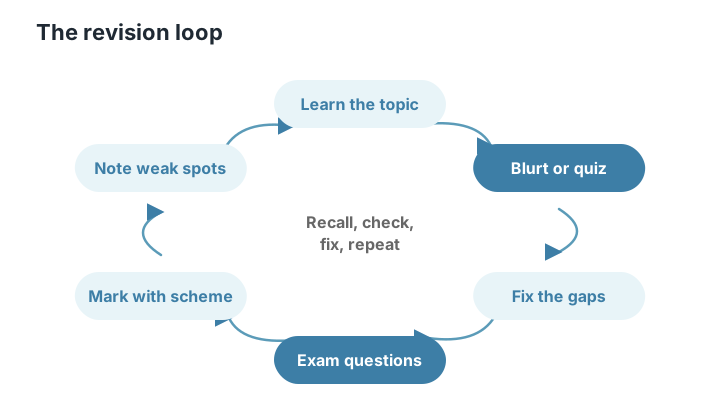
- Each session: blurt or quiz a topic first, then read only what you missed.
- Two or three times a week: exam-style questions on recent topics, marked with the mark scheme.
- Once a week, nearer exams: a timed past paper, then an hour fixing what it showed.
- Every Sunday: update your list of weak topics and plan the next week around it.
Common questions
What is the best revision technique?
Practice testing, spaced over time. In practice, that means past papers, exam questions, flashcards, and blurting, repeated over several weeks rather than done once.
Is 2 hours of revision a day enough for GCSE?
For most students, two focused hours on school days, split across subjects, is a solid amount during the months before exams, with more during holidays and study leave. What you do in those hours matters more than the number.
When should I start revising?
Light, regular revision during the year makes exam season far easier. For GCSEs and A-levels, most students benefit from structured revision at least two to three months before the first exam. For university exams, start at least six weeks out.
How do I revise for an exam in a week?
Prioritise the topics most likely to come up and those you are weakest in. Spend most of your time on past-paper questions and blurting rather than reading, mark yourself strictly, and get enough sleep each night.
How do I revise when I do not know where to start?
Open the specification or syllabus and blurt one spec point from memory. The gaps tell you where to start. Small, specific tasks are much easier to begin than “revise biology”.
Are revision guides worth buying?
They can be a clear summary of the specification, but reading one is still reading. Use them as a source of questions and a check after blurting, not as the main activity.
Calm Study
Calm Study turns your notes into the effective revision techniques: flashcards on a spaced schedule, quizzes that name the page for every miss, and mock exams written in the shape of your course’s papers, with a revision plan that works back from your exam dates.