Mind Mapping for Studying: How to Make a Mind Map (With Examples)
· 8 min read
A mind map is a diagram with one topic in the centre and related ideas branching out from it, each branch splitting into smaller details. For studying, mind maps are good for seeing how a topic fits together and for planning essays. They work much better when you draw them from memory than when you copy them neatly from your notes. This guide shows how to make a mind map step by step, gives mind map examples for different subjects, and explains what the research says about mind maps and concept maps.
What is a mind map?
Mind maps were popularised by the British author Tony Buzan in the 1970s, notably in his BBC series Use Your Head. The format is simple: a central topic, a handful of main branches radiating out from it, and smaller branches for details, with one keyword or short phrase on each line. Colour and small drawings are encouraged.
The layout does something a page of notes does not. It shows the hierarchy of a topic at a glance: what the main parts are, what belongs under each, and how much you know about each part. Gaps are visible, because an empty or thin branch stands out.
How to make a mind map, step by step
A useful study mind map takes 10 to 20 minutes for one topic. Keep it to a single topic; a mind map of a whole course turns into a wall of tiny writing.
- Turn a blank page sideways. Landscape gives the branches room.
- Write the topic in the centre and circle it, or draw a small picture of it.
- Add four to seven main branches for the main parts of the topic, such as causes, stages, types, or key people.
- Use one keyword or short phrase per branch, not sentences.
- Add smaller branches for details, examples, dates, and formulas.
- Use a different colour for each main branch, and add quick sketches where they help.
- Draw arrows between branches that connect, and write a word on the arrow saying how.
A mind map example
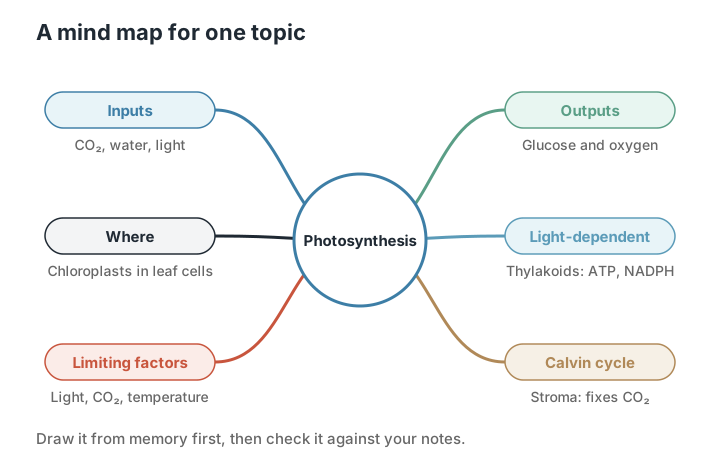
Here is a mind map for photosynthesis, the kind of topic that suits the format well. The centre holds the topic. The main branches cover the inputs, the outputs, where it happens, the two stages, and the factors that limit its rate. Each branch carries only the keywords needed to cue the detail.
Notice what the map does not include: full explanations. Those live in your head, and the map is the prompt. When you can look at each branch and explain it aloud, you know the topic. When a branch draws a blank, that is your next thing to study.
Mind map examples for different subjects
Almost any topic can be mapped. The trick is choosing main branches that match how the exam will ask about it.
| Subject | Centre | Main branches |
|---|---|---|
| Biology | Cellular respiration | Aerobic, anaerobic, where it happens, equation, uses of ATP |
| History | Causes of World War I | Militarism, alliances, imperialism, nationalism, the assassination |
| English literature | A main character | Traits, key quotes, relationships, how they change, themes |
| Psychology | A theory | Key study, evidence for, evidence against, applications |
| Economics | Inflation | Causes, how it is measured, effects, policy responses |
| Languages | A vocabulary topic | Nouns, verbs, useful phrases, common mistakes |
Does mind mapping work? What the research says
There is decent evidence that mapping helps, though less than enthusiasts claim. In a 2002 study, Paul Farrand and colleagues asked medical students to learn from a text using either mind maps or their usual methods. A week later, the mind map group recalled about 10% more of the facts, although they reported feeling less motivated by the technique.
The bigger body of research is on concept maps, a close relative. A 2006 meta-analysis by John Nesbit and Olusola Adesope combined 55 studies and found that learning with concept maps produced better knowledge retention than reading text passages, attending lectures, or taking part in class discussions. A 2018 meta-analysis led by Noah Schroeder found that making maps helped more than studying ready-made ones.
The catch: recall beats mapping from your notes
One famous study is a warning against copying notes into a map. In 2011, Jeffrey Karpicke and Janell Blunt had students learn a science text either by building a concept map with the text in front of them, or by reading it and then writing down everything they could recall. A week later, the recall group did better, even on a test that asked them to draw a concept map.
The follow-up is the useful part. In 2014, Blunt and Karpicke had students build concept maps from memory, without the text, then check. That retrieval-based mapping worked as well as written recall. The map itself was never the problem. Making it with your notes open was.
Try this: Draw your mind map with your notes closed. Then open them, and add everything you missed in a different colour. The coloured parts are what to study next.
Mind map vs concept map
The two are often confused. Concept maps were developed by Joseph Novak and his team at Cornell University in the 1970s, and they differ from mind maps in one important way: every link carries a label saying how two ideas relate.
| Mind map | Concept map | |
|---|---|---|
| Shape | Radiates from one central topic | A network, from general ideas to specific ones |
| Links | Usually unlabelled lines | Arrows labelled with verbs, like “causes” or “requires” |
| Best for | Overviews, brainstorming, planning essays | Understanding relationships and processes |
| Time to make | Quick | Slower, because each link needs thought |
How to make a concept map
A concept map turns each link into a statement you can check, such as “light drives the light-dependent reactions”. That makes it more demanding to build, and better at showing whether you understand a process rather than just its parts.
- List 10 to 20 key concepts from the topic.
- Arrange them from the most general at the top to the most specific at the bottom.
- Draw arrows between related concepts.
- Label each arrow with a short linking phrase, so each pair reads as a sentence.
- Look for cross-links between different parts of the map. These often show the deepest understanding.
- Read each link aloud as a sentence to check it is true.
How to study with a mind map
A mind map is most useful as a recall exercise you repeat, not as a finished poster. This routine works for one topic at a time.
- Learn the topic first from your notes or class.
- Later the same day, draw the map from memory, with your notes closed.
- Check it against your notes and add what you missed in another colour.
- Two or three days later, draw it again on a fresh page, starting with the branches you missed.
- Turn each branch into a question, such as “What limits the rate of photosynthesis?”, and answer it aloud.
- Before an exam, sketch a quick map for each topic in two minutes. Thin branches tell you where to revise first.
Common mind mapping mistakes
Mind maps are easy to make in ways that look productive and teach very little.
- Copying your notes into bubbles, which is rereading with extra steps.
- Writing full sentences on branches, which hides the structure.
- Spending more time on colour and decoration than on the content.
- Making one giant map for a whole course.
- Never redrawing the map, so it never tests you.
- Mapping things that are better as lists or flashcards, such as formulas or vocabulary.
Common questions
How do you make a mind map for studying?
Write the topic in the centre of a landscape page, add four to seven main branches for its main parts, add smaller branches for detail using keywords only, and connect related branches. For studying, draw it from memory and then check it against your notes.
Are mind maps good for studying?
They help you organise a topic and see gaps, and there is evidence they modestly improve recall. They work best when you draw them from memory. Copying notes into a map is much less effective than testing yourself.
What is the difference between a mind map and a concept map?
A mind map branches out from one central topic, usually with unlabelled lines. A concept map is a network of ideas where each link is labelled to say how two ideas relate, which makes it better for showing processes and cause and effect.
Should I make mind maps by hand or with an app?
Either works. Hand-drawn maps are quicker to start and easier to redraw from memory, which is the most useful part. Apps are easier to edit and share, but it is tempting to rearrange instead of recall.
How many branches should a mind map have?
Four to seven main branches is a good range for one topic. Fewer suggests the topic is too small for a map; many more suggests it should be split into two maps.
Can mind maps help with essay exams?
Yes. A quick map is a fast way to plan an essay: the centre is the question, the main branches are your arguments, and the smaller branches are your evidence. Practise drawing one in five minutes before writing timed essays.
Calm Study
Calm Study does the checking half of mind mapping for you. After you redraw a map from memory, its flashcards and quizzes from the same notes test the branches you left out, and its tutor can explain any link on your map using your own materials.
References
- Farrand, P., Hussain, F., & Hennessy, E. (2002). The efficacy of the “mind map” study technique. Medical Education, 36(5), 426–431. https://doi.org/10.1046/j.1365-2923.2002.01205.x
- Nesbit, J. C., & Adesope, O. O. (2006). Learning with concept and knowledge maps: A meta-analysis. Review of Educational Research, 76(3), 413–448. https://doi.org/10.3102/00346543076003413
- Schroeder, N. L., Nesbit, J. C., Anguiano, C. J., & Adesope, O. O. (2018). Studying and constructing concept maps: A meta-analysis. Educational Psychology Review, 30(2), 431–455. https://doi.org/10.1007/s10648-017-9403-9
- Karpicke, J. D., & Blunt, J. R. (2011). Retrieval practice produces more learning than elaborative studying with concept mapping. Science, 331(6018), 772–775. https://doi.org/10.1126/science.1199327
- Blunt, J. R., & Karpicke, J. D. (2014). Learning with retrieval-based concept mapping. Journal of Educational Psychology, 106(3), 849–858. https://doi.org/10.1037/a0035934
- Fiorella, L., & Mayer, R. E. (2016). Eight ways to promote generative learning. Educational Psychology Review, 28(4), 717–741. https://doi.org/10.1007/s10648-015-9348-9