Does Cramming Work? What Happens When You Cram for a Test
· 7 min read
Cramming, packing your study into the hours or days just before a test, can work for that test, but it works far worse than spreading the same study over time, and most of what you cram is forgotten within days. It also tends to cost sleep, which undermines the cramming itself. If you are already out of time, though, there is a right and a wrong way to cram, and this guide covers both.
What counts as cramming
Psychologists call cramming massed practice: studying material in one concentrated block instead of distributing it over several sessions. In everyday terms, it is the long session the night before, the all-nighter, or the weekend spent learning a term’s content for Monday’s exam.
Cramming is extremely common. Many students cram at least occasionally, and some rely on it as their main strategy. It is worth understanding why it feels effective, because that feeling is the main reason people keep doing it.
Does cramming work? What the research says
Cramming does produce some learning. If the test is very soon, crammed material can be recalled reasonably well. The problem is what happens after. Crammed information fades quickly, so it is mostly gone by the time you need it again for a final exam, the next course, or real life.
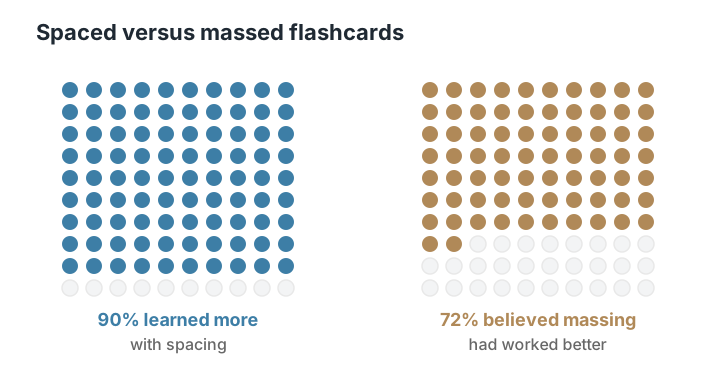
In a 2009 study, Nate Kornell had participants learn vocabulary with flashcards. Studying one large deck, so each card came round only after a gap, was more effective than massing the same cards in small decks for 90% of participants. Spreading sessions across days also beat cramming them into the last day. Yet after the first session, 72% of participants believed massing had worked better. The same pattern shows up again and again: cramming feels better and works worse.
Why cramming feels like it works
When you cram, you study material and then are tested on it soon after, while it is still fresh. Your short-term performance is high, and that feels like learning. Spaced study involves gaps in which you forget a little, so each session feels harder. That difficulty is what makes spaced memories stronger, but in the moment it feels like failure.
There is also a fluency trap. After reading the same notes for hours, they become very familiar. Familiarity feels like knowing. But recognising your notes is not the same as recalling the answer on a blank exam paper, and crammed reading is especially prone to this illusion.
How to cram for a test if you have no choice
Sometimes you really are out of time. If you have to cram, make it the least damaging kind of cram.
- Triage first. List the topics, mark which are most likely to come up and which you know least, and start where those overlap.
- Test, do not read. Use practice questions, past papers, and flashcards. Read only to fix what you got wrong.
- Work in short bursts: 25 to 40 minutes, then a 5-minute break away from the screen.
- Mix topics in each burst rather than finishing one topic before starting the next.
- Write a one-page summary from memory at the end, then check it. That page is your morning review.
- Sleep. Even four to six hours is far better than none.
Try this: If you can only learn some of the material, learn it well. Half the topics recalled confidently beats every topic half-remembered.
A cram schedule for the night before
Here is one way to use an evening when the exam is tomorrow morning. Adjust the times to your own evening, but keep the shape: test early, review your misses, and stop in time to sleep.
| Time | What to do | Why |
|---|---|---|
| 6:00 to 6:20pm | List topics and mark the high-yield ones | Spend the evening where marks are |
| 6:20 to 8:00pm | Practice questions on top topics, with breaks | Recall shows what you know |
| 8:00 to 8:30pm | Dinner, away from your desk | A real break helps focus later |
| 8:30 to 10:00pm | Fix misses, then a second round of questions | Second attempts strengthen memory |
| 10:00 to 10:30pm | One-page summary from memory, then check | Your morning review sheet |
| 10:30pm onwards | Pack your bag and sleep | Sleep consolidates what you learned |
| Morning | 15 minutes on the summary sheet | A final retrieval before the test |
Is cramming ever the right choice?
Occasionally. If a test covers a small amount of material that you will not need again, and the stakes are low, a focused session the evening before may be a reasonable use of time. A short vocabulary quiz in a course you are leaving is a different situation from a final exam in a subject that builds on itself.
Cramming is a poor choice whenever the material is cumulative, such as maths, languages, and sciences, where next term’s course assumes you remember this one. It is also a poor choice for final exams, because the marks are high and the material is too large to cram well. And it is a poor choice if it means losing a night’s sleep before an exam.
How to stop needing to cram
The fix for cramming is not working harder. It is spreading the same work out. Twenty minutes a day on a subject over three weeks is about the same total time as one seven-hour cram, and it will hold far better. Shorter daily sessions are also easier to start, so they are less likely to be put off until the last minute.
Three habits make the biggest difference: a quick recall session after each class, a weekly mixed quiz on everything so far, and a schedule that works back from your exam date so the time is planned before it runs out.
Common questions
Is cramming bad for you?
Not dangerous, but costly. It is an inefficient way to learn, most of the material fades quickly, and it often cuts into sleep, which hurts memory, mood, and concentration. Occasional cramming is common; relying on it is the problem.
Is it better to sleep or cram?
In most cases, sleep. Sleep consolidates what you have already learned and keeps your attention and reasoning sharp for the exam. A few extra hours of tired study rarely makes up for that.
How do you cram effectively?
Pick the highest-yield topics, study them with practice questions rather than reading, work in short bursts with breaks, finish with a summary written from memory, and get at least some sleep. Review that summary in the morning.
Can you learn a whole subject in one night?
Rarely well. You can learn enough to pass a short test on a narrow topic, but a full course in one night means very shallow learning that fades quickly. Prioritise the most important topics instead of trying to cover everything.
What does cram mean?
To cram means to study intensively just before an exam, trying to learn a lot of material in a short time. The word comes from its older meaning of forcing too much into a small space.
When should I stop studying before an exam?
Aim to stop the night before with enough time to wind down and sleep. A short review of a summary sheet on the morning of the exam is fine, but avoid learning new material at the last minute.
Calm Study
Calm Study helps you stop needing to cram. It builds a plan from your exam dates, turns your notes into short daily quizzes and flashcards, and spaces them out automatically, so the work happens in small pieces over weeks rather than in one night. If you are already out of time, it writes a quiz on your weakest topics in seconds.